Daisy Flower Crochet Blanket with Join-as-You-Go Petals
· admin
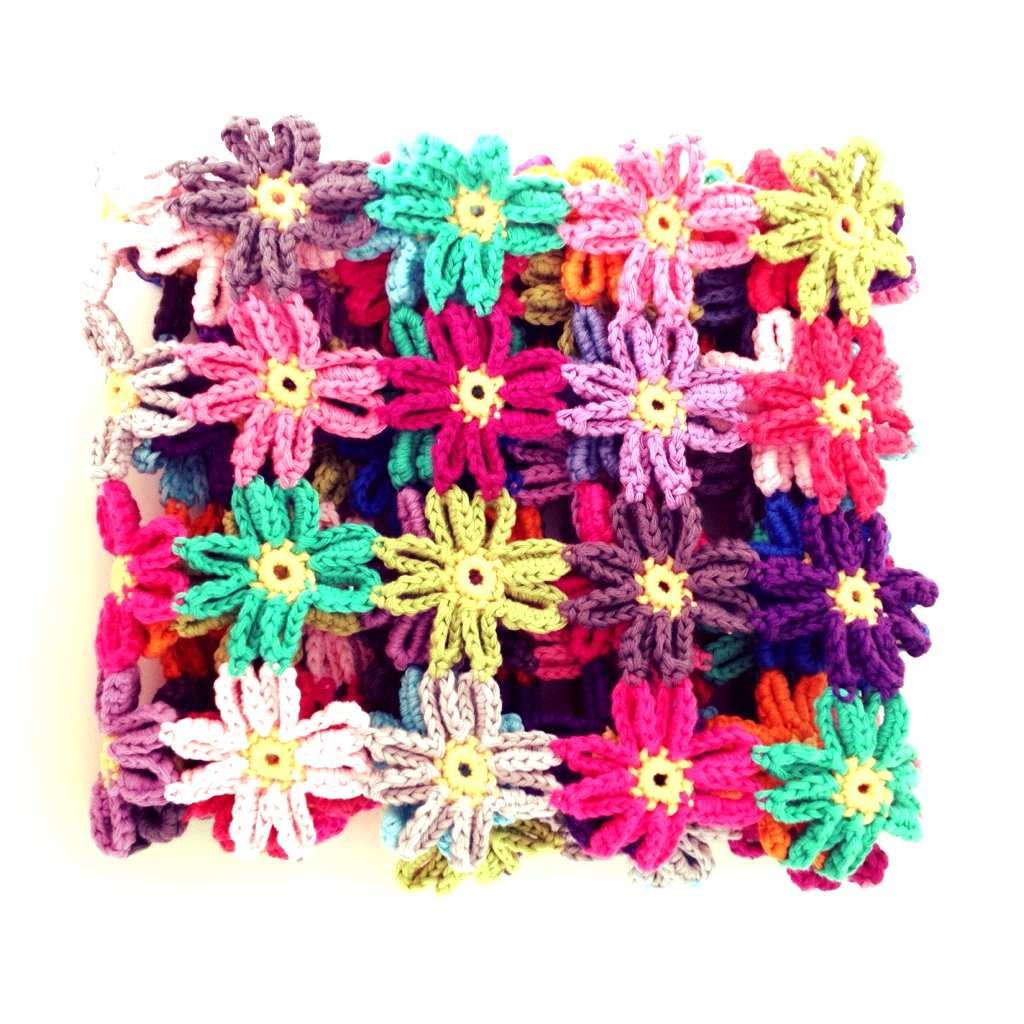
This daisy flower crochet blanket joins open eight-petal flowers directly to one another. There is no solid square around each flower, so the joins and color choices become part of the overall design. Annemarie Benthem’s source uses ninety-six flowers arranged twelve across and eight rows deep, with an original drawing to show how the petals meet.
Project details
| Skill level | Intermediate |
|---|---|
| Finished size | Source layout: 12 flowers wide by 8 rows, 96 flowers; no finished dimensions stated. |
| Hook | 4 mm |
| Pattern source | Daisy Flower Blanket by Annemarie Benthem, supplied four-page PDF. |
Materials
Drops Paris yarn in flower-center and petal colors, 4 mm hook, scissors and tapestry needle. The source does not give a complete yarn quantity or finished blanket measurement.
Plan a small joining sample
Before making ninety-six centers, crochet four flowers and join them as a two-by-two sample. It shows both the single-neighbor join used across a row and the two-direction join needed on later rows. This is a useful tension check because tight connections can pull the petals into points while loose connections leave an uneven mesh.
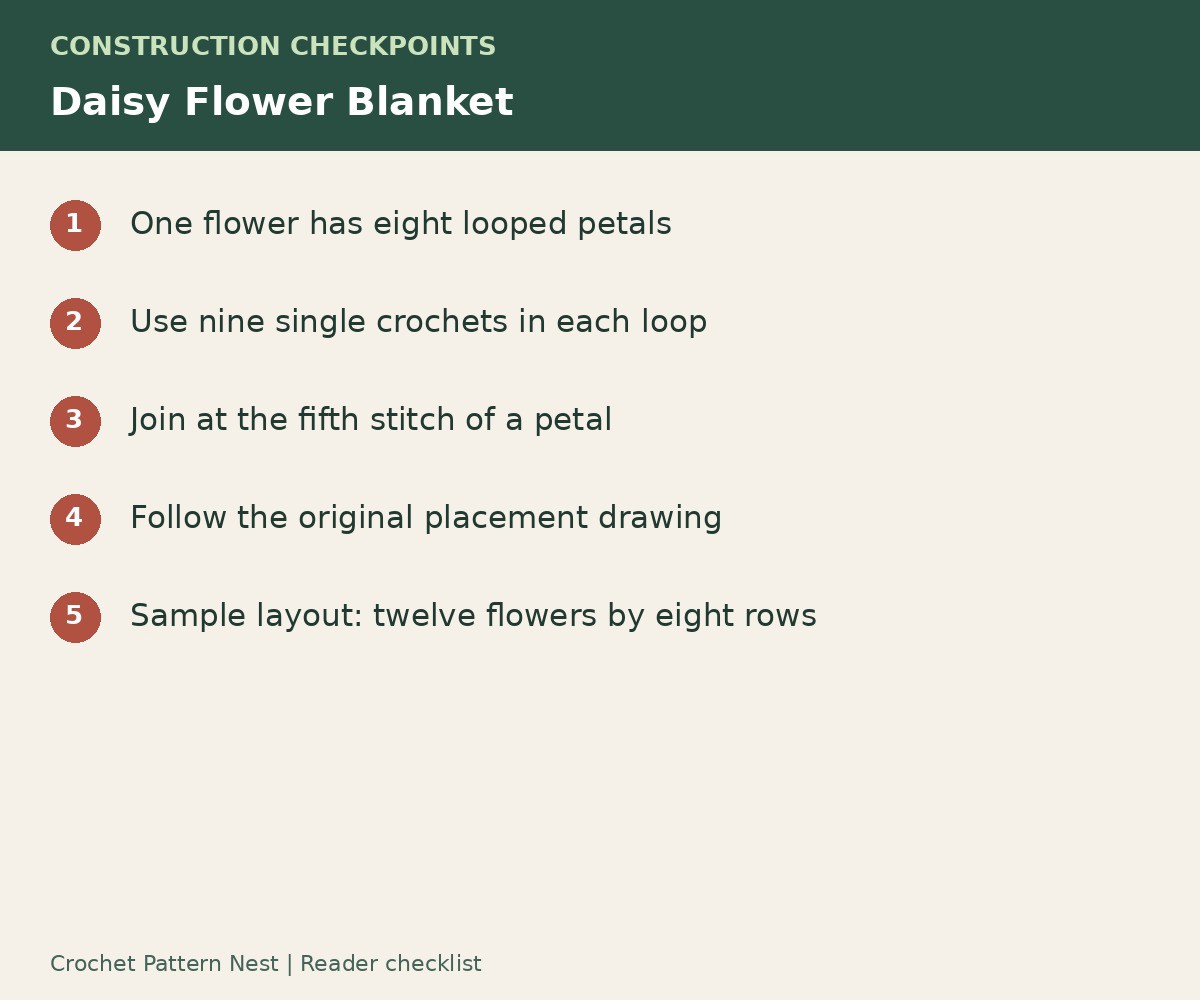
Use US terms: sc means single crochet and sl st means slip stitch. Every flower has eight loops, and every finished loop is covered with nine sc. The joining point is the fifth sc of a petal, the middle stitch of that nine-stitch edge. Keep that number consistent on every connection.
Crochet the first complete flower
- Chain 4 and join with a slip stitch to form a ring.
- Work 8 sc into the ring for the center.
- Change to the petal color. Repeat chain 8 and slip stitch into the next center stitch eight times. This creates eight long loops.
- Work 9 sc around each chain-eight loop. Anchor back at the base point shown by the source before moving to the following loop. Complete all eight petals for the first free-standing flower.
Do not work only into individual chain stitches along one side of the loop. The sc stitches wrap around the loop to cover it, producing the long rounded petals shown in the photograph. Spread the nine stitches evenly before making the base anchor.
Join flowers across the first row
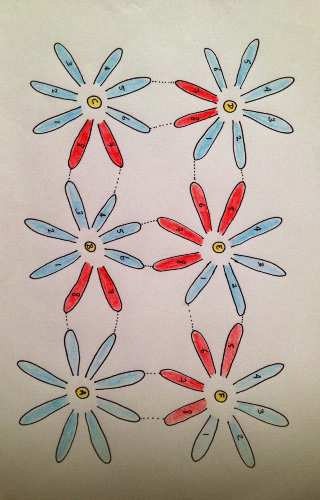
The second flower begins in the same way but is completed with joins during its last petal round. Work six petals normally. On petals seven and eight, connect the fifth sc to the fifth sc of the corresponding petal on the neighboring flower, following the placement drawing. Finish the remainder of each petal after its middle connection.
Continue adding flowers across the row using the same two-petal contact. The source labels the early motif arrangements A, B and C to distinguish their position in the layout; they are joining arrangements, not three unrelated flower patterns. Make twelve flowers across for the sample width.
Add the second and later rows
The first flower of a new row uses the two-petal join against the row above. Interior flowers need connections both to the previous flower in their own row and to flowers above. For that arrangement, work the first four petals freely, then connect petals five through eight at the diagrammed junctions.
Keep the same face of the blanket upward while placing each new flower. Turning a motif over during the joining round can twist a petal and make its middle join sit on the wrong side. Lay the blanket flat after each few additions and check that the open spaces have similar shapes.
The source drawing is part of the joining instructions. Use its colored junctions to determine the neighboring petals rather than guessing which two flowers should meet. The article identifies the fifth-stitch connection and row sequence; the drawing preserves the precise layout.
Size and color planning
| Source layout | Flower count |
|---|---|
| 12 flowers across × 8 rows | 96 |
| Each flower | 8 petals, 9 sc around each loop |
| Petal connection | Middle / fifth sc |
Measure the blocked two-by-two sample before planning a different blanket size. The original file does not state a finished width, length or exact total yarn consumption, so any new measurements should come from your own sample rather than from the ninety-six-flower count alone. Mix center colors while keeping the yarn weight consistent.
Finish and check every join
Weave tails into their own flower backs without bridging the open spaces. Check each fifth-stitch connection gently, particularly where four flowers meet. Shape damp flowers according to the yarn label and dry flat. Avoid pressing down on the open petals so hard that they lose their rounded outline.
Frequently asked questions
How many flowers are in the source blanket?
Ninety-six: twelve across and eight rows.
Which stitch forms the join?
The fifth single crochet of a nine-sc petal edge, matched to the middle stitch on the neighboring petal as shown in the source diagram.
Is there a full yarn quantity?
No complete quantity is stated in the supplied file. Use a joined sample and its weight to estimate your own blanket.
Source and project reference
Daisy Flower Blanket by Annemarie Benthem, supplied four-page PDF. This article is a source-based crochet guide with its own explanations and clearly identified editorial clarifications. Project photographs and the original diagrams shown here come from the supplied source, with crops described in their captions.
Open the original Daisy Flower Blanket.pdf reference in Drive — Whole PDF. Keep the original charts with your project, especially where this guide points to a pictured construction step.
Leave a Reply