Ruffled Lacy Scarf Crochet Pattern: Four Expanding Rounds
· admin
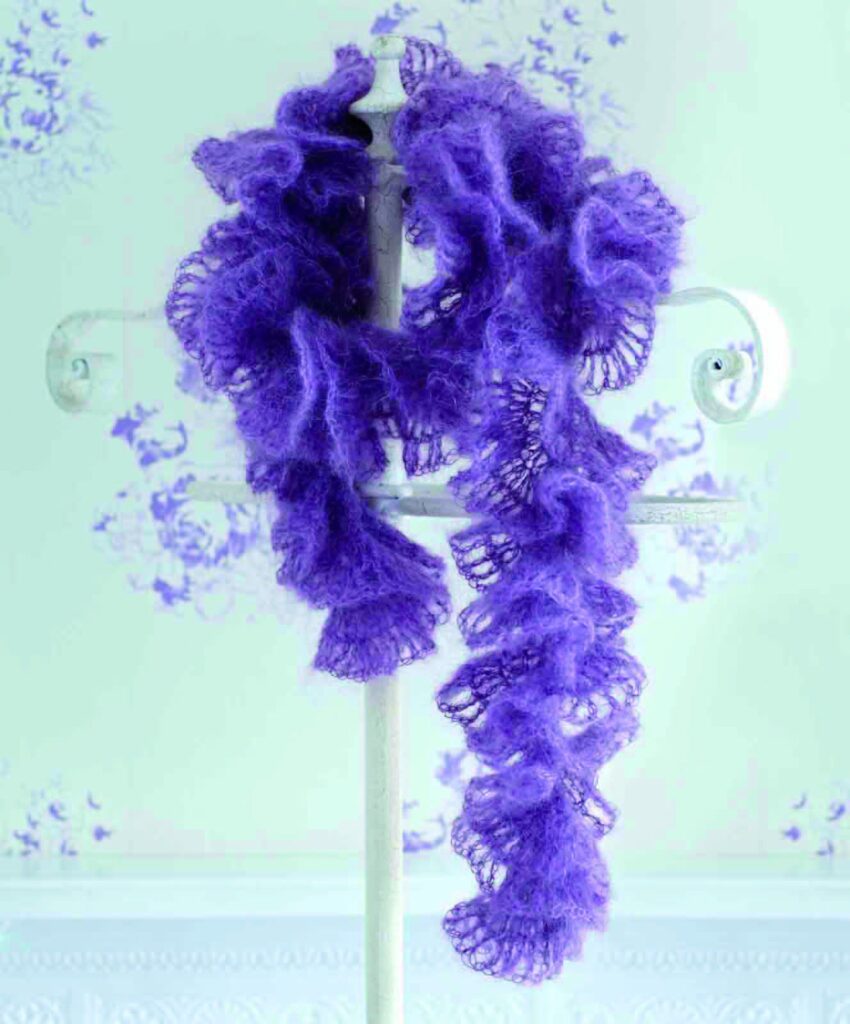
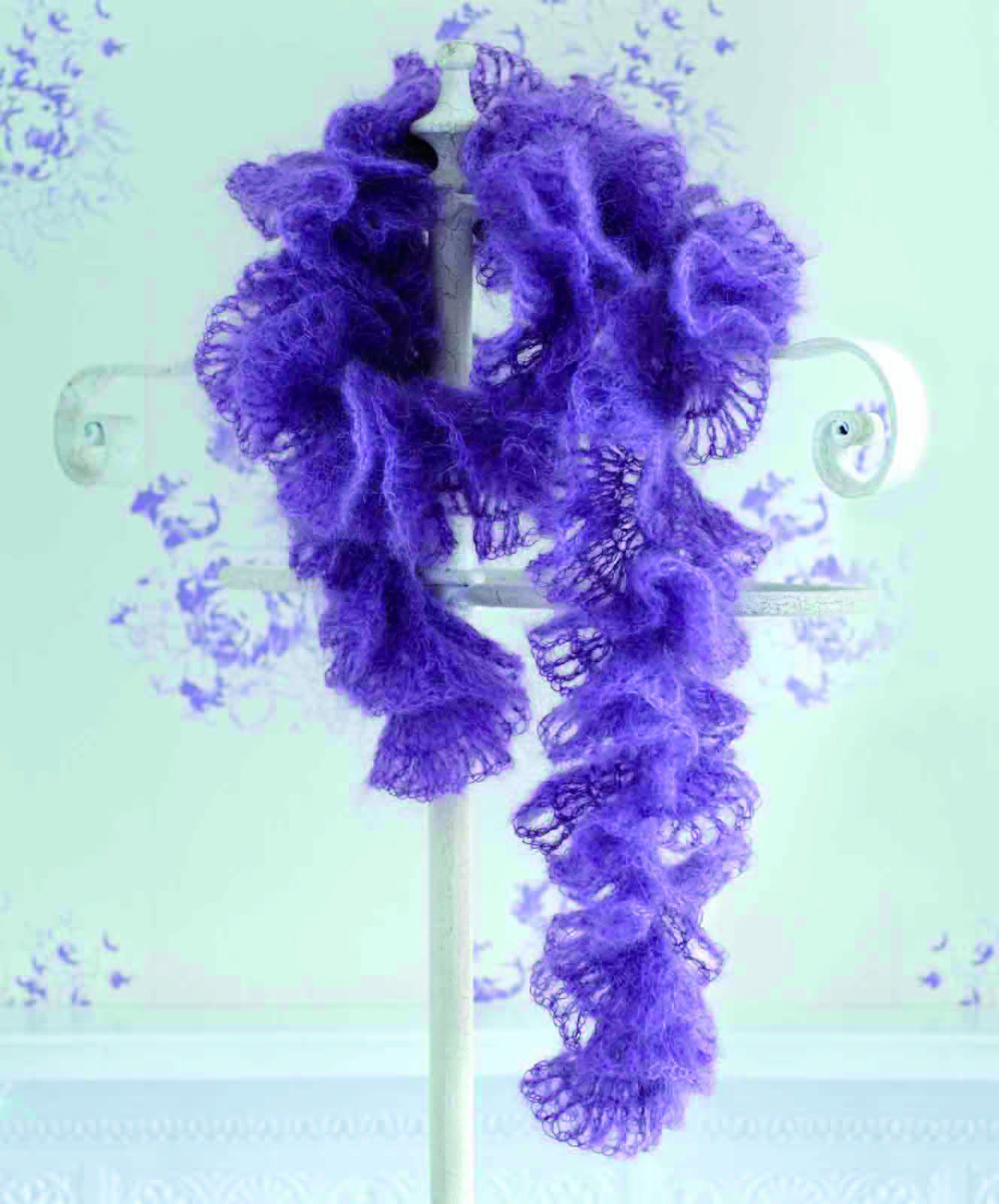
This ruffled lacy scarf crochet pattern works around both sides of a long foundation chain. Repeated increases add far more stitches than the center line can hold flat, creating the soft ripples. Fine mohair keeps that expanding fabric light, while the last treble-and-chain round makes the edge airy.
Project at a glance
| Detail | Project information |
|---|---|
| Skill level | Easy increases around a foundation chain |
| Finished size | Approximately 150 × 10 cm / 59 × 4 in |
| Technique | Crochet; US stitch terms in this article unless a source image is labeled otherwise |
| Construction | Follow the project stages below |
Materials and tools
- 3 × 25 g balls Rowan Kidsilk Haze, Dewberry 600; 210 m / 230 yd per ball, or similar lace-weight yarn
- 4.5 mm crochet hook
- Yarn needle and two markers for the end-center stitches
Stitches and pattern notes
ch = chain; sl st = slip stitch; sc = single crochet; hdc = half double crochet; dc = double crochet; tr = treble crochet; st = stitch; sp = space; RS/WS = right/wrong side. A bracket followed by × 3 means repeat the entire bracket three times.
This article uses US dc and tr. The source calls the starting ch 3 a first treble in one sentence, but Round 1 is otherwise consistently dc; treat ch 3 as the starting dc height. Exact gauge is not essential, but foundation length and the number of increase rounds determine the finished proportions.
Set the center length
Make a chain approximately 10 cm / 4 in shorter than the desired finished length. The source uses about 140 cm / 55 in for a 150 cm scarf. Add three chains for the starting dc height. Mark the two end turns as you establish Round 1 so later increases stay centered.
Work the four ruffle rounds
| Step | Instructions | Checkpoint |
|---|---|---|
| Round 1 | Work 2 dc in the fourth chain from the hook, then dc along the chain. At the far end, work the source three-dc end turn, rotate the work 180 degrees and dc along the unused lower loops of the foundation. Join to the starting chain top. | Work around both sides; do not turn the fabric over |
| Round 2 | Ch 3 and dc in its base. Work 2 dc in each straight-side stitch and 3 dc in the central stitch of each three-dc end group. Join to the starting chain. | Keep the two end-center increases marked |
| Round 3 | Ch 4 and tr in its base. Work 2 tr in each straight-side dc and 3 tr in each end-center stitch. Join. | The edge becomes noticeably fuller |
| Round 4 | Ch 5 counts as tr plus ch 1; work (tr, ch 1) in its base. Work (tr, ch 1) in each straight-side tr. At each end-center work (tr, ch 1, tr, ch 1, tr). Join. | Open final edging |
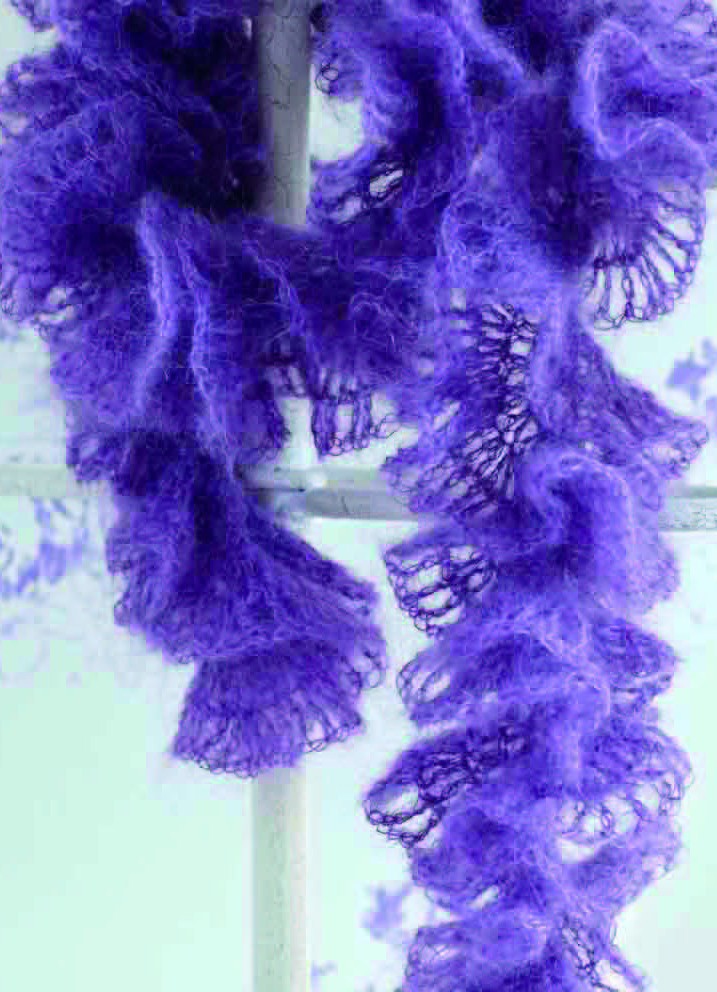
Round 1’s end description can be read as adding three dc after the final side stitch. The important structural point is to establish a clearly marked three-dc end-turn group, then use its middle stitch for subsequent end increases. Avoid treating the side stitch and the turn as two separate unmarked centers.
Control the amount of ruffle
Lay the scarf down after each round and let the edge fall naturally. Ripples are expected: the growing circumference is the design feature. If you prefer a wider ruffle, the source allows further rounds, such as two dc in every stitch or chain space. A plain round between increase rounds produces a gentler effect. These are optional variations beyond the four-round scarf, and they need additional yarn.
Before beginning another increase round, check the yarn remaining. Every expansion makes the next round longer, so the final few rounds can use much more yarn than the first. Use the same treatment at both end centers to keep the scarf balanced.
Finish without flattening
Fasten off and weave the tails into dense stitch bases. Do not stretch or press the scarf flat: that would reduce the ruffle. Let the fabric settle into its natural waves, and follow the care instructions for the yarn. When storing it, arrange the loops loosely rather than compressing them beneath heavier items.
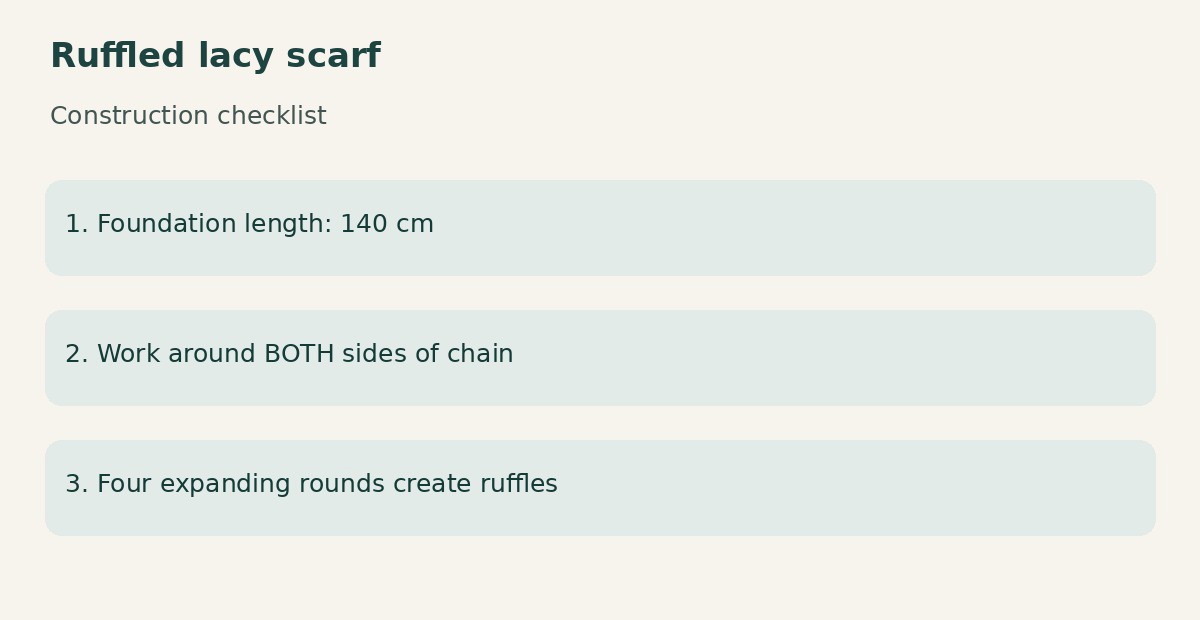
Tips for a clean finish
- Use removable markers in both end-center stitches and move them each round.
- Keep the starting chain supple so the center line can drape.
- A smoother lace yarn gives clearer stitches; a mohair blend adds a softer halo.
Frequently asked questions
Is the scarf worked in rows?
No. You crochet around both sides of the foundation chain in joined rounds.
Should the scarf lie flat?
The center line should lie comfortably, but the expanding outer fabric is meant to ripple.
More scarf and shawl ideas
Explore the Scarves & Shawls collection for more neckwear projects. Compare the yarn weight, width and construction before choosing your next pattern: an airy lace wrap and a dense winter scarf need different fabrics even when they use similar stitches.
Pattern source and credit
Based on [BONUS 2] Crochet Colors Theory.pdf, Printed pages 200-201; PDF pages 202-203. The readable source does not identify an individual designer. Photographs show the original source samples; construction checklists are editorial illustrations. The article reorganizes the source and adds practical explanations. Source ambiguities are identified where relevant; this is a document-based adaptation, not a claim of physical testing.
Open the original pattern in Drive to compare the instructions, source photographs and original layout.
Leave a Reply