Crochet Animal Rattles: Dog, Cat and Mouse
· admin
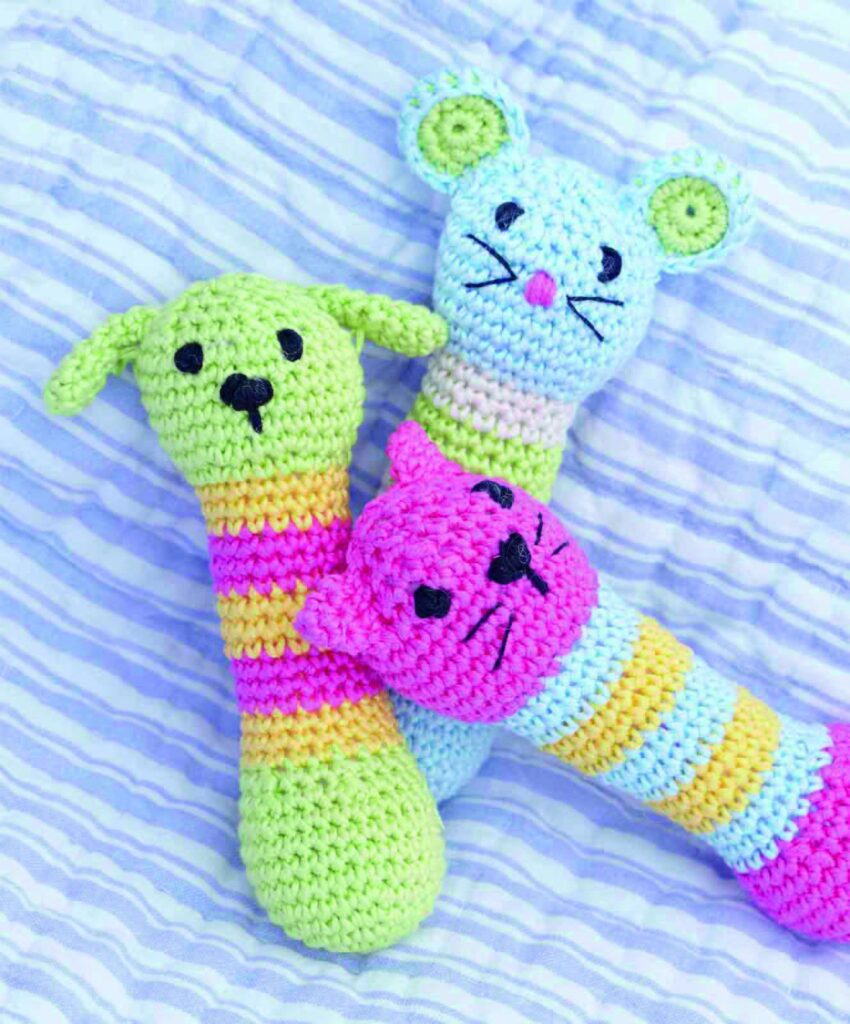
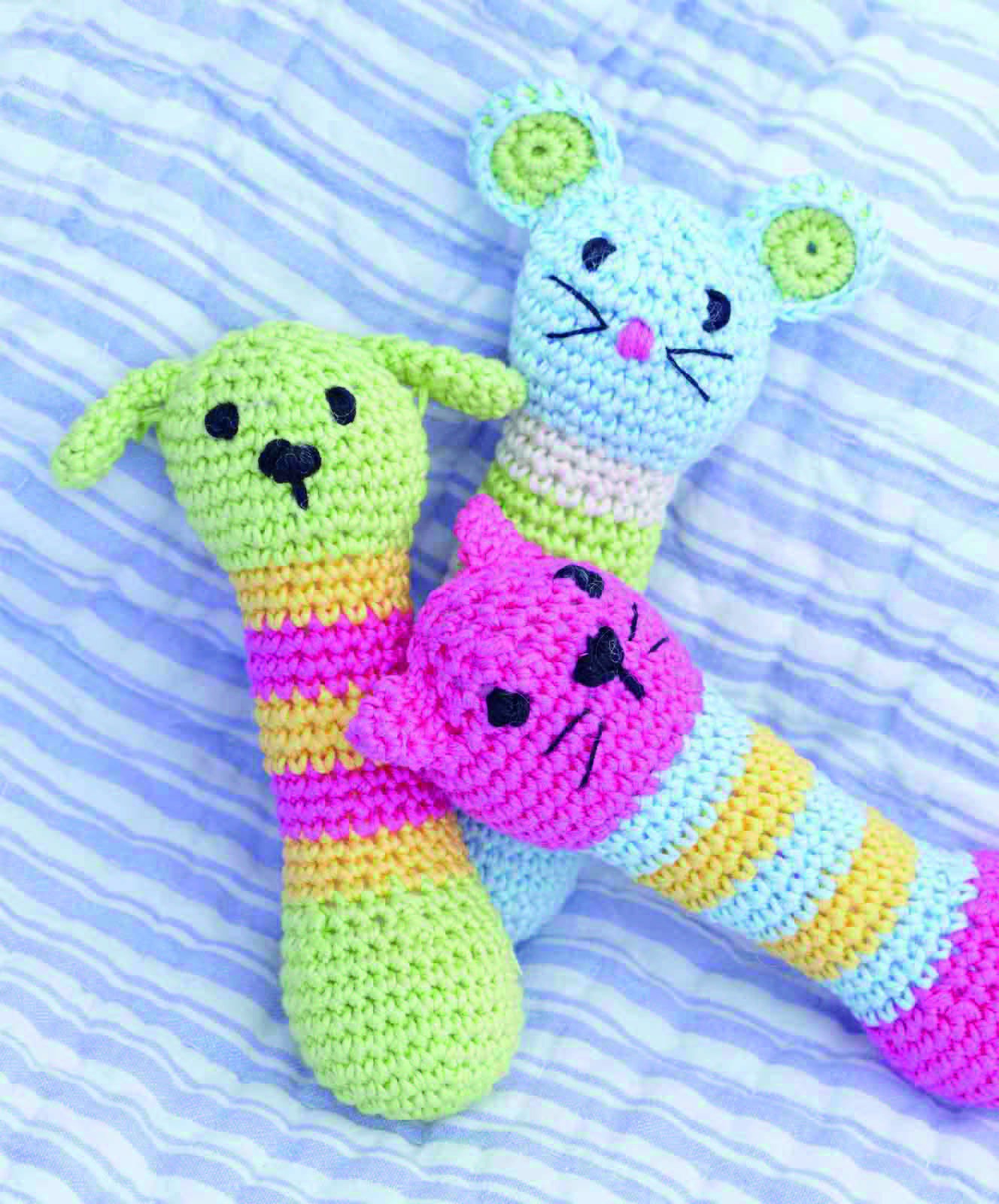
These crochet animal rattles use one shaped body with three different faces. A narrow striped handle joins a rounded lower end to the animal head. Drooping ears make the dog, pointed ears make the cat, and large two-layer circles make the mouse. The original chapter supplies all three variants in one project.
Project details
| Skill level | Intermediate |
|---|---|
| Size | Approximately 12 cm long. |
| Hook | 3 mm |
| Source | Animal Rattles, Crochet Colors Theory, printed pages 260–263 / PDF pages 262–265. |
Materials and gauge
DK cotton in coordinating colors, 3 mm hook, marker, yarn needle, black and pink embroidery thread, filling and an optional purpose-made enclosed rattle insert. Source yarn: Takhi Cotton Classic DK.
Work one shared rattle body
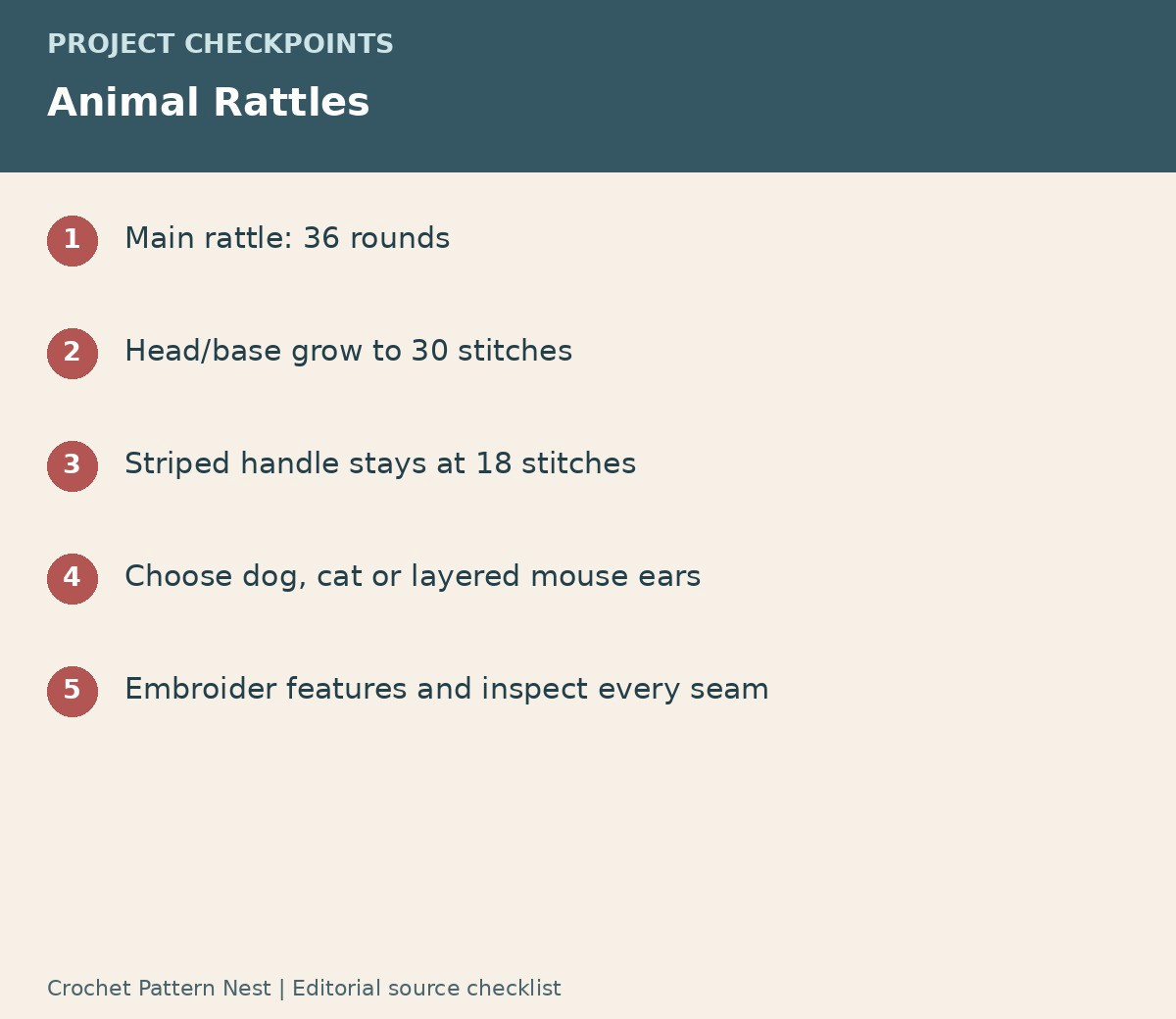
Use US terms and continuous rounds with a moving marker. Start in the main face color with 6 sc in a magic ring, then increase by six per round to 12, 18, 24 and 30. The printed rounds 6–9 say dc around at thirty stitches, although the chapter introduction describes sc fabric; this guide retains that written stitch-height change and flags it so it is not missed.
| Rounds | Shape |
|---|---|
| 1–5 | 6, 12, 18, 24, 30 |
| 6–9 | 30 dc per round as printed |
| 10–11 | Decrease to 24, then 18 |
| 12–26 | 18 sc; alternate colors in five three-round bands |
| 27–28 | Increase to 24, then 30 |
| 29–32 | 30 dc per round as printed |
| 33–36 | Decrease to 24, 18, 12, 6 |
Change color on the final pull-through before each new band. Keep the carried tails inside and add filling progressively through the narrow handle. If using a rattle component, enclose it fully in the filling before the closing rounds rather than leaving it exposed against the crochet.
Dog ears
Make two ears in the face color. Begin with 4 sc, increase to 8 and work two plain rounds at 8. Reduce to 6 using (2 sc, dec) twice, then work two plain six-stitch rounds. Join and fasten off. Sew the ears to the sides of the head, bend their tops downward and add the small securing stitch shown in the source.
Cat ears
For each cat ear, begin with 4 sc. Work (sc, inc) twice for 6, then (2 sc, inc) twice for 8. Close and leave a sewing tail. These short, widening pieces stay pointed when their lower edges are sewn to the rounded head. Place both ears before sewing so their heights match.
Mouse ears
Each mouse ear has a front disc and a back disc. For each disc, make 8 sc, increase to 16, then repeat (sc, inc) eight times for 24. Place the two discs wrong sides together and single crochet through both layers around the edge in the head color. Make a second complete ear and sew them symmetrically onto the head.
Embroider the faces
Use black embroidery for the dog nose and eyes. The cat also gets whiskers; the mouse has a pink nose with black eyes and whiskers. Secure the embroidery ends within the stuffed head. The close-up source photographs are useful for keeping the face centered between the ears.
Inspect the finished construction
Check both ends, each ear seam and the long handle for visible gaps. Filling should support the shape without pushing through the fabric. The supplied pattern is a construction reference, not a certification of a finished handmade toy. Use embroidered features, an enclosed insert if desired and supervised handling; repair a loose seam before further use.
Frequently asked questions
Are these three separate base patterns?
They share one thirty-six-round base. The ear construction, colors and embroidery create the three animals.
Why are dc rounds mentioned?
The printed pattern uses dc in rounds 6–9 and 29–32 despite its general sc description. That inconsistency is identified here rather than silently altered.
Can I omit the sound insert?
Yes. The same crochet body can be filled without an insert for a quiet animal-handled ornament or supervised soft project.
Pattern and photograph credits
Animal Rattles, Crochet Colors Theory, printed pages 260–263 / PDF pages 262–265. Photographs show the supplied source projects. Crops, rotated photographs and editorial checklists are identified in their captions. Any stitch-count or terminology clarification is identified in the relevant section.
Open the original [BONUS 2] Crochet Colors Theory.pdf pattern reference in Drive — Printed pages 260-263; PDF pages 262-265. Keep the original pages beside this guide for the detailed diagrams and any section specifically referenced above.
Leave a Reply