
Teddy Bear Crochet Baby Blanket with 25 Squares
· admin
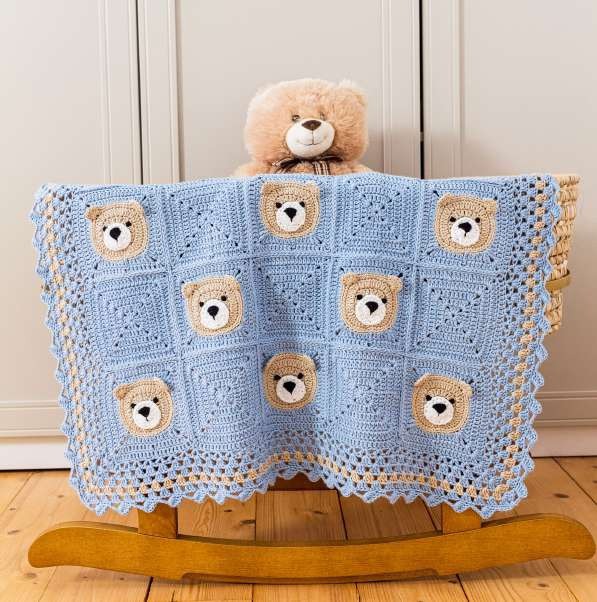
This teddy bear crochet baby blanket alternates thirteen bear-face squares with twelve solid blue squares. The ears are formed directly on the face circle, while a pale muzzle and embroidered features sit on top. Extended double crochet makes the solid blocks tall enough to match the bear blocks. A seven-round border finishes the five-by-five arrangement.
Project details
| Skill level | Intermediate |
|---|---|
| Size | Source approximately 28.5 inches / 72 cm square; blocks about 10.75 cm. |
| Hook | 3 mm |
| Source | Bear Baby Blanket, supplied Teddy bear blanket.pdf. |
Materials and gauge
DK cotton: source two balls beige, seven baby blue and one white, plus black worsted cotton for embroidery; 3 mm hook, needle and optional blocking mats. Source yarn: Hobbii Rainbow Cotton 8/6, 105 m / 50 g.
Make one block of each kind first
Use US terms. Each source square measures about 10.75 cm. Crochet and block one bear and one solid square before making all twenty-five. Their different structures require different stitch heights; replacing the extended dc on the solid square with ordinary dc may leave it too small.
Extended dc begins like a normal dc, but after drawing up the loop, yarn over and draw through one loop first. Then complete the two normal draw-through-two steps. That extra lower loop adds height without changing the number of stitch positions.
Form the bear face and ears
With beige, make twelve dc in the first round, counting the starting chain as directed. Increase every stitch for twenty-four in round 2, then increase every stitch again for forty-eight in round 3. This is intentionally not the usual thirty-six-stitch third round.
Round 4 works a sc outline with two six-dc ear groups placed in front loops. The added ear stitches bring the visible edge total to fifty-eight. Keep the underlying free loops identifiable because the following blue squaring round works behind the ears rather than into all six tall ear stitches.
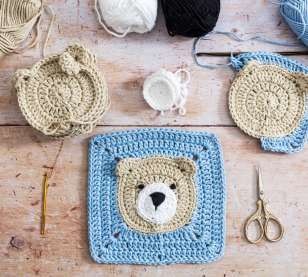
Square the face behind the ears
Join blue at the exact first back-loop position identified in the source photograph. The mixed sc-height geometry uses dc and extended dc along the sides with treble corner groups. Work behind each ear in its designated underlying anchor, keeping the ear itself in front.
The first blue round has fifteen side stitches between four chain-two corners. The following blue round uses (2 dc, chain 2, 2 dc) at each corner and finishes with nineteen stitches per side. Correct starting placement matters: moving the blue join by several stitches rotates the corners away from the ears.
Make and embroider thirteen muzzles
The pale muzzle begins with twelve dc and expands to eighteen hdc using alternating single hdc and hdc increases. Leave a sewing tail. Embroider the nose onto each muzzle before attaching it to the bear face, then embroider one eye to either side.
Keep each face centered and compare the expressions across the thirteen blocks. Sew the muzzle edges thoroughly so the layer lies flat without pulling the circle. Secure the magic-ring tails on every face and muzzle so the centers cannot loosen.
Make twelve matching solid squares
The solid block starts with three dc per side and chain-two corners. Dc rounds grow the sides to seven and eleven. Two rounds of extended dc then grow them to fifteen and nineteen, using the matching corner groups. This is the source’s modified solid square, designed to match the bear block’s final edge.
Lay all twenty-five squares in a five-by-five checkerboard, with bear blocks occupying thirteen positions. Join with a flat slip-stitch seam, keeping the face direction consistent. Check the back as well as the front for trapped ends or a twisted block.
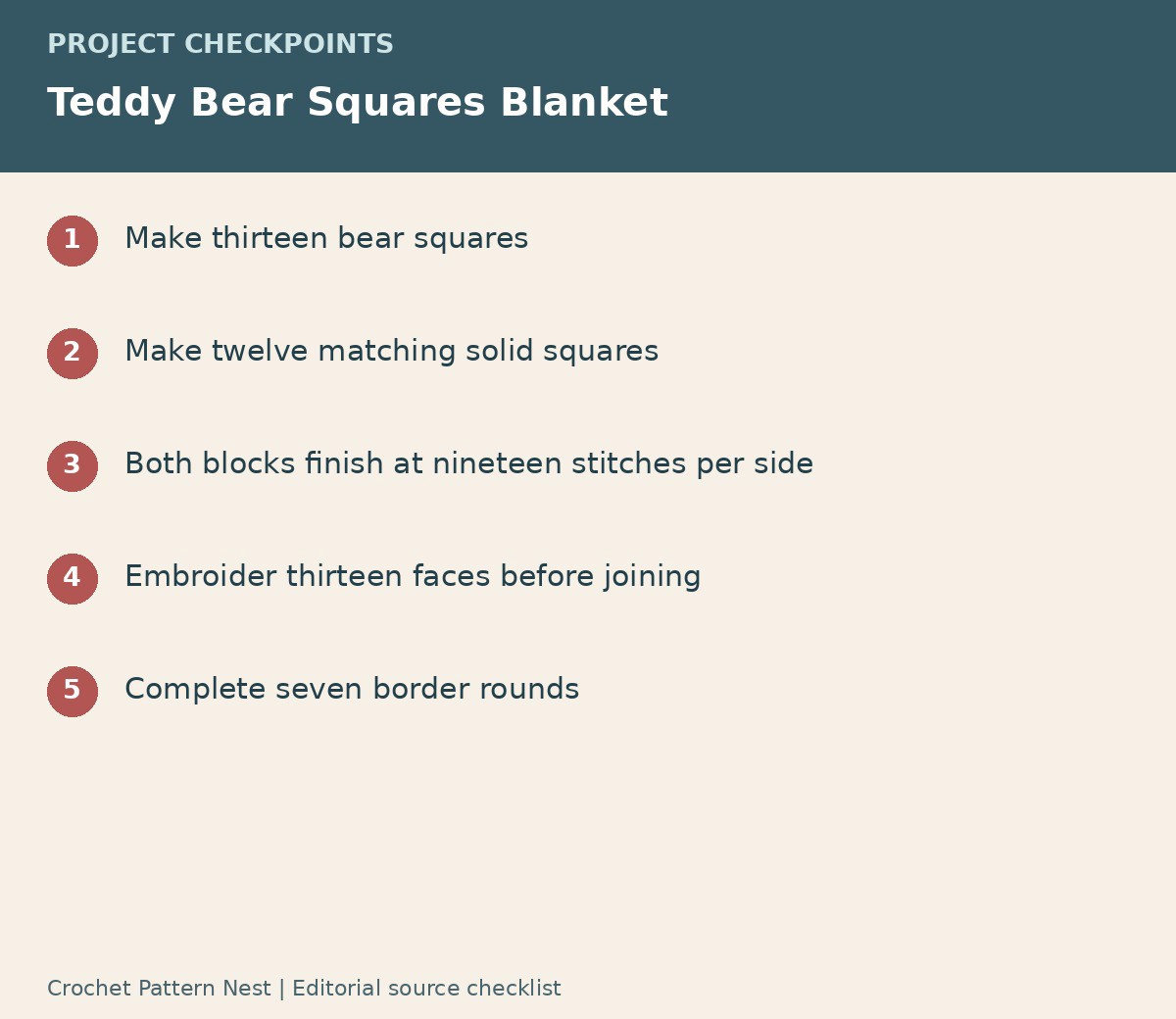
Complete the seven-round border
Begin in blue with dc around the perimeter, using the source’s corner groups and dc2tog across the motif seam gaps. The next round establishes V stitches, defined here as dc, chain 2 and dc in one anchor. The following rounds fill the V spaces with three-dc groups separated by chains.
Round 5 changes to beige for the narrow stripe; round 6 returns to blue. The final textured edge uses a chain-three start, dc into the next space, five dc around that new dc post and a sc anchor in the following space, repeated along each side. Use the original border page for the source’s nineteen-repeat side layout and corner chain-four turn.
Shape the blanket according to the cotton care label. The source gives the same inch measurement for both sides but slightly different metric conversions; approximately seventy-two centimeters square is the sensible rounded planning description.
Frequently asked questions
How many bear faces are made?
Thirteen, alternating with twelve solid blocks in a five-by-five blanket.
Why use extended dc in the solid blocks?
It adds the height needed for those blocks to match the bear squares without changing the final side counts.
Where is the blue round started?
In the exact first back-loop position shown in the source, so the corners align behind the ears.
Pattern and photograph credits
Bear Baby Blanket, supplied Teddy bear blanket.pdf. Photographs show the supplied source projects. Crops, rotated photographs and editorial checklists are identified in their captions. Any stitch-count or terminology clarification is identified in the relevant section.
Open the original Teddy bear blanket.pdf pattern reference in Drive — Whole PDF. Keep the original pages beside this guide for the detailed diagrams and any section specifically referenced above.
Leave a Reply