
Lilac Strawberry Crochet Baby Dress: Pattern Guide
· admin
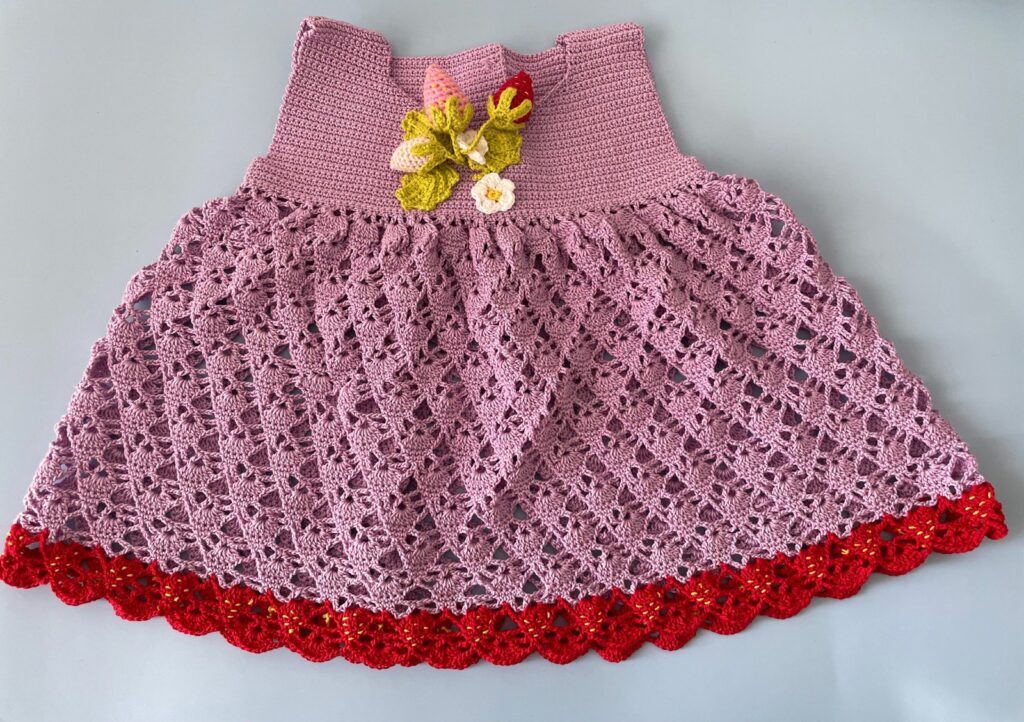
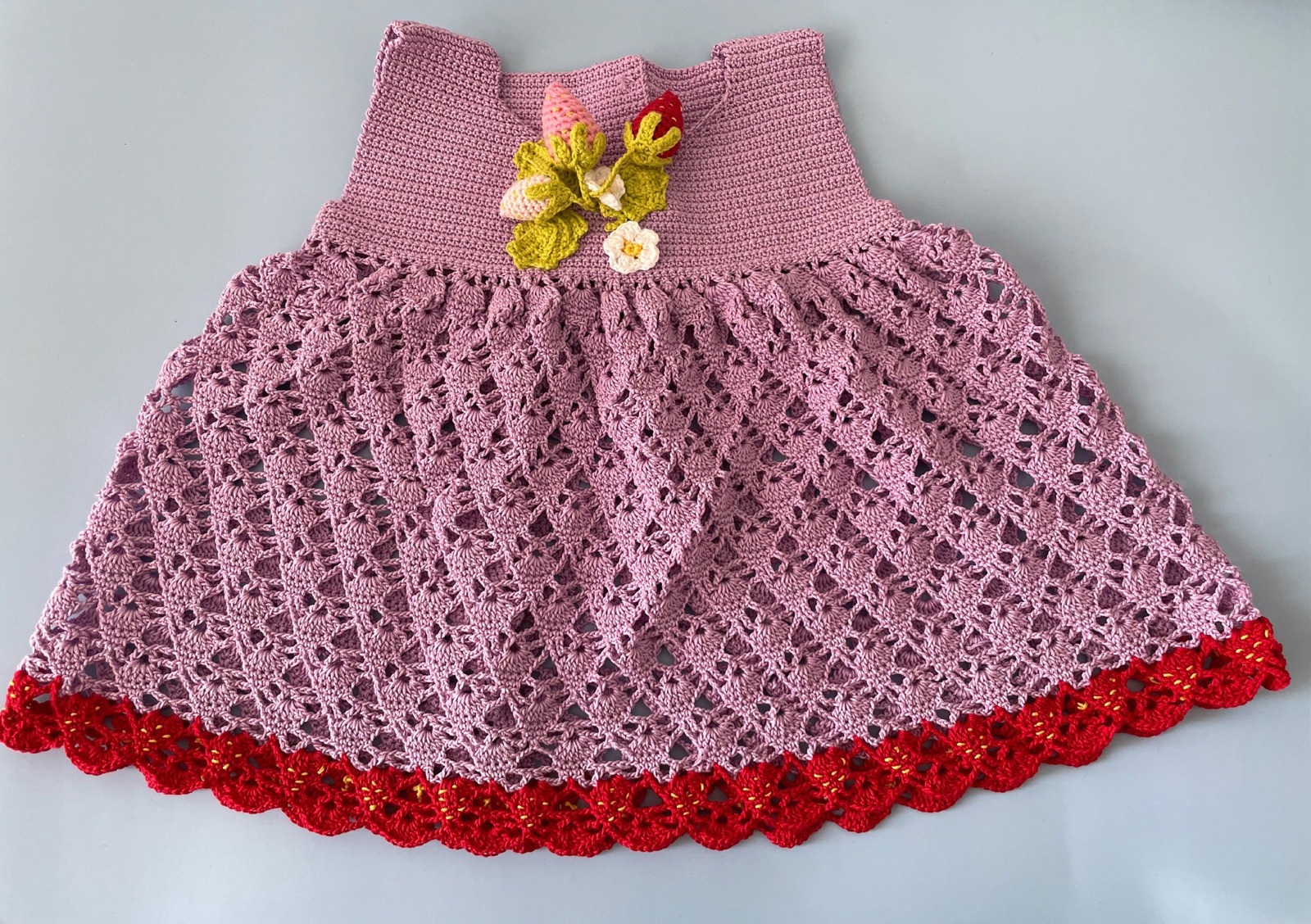
This lilac strawberry crochet baby dress pairs a dense sleeveless bodice with an open patterned skirt and red scalloped hem. Small strawberries, leaves and flowers decorate the waist. The supplied Tarif 30 file includes detailed process photographs, but some written abbreviations and row labels are incomplete. This article is a pattern-reading guide, with those limits identified before yarn and size decisions are made.
Project details
| Skill level | Intermediate; source clarification required for the skirt |
|---|---|
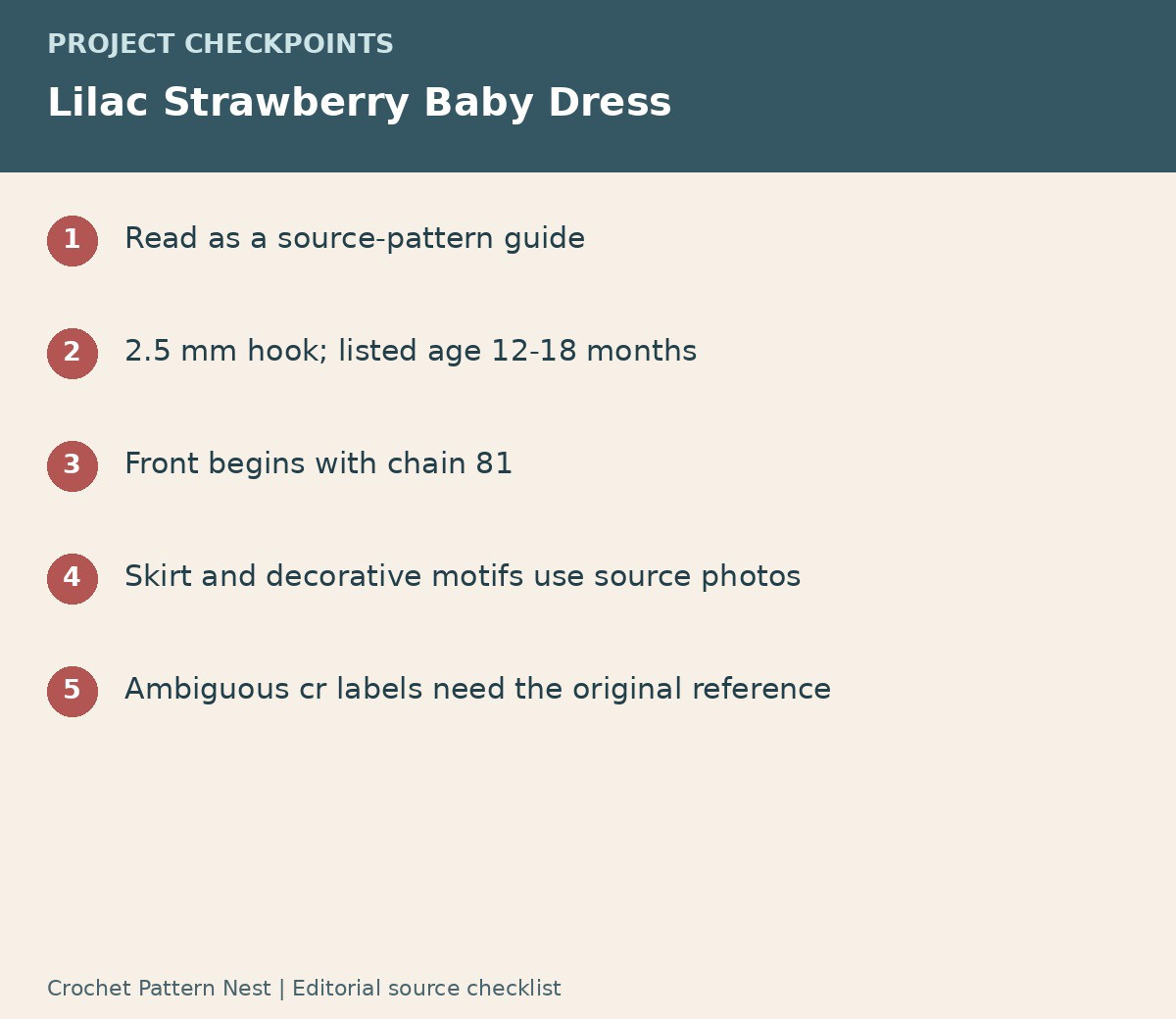
| Size | Source label: 12–18 months and 45–48 cm; the measurement type is not defined. |
| Hook | 2.5 mm or a hook matching the chosen yarn. |
| Source | Tarif-30.pdf, supplied four-page illustrated dress reference; individual designer not identified in its readable cover. |
Materials and gauge
Lilac yarn for the dress, red, green, pink, white and yellow accents, 2.5 mm hook, needle, scissors and markers. Yarn weight, yardage and a measured gauge are not supplied.
Identify the actual source design
The photographed sample has a lilac bodice and skirt, red edging and dimensional fruit at the front. Its dense upper section and open lower fabric are separate stages. The source uses sc wording for much of the bodice, while the skirt repeatedly uses an undefined “cr” label. That label cannot safely be converted into dc, tr or another particular stitch without clarification.
The age is listed as twelve to eighteen months. Beside it is a 45–48 cm measurement without a clear label saying chest, length or another dimension. Do not treat it as a confirmed chest circumference. Measure the intended garment and make a stitch sample before deciding whether the source proportions will fit.
Understand the bodice plan
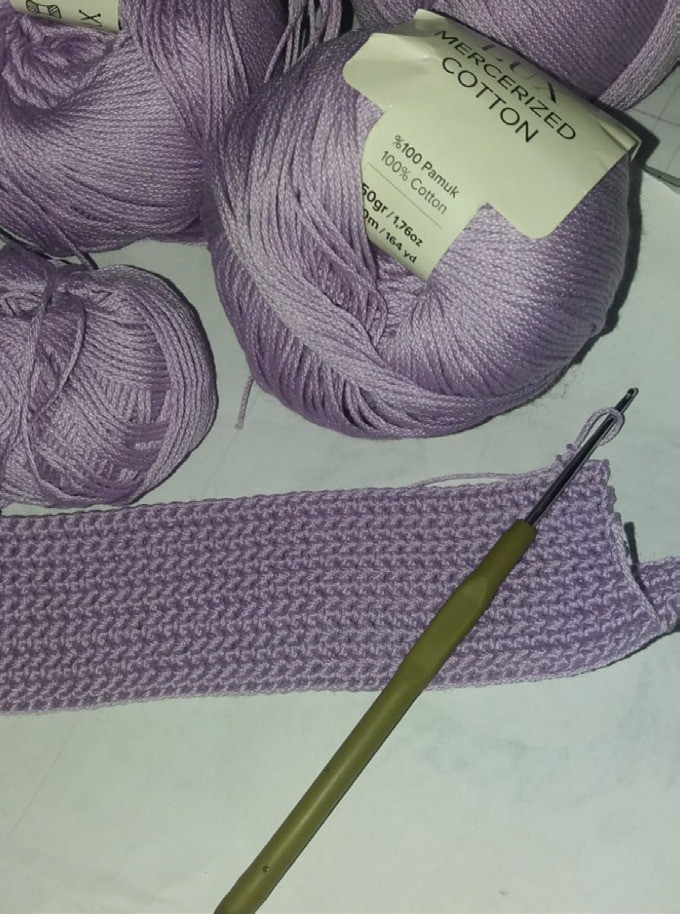
The front begins with chain 81 and a first row of eighty sc. The early rectangle holds that width, then reduces through seventy-five and seventy stitches before dividing toward the shoulders. Later labels describe a thirty-five-stitch section tapering to a fifteen-stitch shoulder. The instruction to work the other side mirrors the neck opening.
The back is made in separate pieces with an opening. The source includes chain gaps for fastening and shoulder sections that meet the front. Keep the two back pieces laid beside the front as you work so their armholes and shoulder heights can be compared. The printed numbering skips or repeats a few lines; do not assume each “Rnd” label means a joined circular round.
Use the skirt photographs as a construction map
The skirt starts at the lower edge of the assembled bodice. The photographs show the open pattern expanding away from the waist, with repeated chain spaces and taller grouped stitches. The source text lists thirty-six repeats in several places, but it does not define the “cr” stitch needed to execute those repeats unambiguously.
This guide therefore does not supply an invented complete skirt sequence or a new stitch-total chart. Keep the original pages 2–3 with the project and resolve the ambiguous stitch label before attempting the full skirt. The red scalloped edge in the finished photograph is a separate color accent; the mixed color notes should also be compared with that photograph.
Plan the fruit and leaf decorations
The source offers three sizes of strawberry-like pieces. The main red version starts with 6 sc, increases to 12 and 18, works a short cylindrical section and tapers through sixteen, fourteen, twelve, ten, eight and six. Smaller accent versions begin from seven- and eight-stitch rings. These are stuffed motifs sewn to the waist rather than colorwork inside the bodice.
The leaf pages show shaped flat pieces and smaller leaves, along with small flower accents. Make a small trial set before sewing anything to the dress. Arrange the components on the finished waist and pin their positions, then sew through stable bodice stitches rather than only catching a loose chain-space edge.
Choose a practical finish
Secure every dimensional motif at multiple points, particularly leaves and the backs of the strawberries. Keep the bodice fastening smooth against the inside of the garment. Block the open skirt with a method suitable for the actual yarn and avoid stretching it to compensate for an uncertain starting size.
Use this source when you want its photographed design and are prepared to clarify the abbreviated skirt instructions. It does not provide a dependable yardage figure or fully labeled measurement chart, and this article keeps those missing details visible rather than substituting a different dress pattern.
Frequently asked questions
Is this a complete independently corrected dress pattern?
No. It is an illustrated source guide because the supplied skirt instructions use an undefined cr abbreviation and incomplete row labels.
What does 45–48 cm measure?
The file does not label that dimension clearly. Do not assume it is chest circumference or finished length.
Are the strawberries worked into the dress?
They are separate stuffed decorations sewn onto the waist area.
Pattern and photograph credits
Tarif-30.pdf, supplied four-page illustrated dress reference; individual designer not identified in its readable cover. Photographs show the supplied source projects. Crops, rotated photographs and editorial checklists are identified in their captions. Any stitch-count or terminology clarification is identified in the relevant section.
Open the original Tarif-30.pdf pattern reference in Drive — Whole PDF. Keep the original pages beside this guide for the detailed diagrams and any section specifically referenced above.
Leave a Reply