Crochet Rolled Flowers in Three Sizes for a Purple Bouquet
· admin
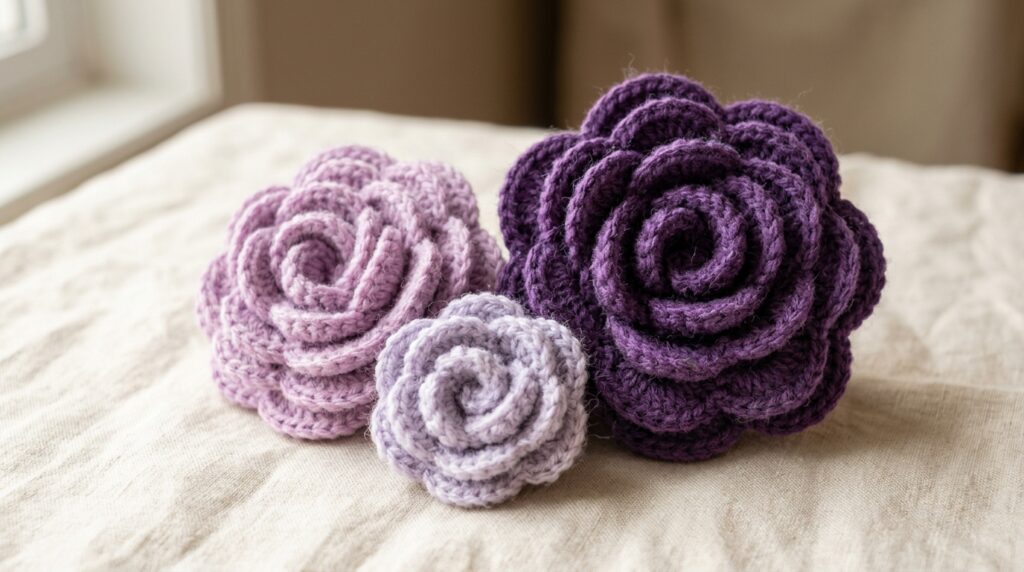
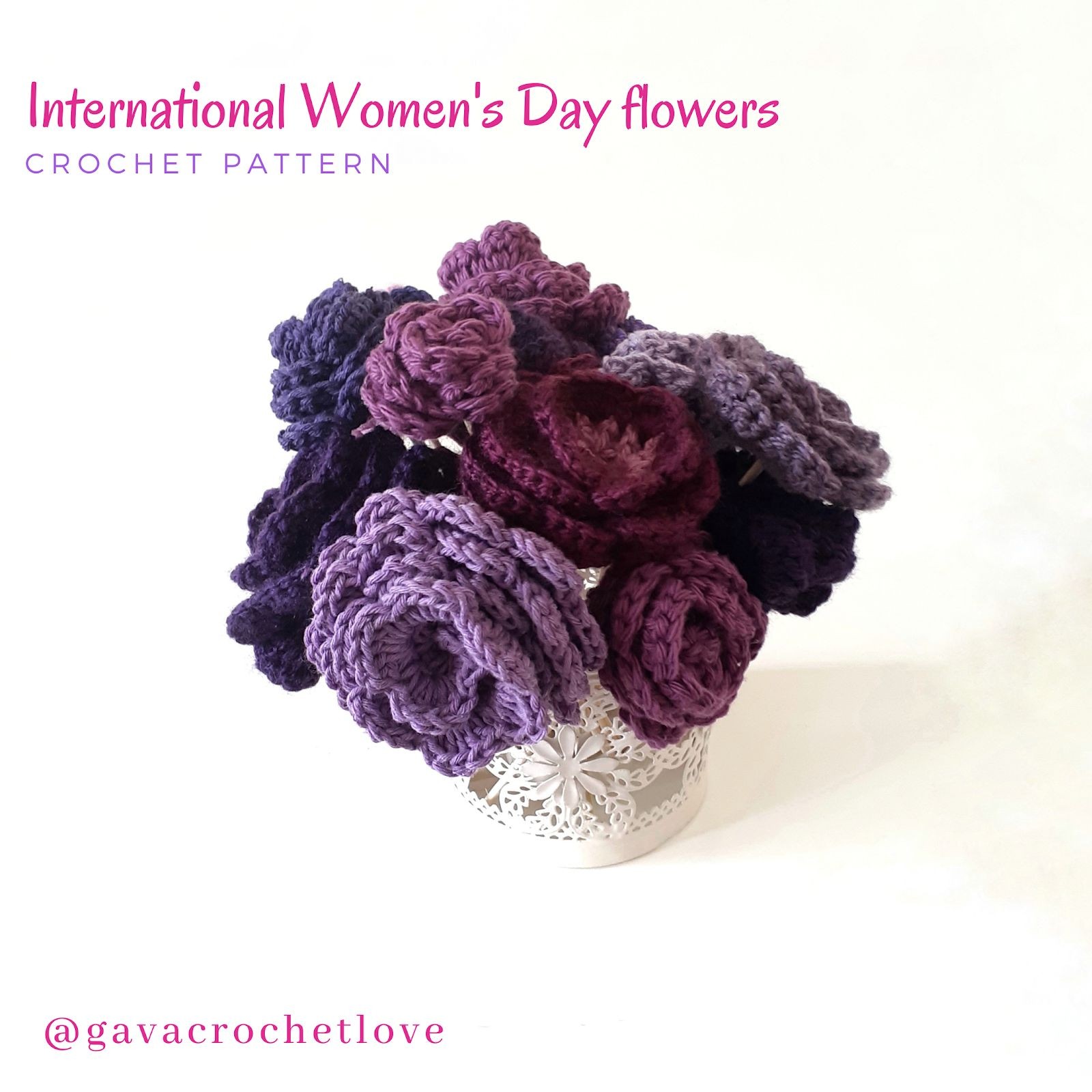
These crochet rolled flowers begin as flat petal strips that you roll and sew into layered blooms. This pattern offers three versions: a small one-row flower, a medium shell-petal flower and a larger flower with an extra shaping row. The original International Women’s Day design uses purple shades, which can be mixed to give the finished bunch depth without changing the stitch pattern.
Materials for Crochet Rolled Flowers
- Purple DK or light-weight yarn in one or several shades.
- A matching hook; the designer used 4 mm.
- Scissors and a yarn needle.
Before you begin
Use US terms: ch = chain, sc = single crochet, hdc = half double crochet and dc = double crochet. Stitches grouped inside parentheses are worked together in the indicated chain or space. The source gives no fixed gauge or finished measurements. Make one flower before choosing how many to include in a bouquet.
Small flower: a one-row petal strip
Ch 24. Work 1 sc in the second chain from the hook. Repeat to the end of the chain: (1 hdc, 3 dc, 1 hdc) in the next chain, then 1 sc in the next chain. Fasten off, leaving a long tail for sewing. The small shells form the petal edge when the strip is rolled.
Medium flower: two rows
- Ch 35. Work 1 dc in the fifth chain from the hook. Repeat to the end: skip the next chain, then work (1 dc, ch 1, 1 dc) in the following chain.
- Ch 1 and turn. Work 5 dc in the next ch-1 space, then 1 sc between the next two dc. Continue this shell-and-sc sequence along the row, ending with 5 dc in the last chain space.
- Fasten off, keeping a long sewing tail. Avoid gathering the strip tightly before rolling; the shells need room to overlap.
Large flower: three rows
- Ch 39. Work 1 dc in the fifth chain from the hook. Repeat to the end: skip the next chain, then work (1 dc, ch 1, 1 dc) in the following chain.
- Ch 4, turn, and work 1 dc in the same stitch. Repeat across the row: (1 dc, ch 1, 1 dc) in the next chain space, then two complete (1 dc, ch 1, 1 dc) groups in the following chain space.
- Ch 1 and turn. Work 5 dc in the next ch-1 space and 1 sc between the next two dc. Continue across, finishing with 5 dc in the last chain space. Fasten off and leave a long tail.
Roll and sew each flower
- Lay the strip with the shell-petal edge facing upward.
- Start at one end and roll the strip to form the center, keeping the lower edge aligned.
- Continue rolling so the shells overlap around the center rather than being squeezed flat.
- Thread the long tail through the needle and sew across the base through several layers. Rotate the bloom and add more securing stitches until the strip stays rolled.
- Weave in the remaining tail. Arrange different sizes and purple shades together.
Plan a balanced bouquet
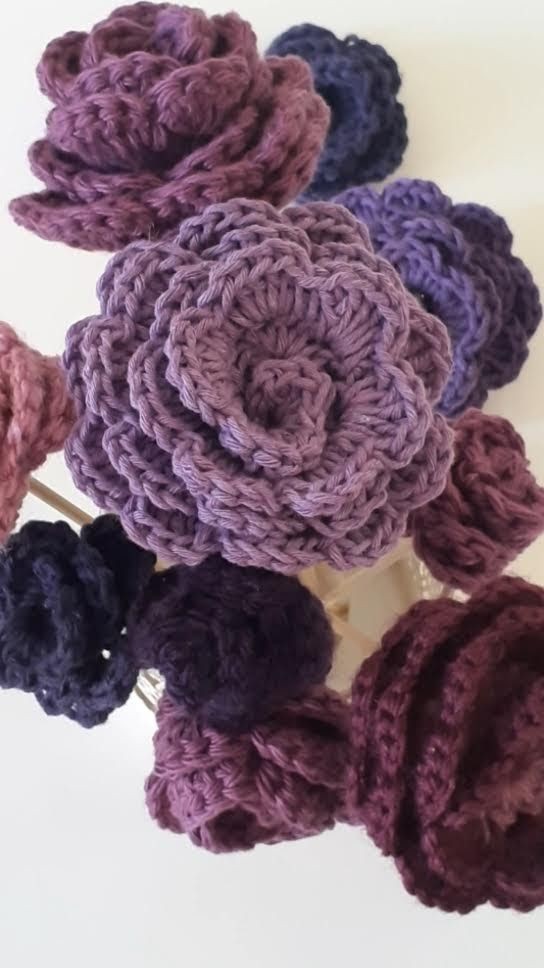
Begin with a large flower as a focal point, add medium flowers around it and use small flowers to fill the gaps. Make the blooms before selecting a display container so you can judge their actual size. The source gives the crochet flowers themselves; it does not specify a separate wire-stem construction.
Questions before you finish
Are these three versions the same size?
No. They use different foundation lengths and numbers of rows. The exact finished sizes depend on your yarn and tension.
Can I use one shade only?
Yes. A single color will still show the layered shells. Several close shades make it easier to distinguish neighboring flowers in a bouquet.
More Crochet Flowers and Plants
For another handmade botanical project, try our crochet lavender stem pattern or crochet carnation flower pattern.
Design credit
Original design and reference photographs: Gava Crochet Love / @gavacrochetlove. This article is an editorial adaptation of the supplied pattern.
Leave a Reply