Daisy Granny Square Crochet Pattern: Two Center Styles
· admin
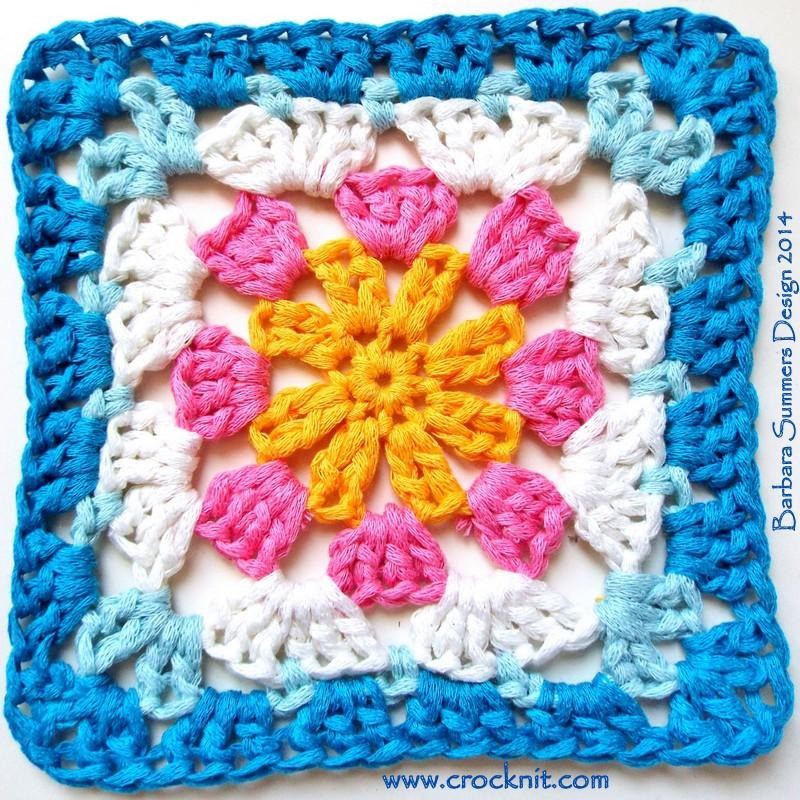
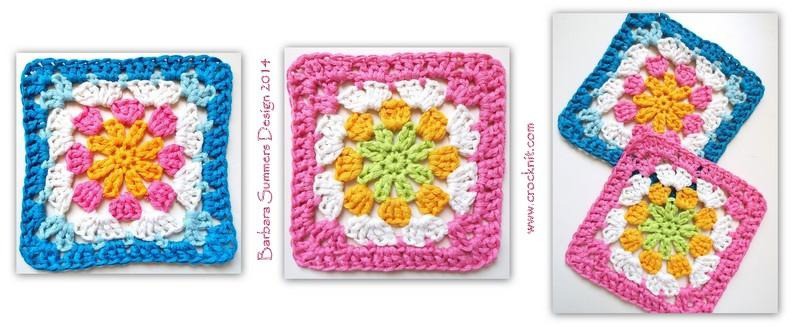
This daisy granny square crochet pattern offers two flower centers with one shared square border. Version A begins with paired double crochets, while version B uses a more open chain-two framework. Both create eight petal groups and become a six-round square suitable for a larger joined project.
Project details
| Skill level | Confident beginner |
|---|---|
| Finished size | About 11–12.5 cm across in the source yarn examples. |
| Hook | 4.5 mm in the source samples. |
| Pattern source | Daisy Granny Crochet Square by Barbara Summers / MiCrocknit Creations, 2008–2014. |
Materials
Coordinating yarn colors, 4.5 mm hook or a hook suited to the chosen yarn, scissors and tapestry needle. Source examples include Rowan Bamboo Soft, Katia Swing and Bendigo Woollen Mills Alpaca.
Choose version A or B
Version A uses four colors in the written source and version B uses three, though the photographs show other color combinations. Keep the same yarn family when combining squares in a blanket or cushion. The sample dimensions range from about eleven to twelve-and-a-half centimeters because the yarns differ.
The source uses US terms. Chain 3 substitutes for the first dc in the tall-stitch rounds. A starting chain 1 is normally not a sc; the source’s first round says chain 1 plus seven sc but lists eight stitches. To give the next round eight clear anchors, this guide uses eight actual sc in a magic ring. That is an explicit counting clarification.
Make the version A center
- Round 1: Make 8 sc in a magic ring and join.
- Round 2: Work (2 dc, chain 1) into each center stitch. Use chain 3 as the first dc of the first pair. Join with eight paired groups.
- Round 3: Change color. Work (4 dc, chain 1) in each chain-one space, using the starting chain 3 for the first dc. Join after eight groups.
Check the spaces, not only the solid stitches. Eight chain-one spaces around the center are the anchors for the next color. A missed space can produce seven large groups and make the eventual square lean.
Make the version B center
Begin with the same eight-stitch center. For round 2, chain 5 as the first dc plus chain 2. Continue with dc and chain 2 in each remaining center stitch, then join to the third chain of the starting chain-five. There are eight dc positions with eight chain-two spaces.
For round 3, work (4 dc, chain 1) into each chain-two space, again substituting chain 3 for the first dc. The source refers to a chain-one space within this version’s round 3, but the spaces created by round 2 are chain-two spaces. The correction preserves the actual eight-space framework.
Square either center over rounds 4–6
Round 4: Change to the squaring color. Work six dc in each chain-one space, adding chain 1 after every second six-dc group. That creates eight groups of six dc and four corner spaces. The starting chain 3 counts as the first of the six dc in the first group.
Round 5: Begin in a corner space and work (2 dc, chain 1, 2 dc). Across each side, make four chain-two arches: chain 2 and sc between the middle dc of the first six-dc group; chain 2 and sc in the gap between groups; chain 2 and sc between the middle dc of the second group; then chain 2 to the next corner. Work the same corner group and repeat around.
Round 6: Slip stitch to the corner chain-one space. Work the same (2 dc, chain 1, 2 dc) corner group, and place three dc into each of the four chain-two spaces along the side. Repeat for all four sides and join. Fasten off and weave the tails into their matching colors.
At the end of round 6, the side groups should be evenly distributed between four distinct corners. If a side has only three three-dc groups, a chain-two arch was missed in round 5. Correct that side before joining it to another square.
Block a consistent set
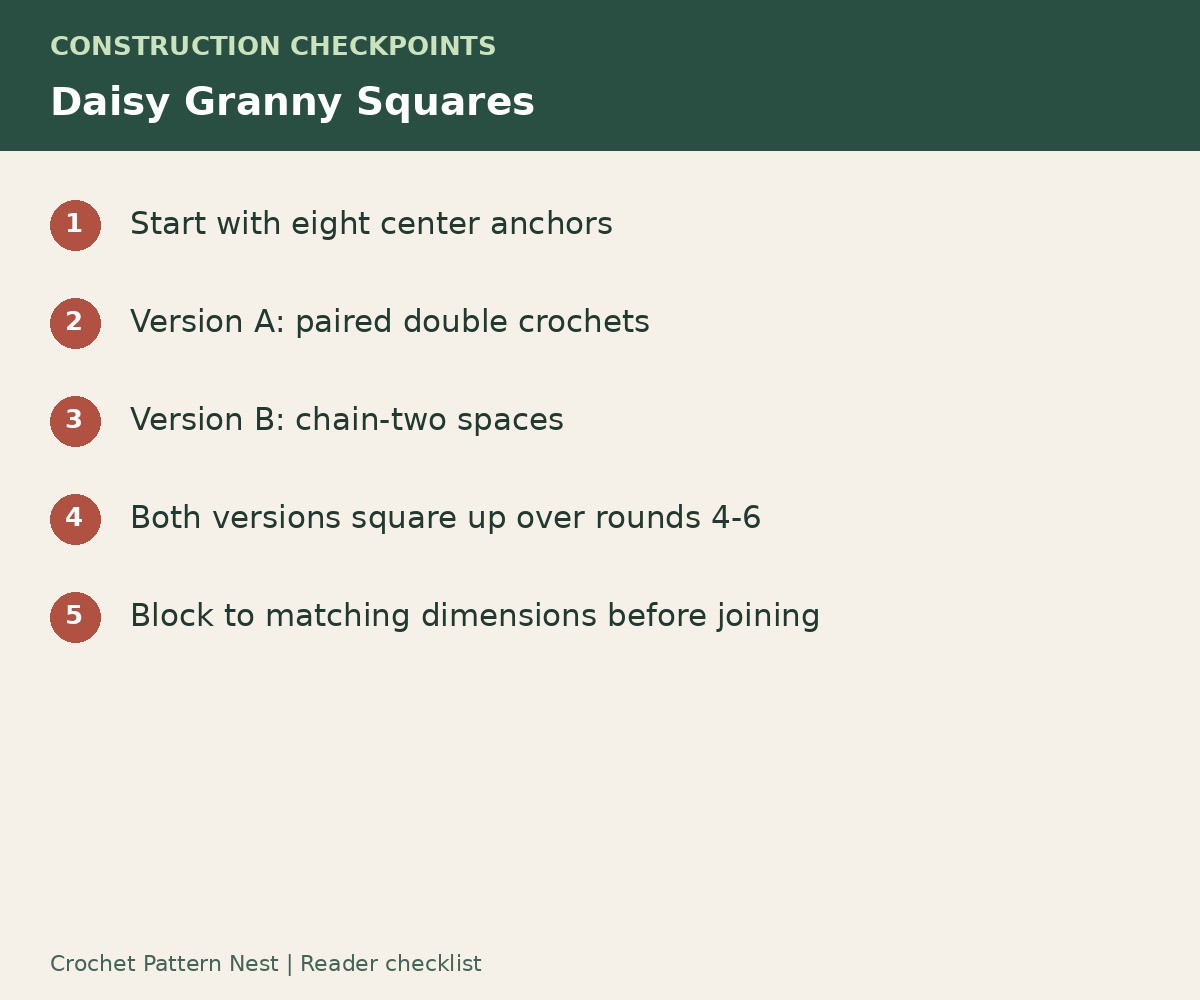
Lay squares flat with the corners at matching right angles and use a fiber-appropriate blocking method. Choose one target measurement for a joined project, then check every square against it. Stretching a small square forcefully to match a larger one can distort the daisy; adjust hook or tension on subsequent squares instead.
Keep the original source with your project for its yarn examples and designer terms. This article groups both center styles in one tutorial because they share the same final three rounds, rather than counting them as separate source files.
Frequently asked questions
What changes between the two versions?
The second round: version A uses paired dc with chain-one spaces, and version B uses single dc with chain-two spaces. They share rounds 4–6.
Why use eight actual sc in the center?
The source lists an eight-stitch total after chain 1 plus seven sc. Eight actual sc give the following round eight unambiguous anchors.
Can I mix both versions in one blanket?
Yes. Make them with compatible yarn and block to the same square size before joining.
Source and project reference
Daisy Granny Crochet Square by Barbara Summers / MiCrocknit Creations, 2008–2014. This article is a source-based crochet guide with its own explanations and clearly identified editorial clarifications. Project photographs and the original diagrams shown here come from the supplied source, with crops described in their captions.
Open the original Granny Squafe – Daisy.pdf reference in Drive — Whole PDF. Keep the original charts with your project, especially where this guide points to a pictured construction step.
Leave a Reply