Textured Crochet Dishcloths with Cluster Stitch Bands
· admin
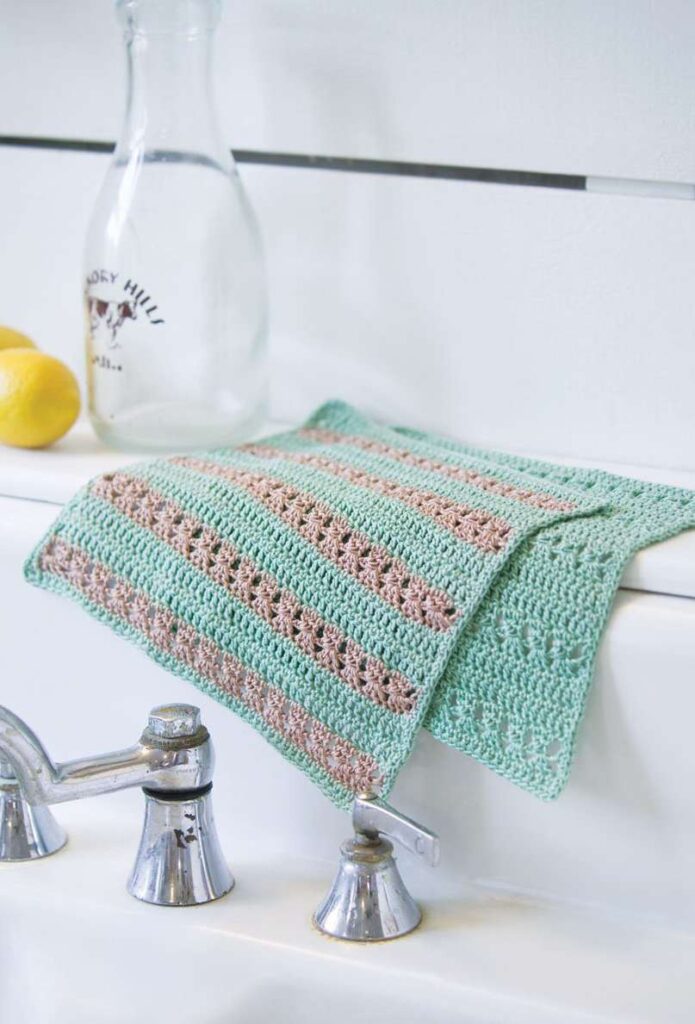
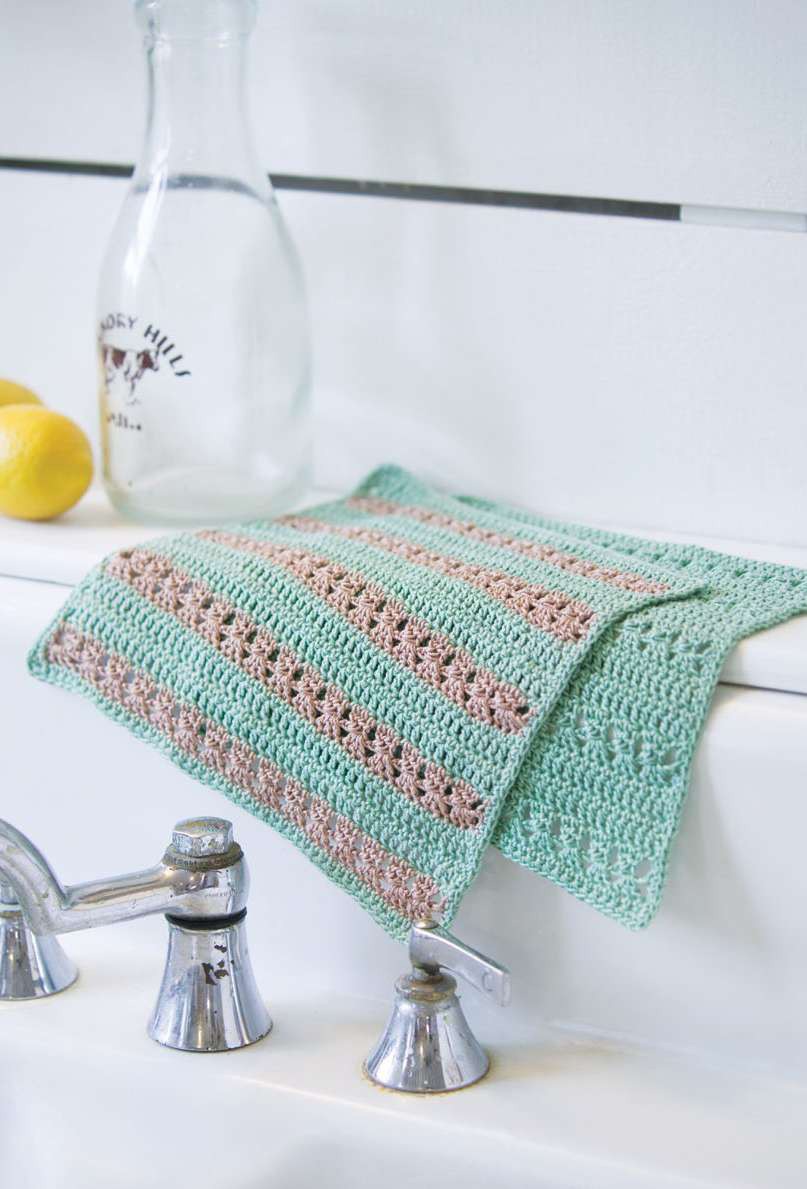
Textured crochet dishcloths combine flat stitch bands with rows of joined double-crochet clusters. The Red Heart source offers a solid sage version and a sage-and-tan version that uses color to emphasize the raised bands. Both start from the same foundation and finish with a single-crochet border. This guide maps the six-row sequence and explains how to read the counting chains without silently adding width to the cloth.
Materials and finished size
The original lists Aunt Lydia’s Fashion Crochet Thread Size 3 in Sage (625), with Tan (377) added for the striped version. Use a 3.5 mm / US E-4 hook. One ball is listed for the solid cloth, or one of each color for the striped cloth; the source does not give a measured gram consumption.
The nominal finished measurements are 9½ × 9 inches. The stated gauge is 21 dc per 4 inches. Use a thread of similar thickness and test a swatch if you want to match those dimensions. A much thicker kitchen cotton creates a different fabric and a larger cloth with the same foundation count.
Define the cluster correctly
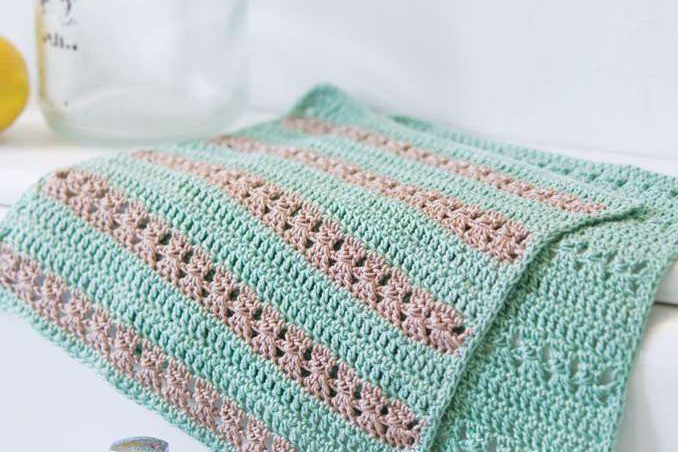
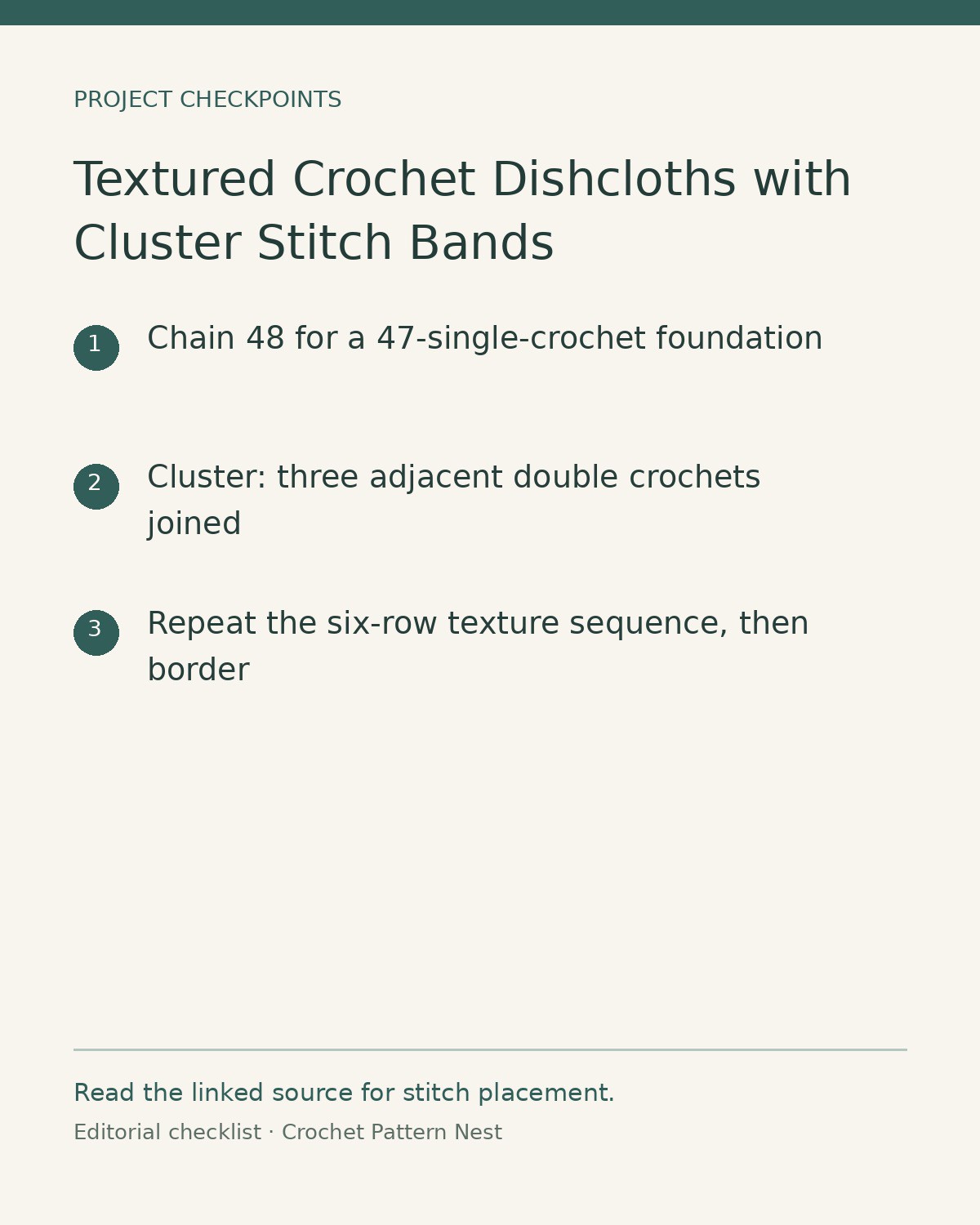
The chapter uses US terms. Its cluster is a dc3tog worked over three adjacent stitches: begin a dc in each of the next three stitches, retaining the final loop of each, then yarn over and draw through all four loops on the hook. It is not a bobble made by working several stitches into one base stitch.
That distinction matters because the cluster joins three incoming positions into one top. Chain spaces restore the spacing between clusters on the openwork row, and the following row builds the width back into a more solid fabric.
Read the foundation and counting chains
Start with ch 48. The first row works sc from the second chain for 47 sc. The source’s ch 2 counts as the first dc on the following dc rows. Mark that counted position so it does not disappear beside the first worked dc.
The wording later says dc in each sc without fully spelling out how the counted turning chain occupies the edge. Adding the counted chain and an additional dc indiscriminately can introduce an extra position. Check the edge convention against the complete source before repeating the textured section. This article is a source-reading guide rather than an independently tested replacement for that abbreviated wording.
Follow the six-row texture cycle
- The setup begins with the sc foundation and a dc row.
- Row three creates the cluster-and-chain-space band and finishes against the turning chain.
- Row four rebuilds grouped dc above the textured row, using the specific anchors in the original.
- Row five returns to sc. Row six is dc, row seven is sc, and row eight is dc with the taller turning chain needed for the next cluster row.
- Repeat rows three through eight three more times, then finish with rows three through five.
Keep printed page 37 open for the precise row-four anchor: the source specifies a first chain-space group and later groups at the designated cluster tops. Do not automatically replace that wording with a generic granny-cluster repeat, because the two fabrics have different structures.
Place the stripe colors
The striped version changes to the contrast color for the cluster band and returns to the main color at the end of the following grouped-dc row. The plain sc and dc bands remain in the main shade. Change color on the last pull-through of the final stitch, then leave a tail long enough to weave in securely.
There is a source typo referring to a final sc in a dc row. Read the actual stitch row, not that isolated label, when placing the color change. Keep the same body layout for both the solid and striped versions.
Border and finishing
Single crochet around the four edges, working three sc in each corner and distributing the row-end stitches evenly. Join to the first sc and fasten off. A flat cloth should remain flat after the border; reduce crowding along a ruffled side or relax a tight border before blocking. Weave in the tails and wash and dry according to the cotton-thread label.
Frequently asked questions
Is the cluster worked in one stitch?
No. It joins partial double crochets over three adjacent stitches.
What changes in the striped version?
The cluster band and following grouped-dc row use the contrast shade; the plain bands use the main color.
Why does the turning-chain convention matter?
The ch 2 counts as the first dc. Treating it as an uncounted extra chain can add an unwanted edge position.
Original source and more crochet projects
Design credit: Red Heart, Textured Dishcloths, J27.0002-6C; Crochet Guide printed pages 36–37. This article explains the supplied source and its construction; it does not claim an independently tested sample. The photographs are from that source, and the checklist is an editorial reading aid.
Open the original pattern in Drive. Source location: Printed pages 36-37; PDF pages 38-39. Keep the original instructions and diagrams beside you when working the project.
For another project, explore Anima Floris crochet coasters, or Strand Basket pattern.
Leave a Reply