Horizon Crochet Fingerless Gloves with Colorful Bobbles
· admin
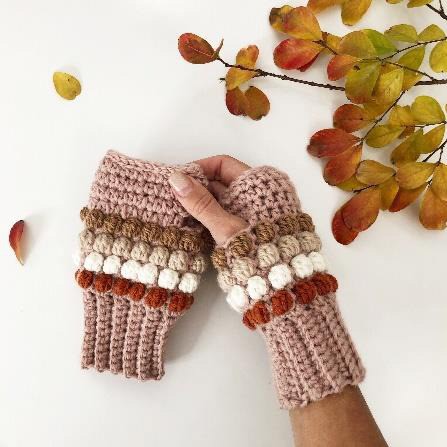
Horizon crochet fingerless gloves combine a narrow ribbed cuff with four bands of contrast bobbles. The Little Golden Nook source keeps the fingers free and places the thumb openings on opposite sides for the right and left hands. Its two-page pattern uses one main color and four small contrast amounts. This guide follows the 26-stitch body and explains how to carry the main color through each raised bobble without accidentally increasing the round.
Materials and fit
The source lists approximately 100 m of Aran / 10–12-ply yarn in the main color and 10 m of each of four contrast colors in a similar weight. Use a 5 mm hook and tapestry needle. A 4 or 4.5 mm hook is offered as an optional choice for a snugger cuff.
Only one size is given, with no finished hand circumference or numerical gauge. Try the cuff around the wrist before closing it, and try the glove on before completing the upper rounds. Changing yarn weight affects both warmth and fit; it is not a simple way to obtain a verified additional size.
Make the ribbed cuff
US sc means single crochet, hdc means half double crochet and scblo means single crochet in the back loop only. Begin with ch 11 and work ten sc from the second chain. Continue in back-loop sc for twenty-five rows total, turning after each row.
Join the final row to the foundation with slip stitches through the source’s selected loops. Turn the cuff so the outside is facing correctly. The body begins around a row-end edge, not along one of the ten-stitch cuff-width edges.
Establish the body count
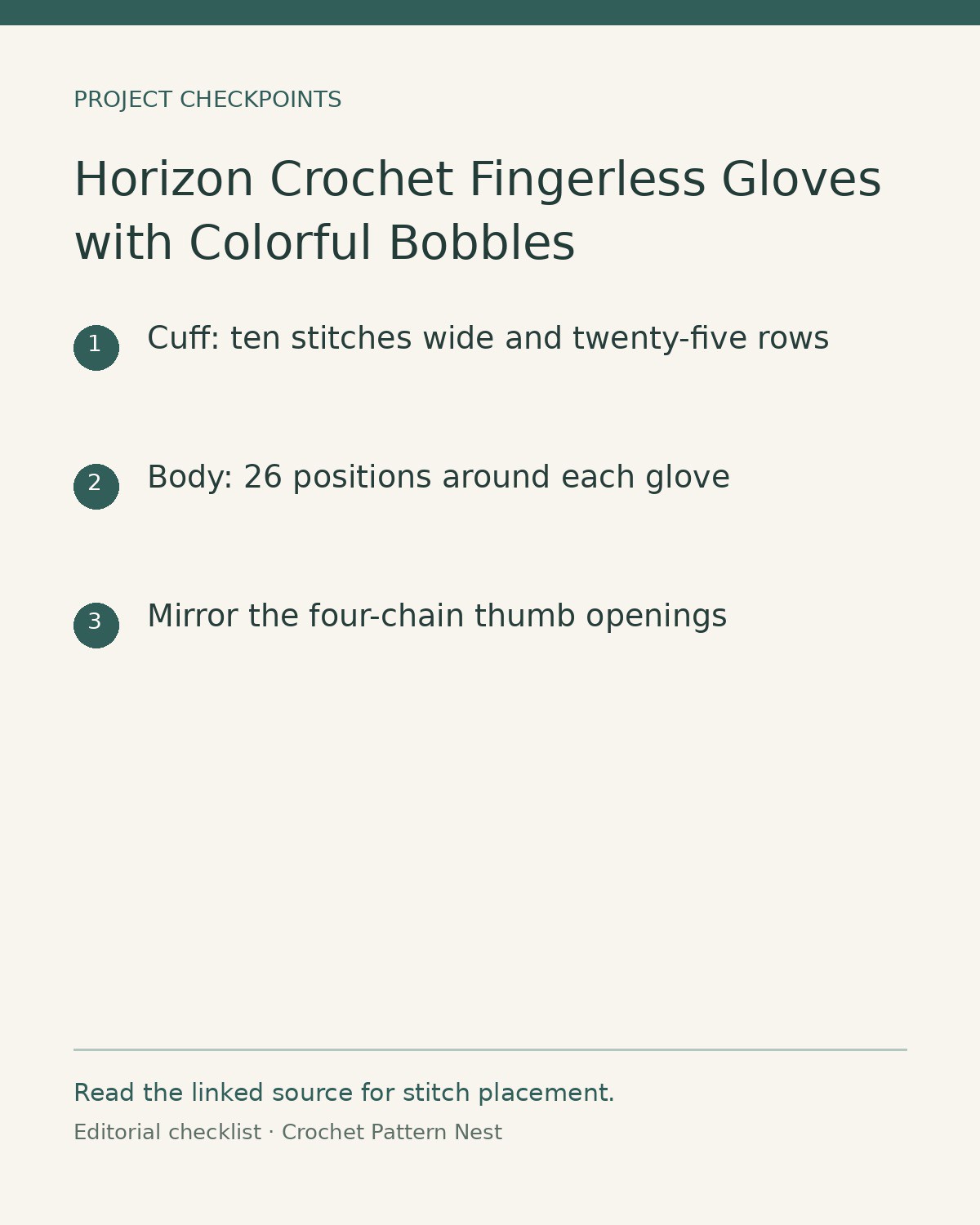
The first body round works around the cuff and includes the extra stitch at the starting-chain base described in the source. Its target is 26 sc. Mark the first stitch and count before beginning the bobbles. The cuff has twenty-five rows, but the written body target is 26 positions, which allows an even alternating bobble repeat.
The body rounds are joined with slip stitches and are not turned. Do not count those joining stitches as additional sc. One sc followed by one bobble repeats thirteen times around the 26-position circuit.
Work the contrast bobble bands
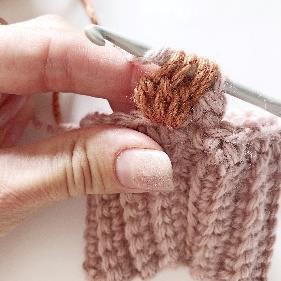
Each bobble joins four partially completed dc into one top. With the main-color loop still on the hook, use the contrast color for the four partial stitches, leaving four contrast loops plus the main loop. Draw the main color through all five loops to finish the bobble, ready to work the next sc in the main color.
- Body round two alternates main-color sc and contrast bobbles.
- Round three is plain main-color sc.
- Round four begins with a bobble and alternates bobble/sc, shifting the raised stitches relative to the previous band.
- Round five is plain sc. Rounds six to eight repeat the bobble/plain/bobble sequence.
Use your four contrast colors across the four bobble bands. Cut each contrast when its band is finished and leave enough tail to weave in securely. Keep the carried main-color strand relaxed behind the bobble so it does not pinch the glove.
Mirror the thumb openings
For the right glove’s ninth body round, work hdc until four stitches remain, chain four and join back to the round start. For the left glove, begin with one hdc, chain four, skip four positions and continue hdc around. The opening therefore moves to the opposite side rather than being repeated in the same location.
The next round works hdc into the existing stitches and each chain of the four-chain bridge, preserving 26 positions. Add the two further hdc rounds, then the slip-stitch finishing round. Weave in all ends and check both gloves on the hands before trimming the tails close.
The source photos show the actual cuff seam and bobble-making stages. Use the linked pattern for the precise joins, and keep both thumb openings visible side by side when checking the finished pair.
Frequently asked questions
How many bobble bands are there?
Four, on body rounds two, four, six and eight, separated by plain single-crochet rounds.
Why is the body count 26 when the cuff has 25 rows?
The source includes an additional stitch at the starting-chain base when establishing the first body round.
Are both thumb holes made in the same place?
No. The right opening comes at the end of round nine; the left opening follows the first hdc.
Original source and more crochet projects
Design credit: Little Golden Nook, Horizon Fingerless Gloves. This article explains the supplied source and its construction; it does not claim an independently tested sample. The photographs are from that source, and the checklist is an editorial reading aid.
Open the original pattern in Drive. Source location: Whole PDF. Keep the original instructions and diagrams beside you when working the project.
For another project, explore Anima Floris crochet coasters, or Strand Basket pattern.
Leave a Reply