Furrylicious Crochet Baby Boots with Loop Stitch Cuffs
· admin
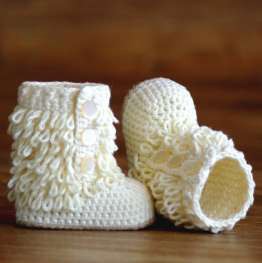
These Furrylicious crochet baby boots have a smooth lower foot and a textured leg worked with loops of yarn. This article follows the source’s 0–6 month version, with an approximate 3.75 in / 9.5 cm sole. The ankle contains an overlapping section, so the number of stitches worked during that transition is different from the number around the opening. Both boot directions are included.
Materials, Gauge and Size
Worsted yarn: approximately 1 oz / 28 g for sole color A and 3.5 oz / 99 g for upper color B, a 3.75 mm / F hook, six half-inch buttons, needle, scissors and markers. The source sample uses Knit Picks Shine Worsted cotton. Gauge: five sc per inch. Choose by measured foot length and opening fit, since the source age range is broad. The source also has a larger size; its counts are not mixed into this smaller pair.
Stitches and Pattern Notes
US crochet terms: ch = chain; sc = single crochet; hdc = half double crochet; dc = double crochet; tr = treble crochet; sl st = slip stitch; st = stitch; sp = space; BLO = back loop only; inc = 2 stitches in one stitch. Sc2tog, hdc2tog and dc2tog combine two neighboring stitches into one. A number before a stitch tells you how many consecutive stitches to work. Parentheses followed by a repeat number describe one complete group repeated that many times.
Step 1: Learn the Loop Stitch and Round Starts
Insert the hook into the next stitch. Wrap the working yarn around your index finger to form a loop, then draw both strands at the base of that loop through the fabric. There are three strands on the hook. Remove your finger, yarn over and pull through all three strands. Keep the loop on the outside of the boot. The reference loops are about three-quarters of an inch long; uniform length matters more than pulling them tightly.
Starting ch 1 or ch 2 does not count in this pattern. Join to the first working stitch. Keep the first stitch at the center heel: if the seam shifts by one position, begin in the next stitch and work the skipped position at the end. Mark the center before every shaping round so the toe decreases stay at the front.
Step 2: Crochet Two Soles
| Row / round | Instructions | Count / note |
|---|---|---|
| 1 | In A, ch 13. Two hdc in third chain, 9 hdc, 4 hdc in last chain; along opposite side work 9 hdc and 2 hdc in starting end. Join. | 26 |
| 2 | Ch 1; inc-sc in first 2 stitches, 4 sc, 5 hdc, inc-hdc in next 4, 5 hdc, 4 sc, inc-sc in last 2. Join. | 34 |
| 3 | Ch 1; 2 sc, inc-sc, 9 sc, 3 hdc, inc-hdc in next 2, 2 hdc, inc-hdc in next 2, 3 hdc, 9 sc, inc-sc. Join and fasten off. | 40 |
| 4 | With sole wrong side facing, join B at center heel; slip stitch around the edge and join. | 40 |
In this table “inc-hdc” means two hdc in one stitch, and “inc-sc” means two sc in one. The initial skipped chains on Round 1 supply height only. Make the second sole now and compare their length before building the uppers.
Step 3: Raise and Shape the Foot
| Row / round | Instructions | Count / note |
|---|---|---|
| 5 | Ch 1; sc into each of the forty slip stitches, without catching the sole stitches below. Join. | 40 |
| 6–7 | Ch 1, sc around and join. | 40 |
| 8 | Dec, 14 sc, (dec, 2 sc) twice, dec, 14 sc. Join. | 36 |
| 9 | 12 sc, dec, sc, dec, 2 sc, dec, sc, dec, 12 sc. Join. | 32 |
| 10 | 6 loop stitches, 4 sc, dec, sc, dec, 2 sc, dec, sc, dec, 4 sc, 6 loop stitches. Join; fasten off. | 28 |
Step 4: Form the First Boot’s Overlapping Ankle
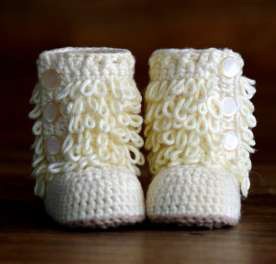
Count nine stitches from center heel toward the side and mark the ninth; attach in the next stitch toward the toe. With the hook passing from inside to outside, work five sc2tog across the centered ten front stitches. This is Row 11, with five stitches; turn.
Row 12: ch 1, sc in the first stitch and mark it, sc2tog, then two sc. Step down into the marked side stitch and work eighteen sc around the remaining lower opening. Step back up and work five sc across the overlapping front, beginning at the marked front stitch, then turn. You have made twenty-seven stitches during the pass, but the overlap leaves only twenty-two positions around the ankle. Do not try to turn all twenty-seven into a new independent circumference. Row 13: ch 1, loop stitch across those twenty-two opening positions; turn.
Step 5: Work the First Leg and Button Band
| Row / round | Instructions | Count / note |
|---|---|---|
| 14 | 11 sc, inc, then sc to end; turn. | 23 |
| 15 | Loop stitch across, replacing final two stitches with sc; turn. | 23 |
| 16 | 11 sc, inc, sc to end; turn. | 24 |
| 17 | Loop stitch across, final two stitches sc; turn. | 24 |
| 18 | Sc across; turn. | 24 |
| 19 | Loop stitch across, final two stitches sc; turn. | 24 |
| 20 | Sc across; turn. | 24 |
| 21 | Loop stitch across, final two stitches sc; turn. | 24 |
| 22 | Ch 2, 2 dc, then alternate front-post dc and back-post dc across. Do not turn. | 24 |
Begin ordinary leg rows with an uncounted ch 1. For a front-post dc, pass the hook around the stitch post from the front; for a back-post dc, pass around it from the back. After Row 22, work down the adjacent side edge: ch 1, distribute twelve sc, turn. Buttonhole row: sc, ch 2, skip two, two sc, ch 2, skip two, two sc, ch 2, skip two, sc; turn. Final row: twelve sc, working two into each ch-2 space. Fasten off.
Step 6: Mirror the Second Boot
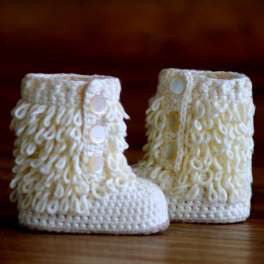
Repeat sole and foot Rounds 1–10. Mark the ninth stitch from heel on the opposite side and join in the next toward the toe. Work Row 11’s five decreases from outside to inside this time; mark the following lower-edge stitch and turn. Row 12: ch 1, sc, sc2tog, two sc, then one sc down into the marked side position. Turn, ch 1, five sc across the front; step down with one sc at the other marked side and sixteen more sc around the boot, then turn. The opening again has twenty-two positions. Row 13: twenty-two loop stitches and turn.
Mirror the first leg by placing the increases after twelve sc in Rows 14 and 16, and by working two sc first, followed by loop stitches, on Rows 15, 17, 19 and 21. Plain Rows 18 and 20 stay at twenty-four sc. Row 22: ch 2, alternate front- and back-post dc until two stitches remain, then two dc. Fasten off. Rejoin at the beginning of that row to work twelve sc down the side and the same three-row buttonhole band.
Sew three buttons opposite each set of holes. Check that the openings face opposite sides when the boots sit as a pair, and that the smooth two-stitch bands line up with those openings. Secure buttons firmly and hide all tails. Straighten the loops gently with a spare hook, avoiding pulling yarn out of the fabric.
Frequently Asked Questions
Which size is written here? The source’s smaller 0–6 month version, approximately 9.5 cm long at its gauge.
Why does Row 12 mention twenty-seven stitches but a twenty-two-stitch ankle? Five stitches are worked over an overlapping front section; they do not all add to the opening circumference.
Do I make the two legs identically? The foot is identical, but the overlap, plain edge stitches and button openings are mirrored.
More Baby Crochet Ideas
Browse our Crochet Baby collection, compare baby bootie patterns, or explore baby cardigan ideas. Save the project to Pinterest before gathering your yarn.
Pattern and Photo Credits
Adapted from the supplied Furrylicious Loop Baby Boots.pdf. Pattern and photographs: supplied Furrylicious Loop Baby Boots PDF, The Furrylicious Baby Boot. Source photographs show the reference samples; captions identify any detail crops. This written adaptation has been reviewed against the supplied pattern pages but has not been physically crocheted or maker-tested. Yarn substitutions and tension can change the result.
Leave a Reply