Filigree Crochet Bookmarks with an Openwork Border
· admin
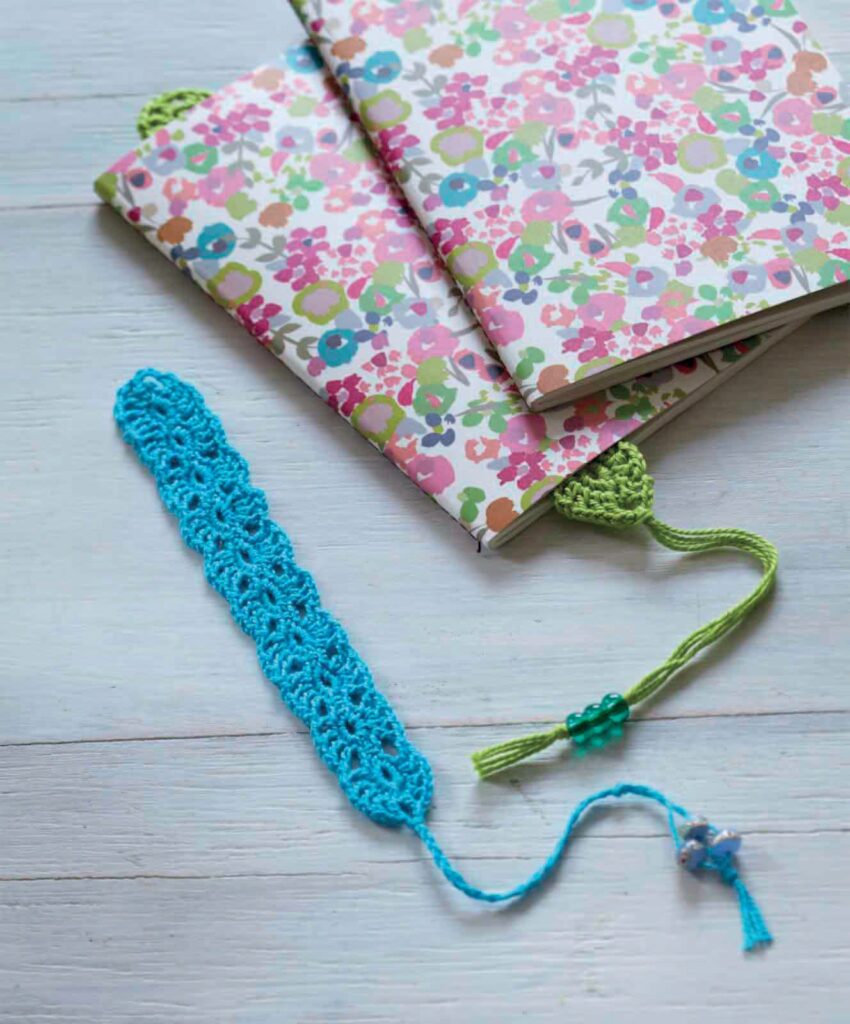
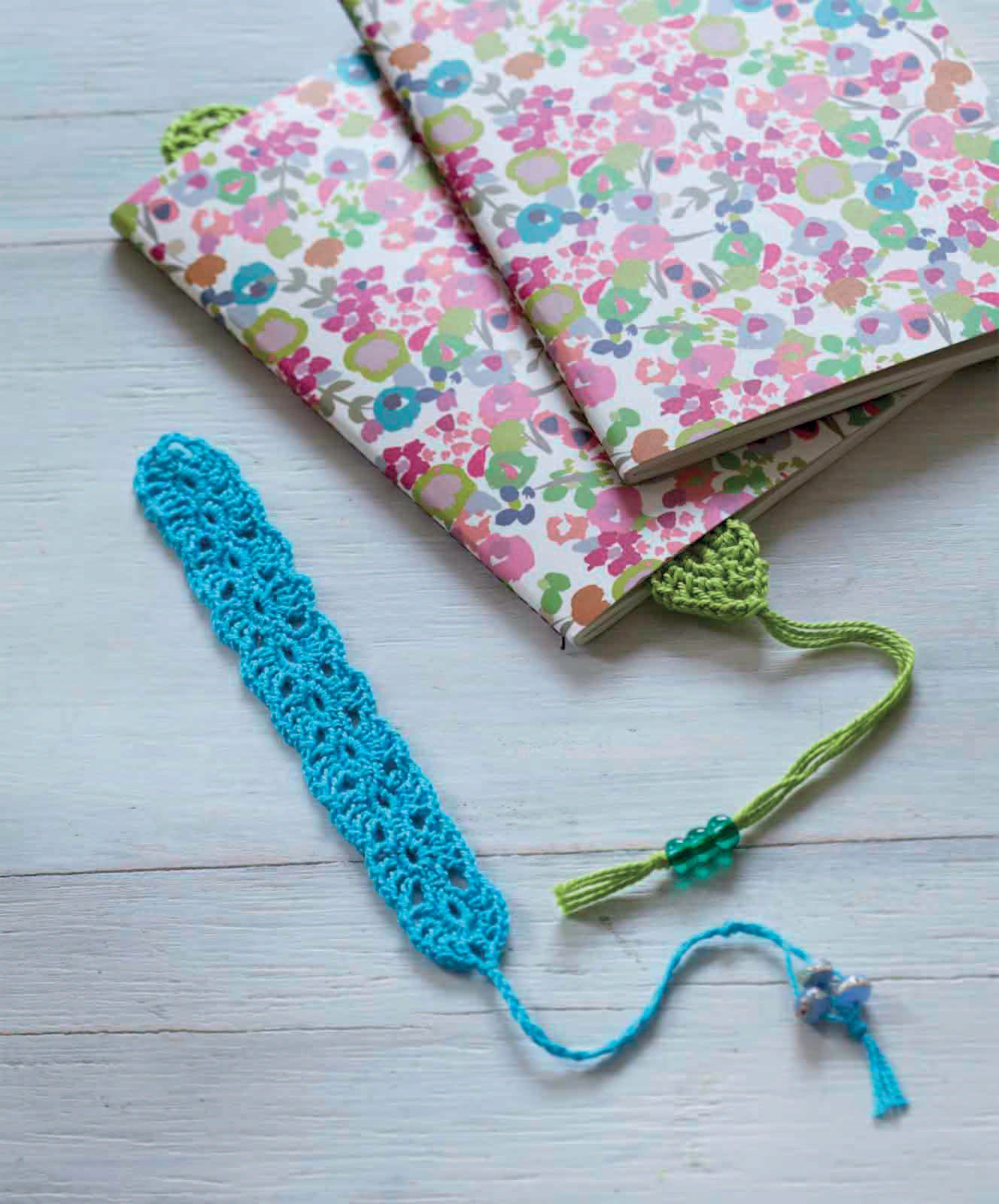
Filigree crochet bookmarks use a narrow double-sided foundation and a second round of openwork to create a delicate lace strip. The source shows a small blue version and a larger green one made from different cotton thicknesses. The same construction changes scale through the yarn and hook, rather than through a completely different pattern. This guide explains the two-round route and the long tassel, with the original book pages linked for the abbreviated repeat.
Choose the cotton and hook
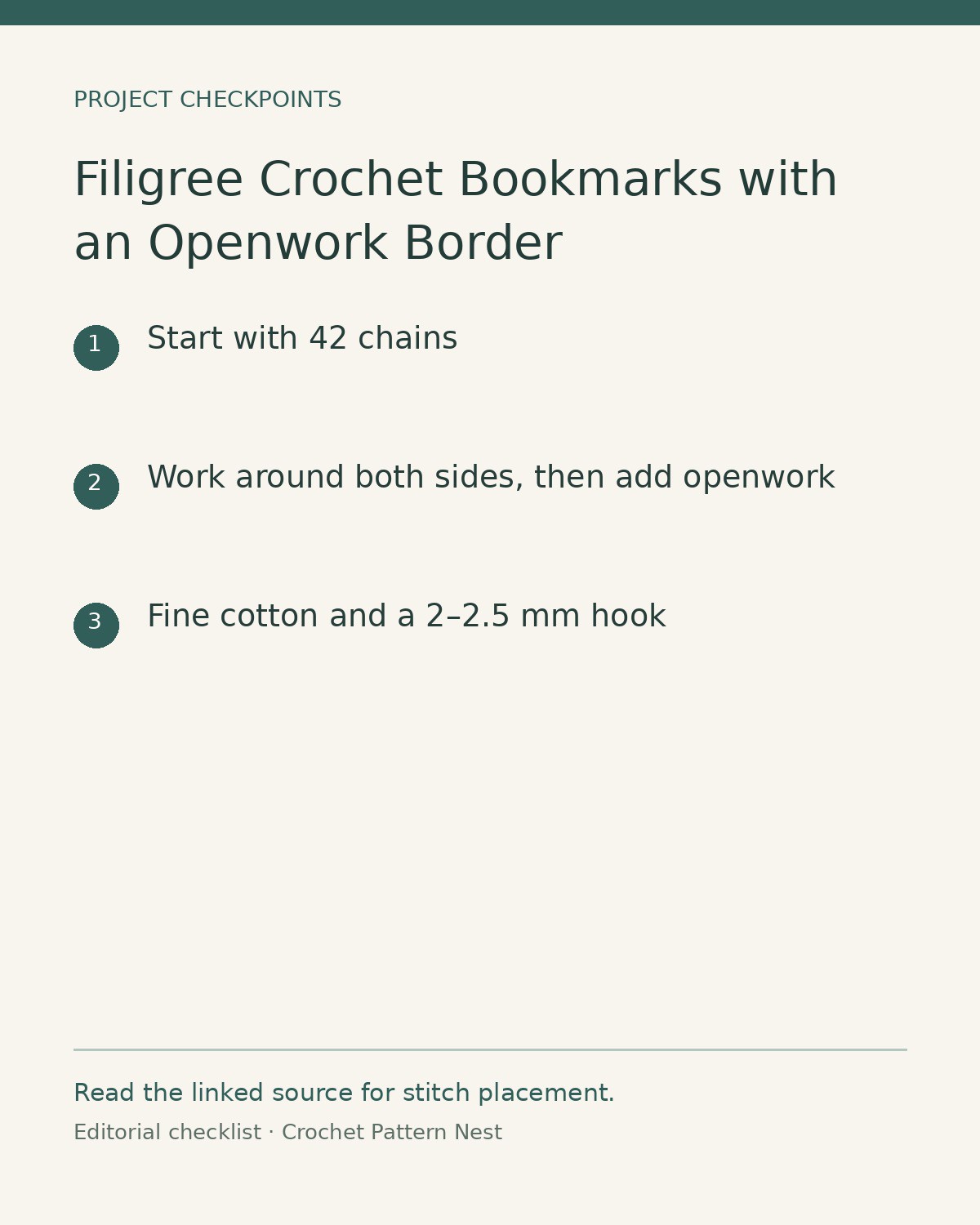
The smaller sample uses size-eight pearl cotton, listed at 90 m per 10 g, and a 2 mm steel hook. The larger sample uses Rowan Siena 4 Ply, 140 m per 50 g, with a 2.5 mm hook. Small leftover amounts are enough for the intended project, although the source does not specify an exact consumption weight.
The approximate strip size is 18 × 2 cm, with an additional 18 cm tassel. Exact gauge is not essential. That does not mean yarn thickness has no effect: the photographs deliberately demonstrate a different size from each cotton and hook combination.
Gather a fine yarn needle, scissors and optional beads. Keep the decorative beads at the tassel end outside the book rather than pressing them between closed pages. A smooth cotton makes the small chain spaces easier to identify and produces a less bulky strip.
Understand the stitch language
This chapter uses US sc for single crochet and dc for double crochet. The first round creates groups of six sc with narrow anchors between them. The second round distributes dc and chain-one spaces over those groups to turn the solid scallops into lace.
Read the repeat once before starting. One foundation-chain line refers to a next sc even though that section is still working into the chain. That is inconsistent wording in the source. Use the surrounding chain positions and the complete book layout to check the intended anchor rather than looking for a nonexistent previous-row stitch.
Follow the two-round route
- Make the source’s 42-chain foundation with the hook chosen for your cotton.
- Begin the first six-sc group near the start, leaving the specified skipped chains between the following anchors and groups.
- At the far end, work the paired six-sc groups and chain space that turn the strip around.
- Rotate the work 180 degrees and travel back through the unused foundation loops. Join the returning edge to the start.
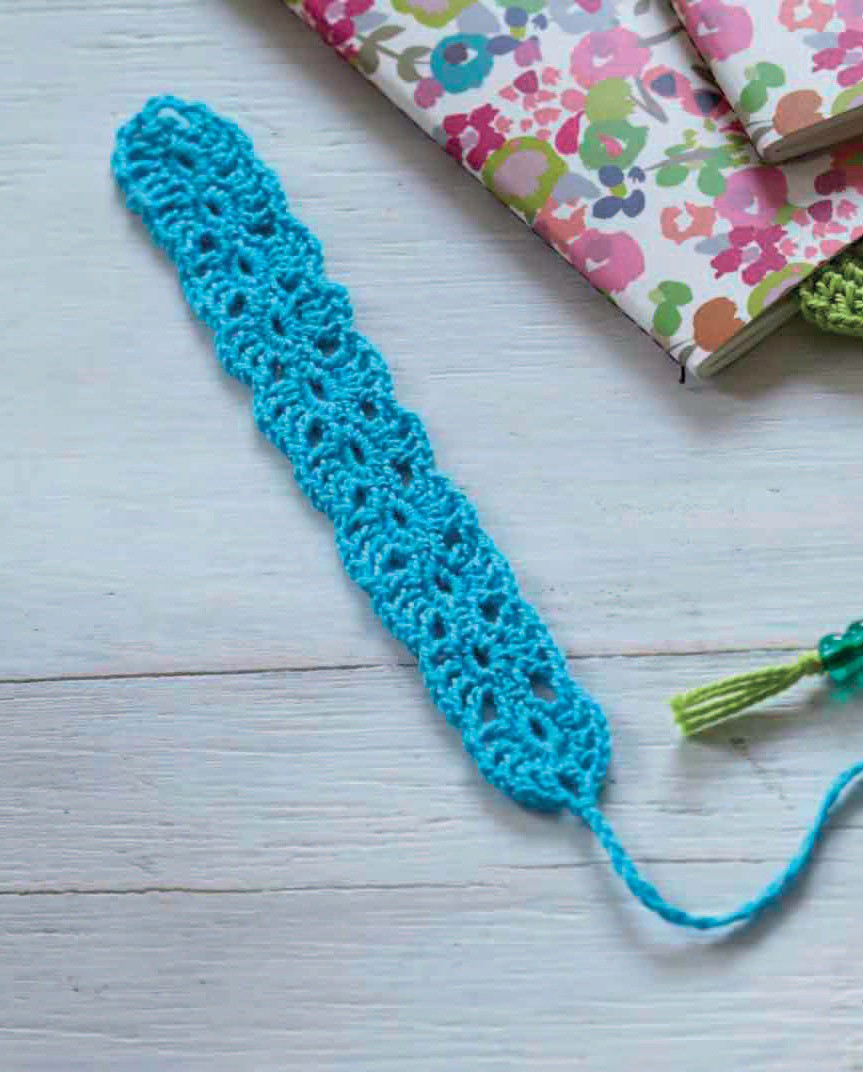
- Work the second openwork round over the first-round groups, following the original’s dc-and-chain spacing. Finish the end chain space and join.
The exact second-round sequence uses several repeat markers. Keep printed page 178 open for those placements; the facing page supplies the photographed result. This is a source-reading guide, not a new claim that the compressed repeat has been tested or corrected in full.
Add the tassel
The source cuts two 36 cm lengths and folds them in half. Pass the folded loop through the three-chain space at one end of the bookmark, draw the loose ends through the loop and tighten gently. The doubled lengths produce an approximately 18 cm tassel before trimming or braiding.
Braid the strands if you want a more compact tail, or leave them loose for a lighter finish. Optional beads are secured at their ends with knots sized to keep the beads from sliding off. Do not pull the tassel knot so firmly that it gathers the lace at the bookmark tip.
Block without flattening the lace
Weave in the beginning and ending tails along the denser stitch groups. Dampen the cotton as its label permits, smooth the strip into an even shape and open the two rows of scallops gently. Let it dry fully away from the book.
To make a coordinated pair, use the same cotton and hook in two shades. To recreate the size contrast in the source, change the cotton thickness and its matching hook together. Check the actual finished length before adding the tassel to a particular notebook or novel.
Frequently asked questions
Is the tassel included in the 18 cm strip length?
No. The source lists an approximately 18 cm strip and a separate 18 cm tassel.
Why are the two photographed bookmarks different sizes?
They use different cotton thicknesses and hook sizes while following the same design.
Does the first-round wording contain an issue?
One foundation anchor is called a sc even though it is worked along the starting chain. Use the full source layout to interpret it.
Original source and more crochet projects
Design credit: Filigree bookmarks, Crochet Colors Theory, printed pages 178–179 / PDF pages 180–181. This article explains the supplied source and its construction; it does not claim an independently tested sample. The photographs are from that source, and the checklist is an editorial reading aid.
Open the original pattern in Drive. Source location: Printed pages 178-179; PDF pages 180-181. Keep the original instructions and diagrams beside you when working the project.
For another project, explore Anima Floris crochet coasters, or Strand Basket pattern.
Leave a Reply