Color Block Crochet Coasters with a Five-Color Square
· admin
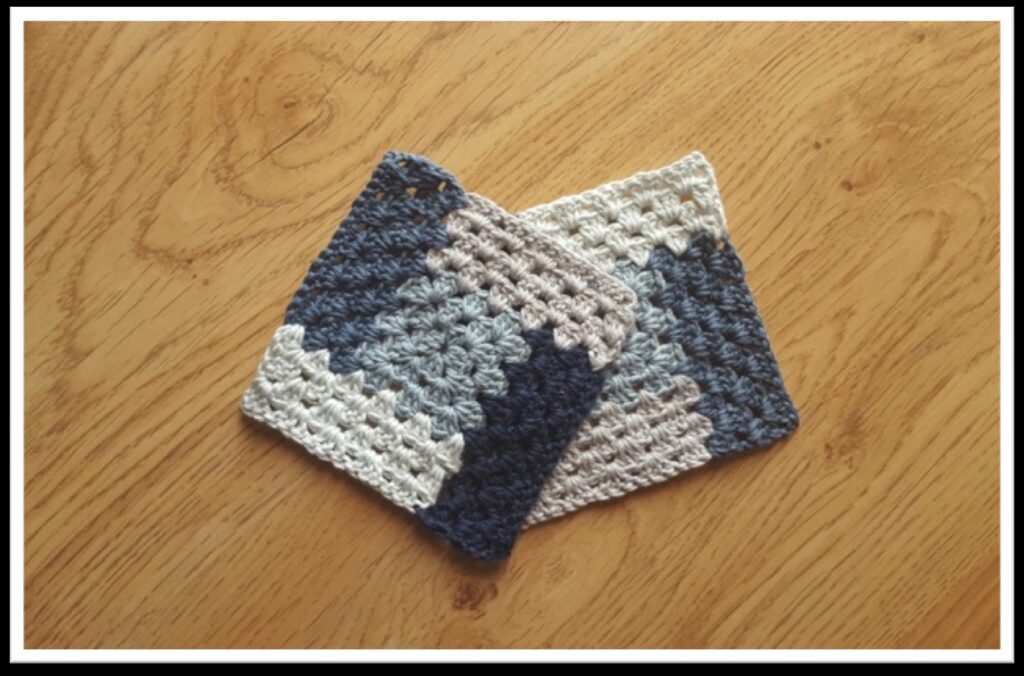
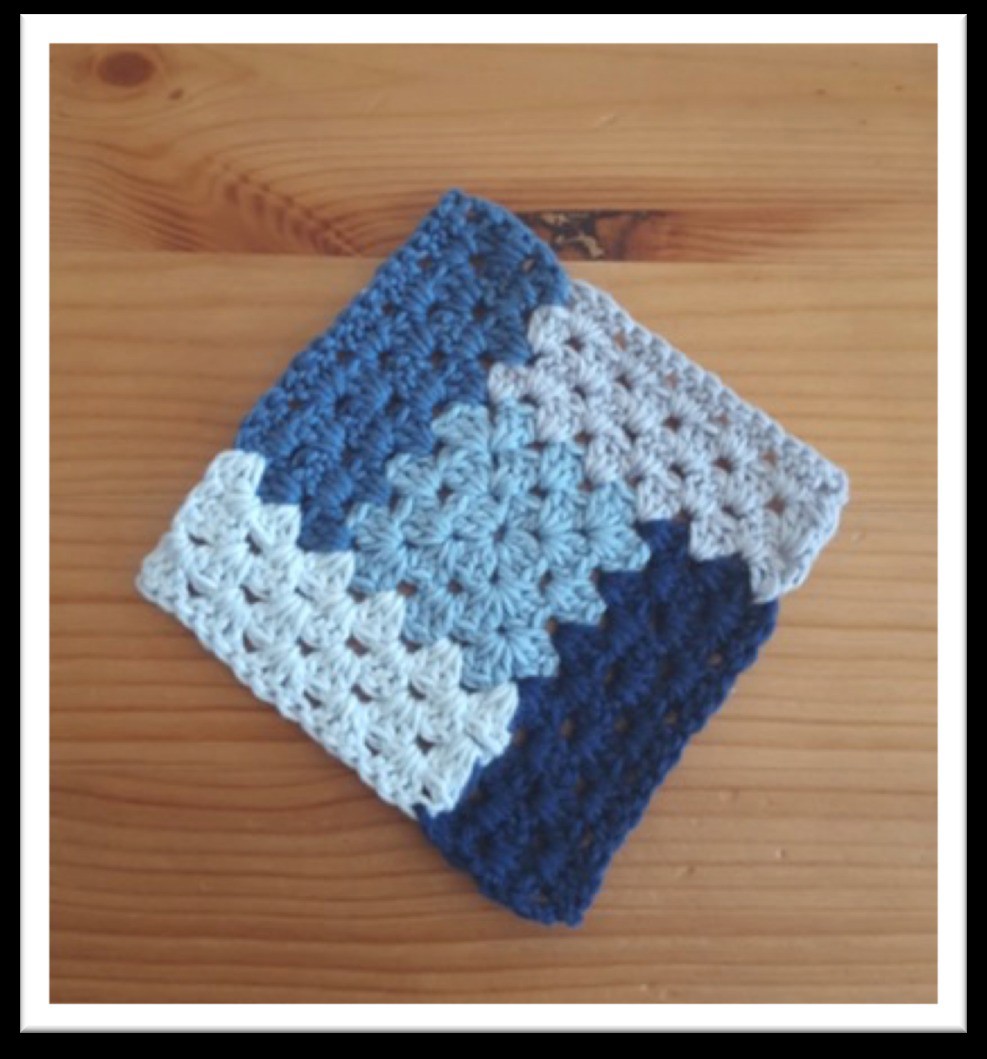
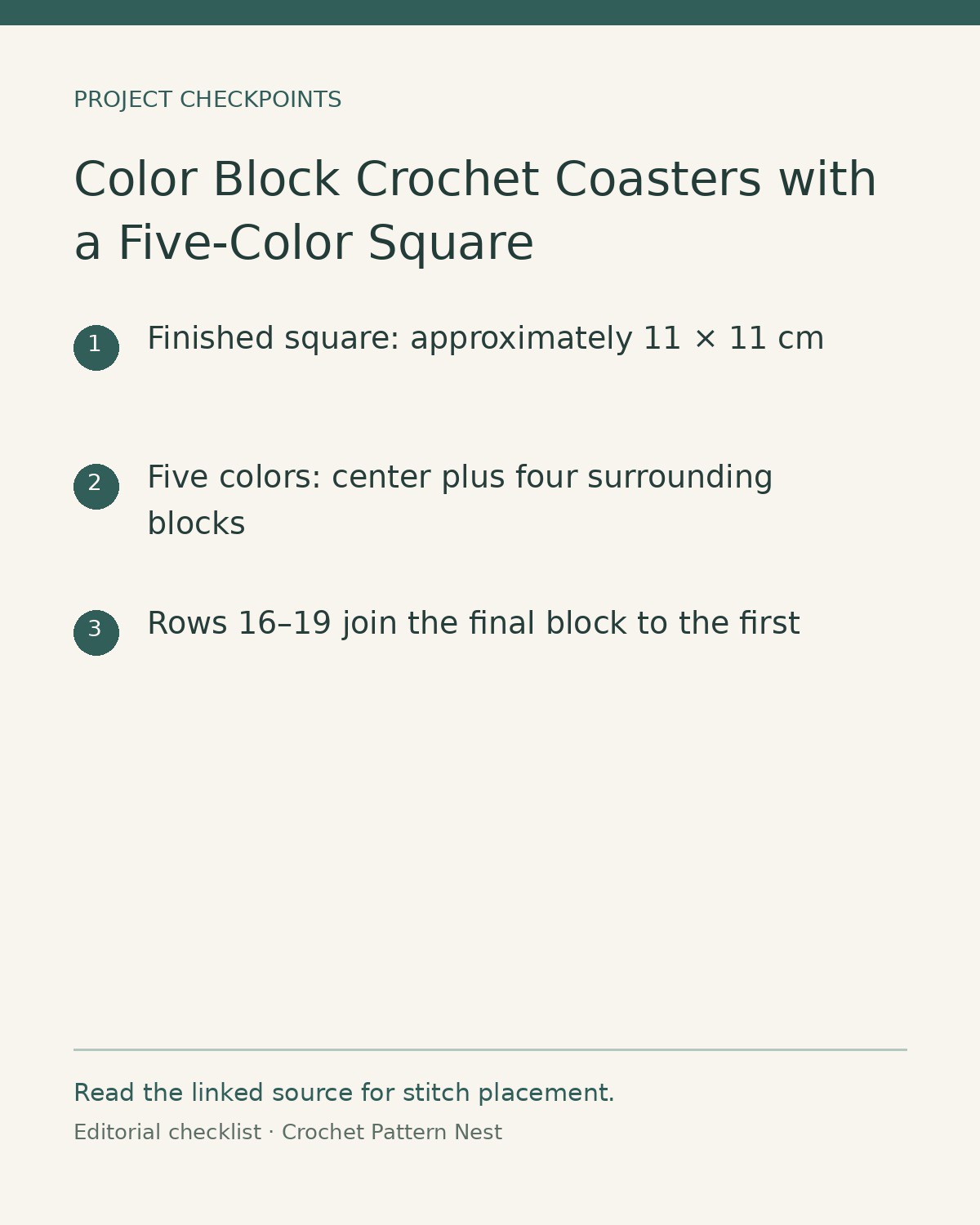
Color block crochet coasters give a familiar granny stitch a different geometry. A small three-round center is surrounded by four colored strips that turn around the square, creating a pinwheel-like arrangement without sewing several separate squares together. The Really Crafty Store’s photo tutorial uses five related blue and grey shades. This guide maps its nineteen numbered rows and explains the final join, where the last block connects to the edge of the first.
Materials and sample size
The source uses five shades of 100% cotton yarn: Hobbii Rainbow 8/4 in colors 27, 30, 16, 29 and 26, labeled A through E. It chooses a 2 mm hook for a close fabric even though the yarn’s usual suggested hook range is larger. The estimated finished coaster is 11 × 11 cm, approximately 4.3 inches square.
The yarn allowance is printed as approximately 10 g of each color per coaster. Treat that as the source’s allowance, not as a measured consumption claim from this article. You also need scissors and a yarn needle for the several color ends. Keep the yarn thickness consistent across all five shades.
Read the layout before starting
The PDF uses US dc for double crochet, ch for chain and sst for slip stitch. It calls both circular passes and back-and-forth passes rows. The first three passes form the center square; the later sections are worked in turned rows. This change in direction is what gives the design its block structure.
Choose your darkest and lightest shades before crocheting. The sample places A in the center, then B, C, D and E around it. Lay small yarn snippets in that order to check the contrast. If two adjacent colors are nearly identical, the individual blocks will be less visible even when the stitches are correct.
Construction map
- Rows 1–3, color A: work the small granny square around a magic ring. The source counts its opening ch 3 as a dc plus a corner chain space. Keep the four corners distinct as the side groups increase.
- Rows 4–7, color B: start at a corner and make the source’s chain-eleven extension. Work granny groups back along it and along the existing side. Turn for the following rows, alternating grouped stitches and the prescribed end dc.
- Rows 8–11, color C: begin at the edge of the completed B section. Extend the next side with another four-row block.
- Rows 12–15, color D: repeat that side-building approach around the next edge.
- Rows 16–19, color E: complete the last block, catching the corresponding edge chains of B as directed in the close-up photos.
The chain-extension positions and final catching points are illustrated throughout PDF pages eight to twenty-one. Keep those pictures beside you. This article explains the route through the construction; it does not replace the source’s close-up placement photographs with an invented generic granny-square border.
Make the last join tidy
During the final E block, the last dc on one pass catches the appropriate B edge chain. The return pass also links into the corresponding B edge. Check the fabric from the right side after each join: it should close the gap between blocks without pulling a diagonal ridge across the square.
Do not sew the last side shut early. The original completes that connection as it crochets. A marker in the first B edge chain can make it easier to find the matching point when you return with E several sections later.
Finish a flat set
Weave each color tail into its matching section, moving back through several stitches. Block the square gently according to the cotton label, keeping all four outside corners at right angles. If one block is longer than its neighbor, check its row count and the placement of the edge dc before trying to stretch the whole piece square.
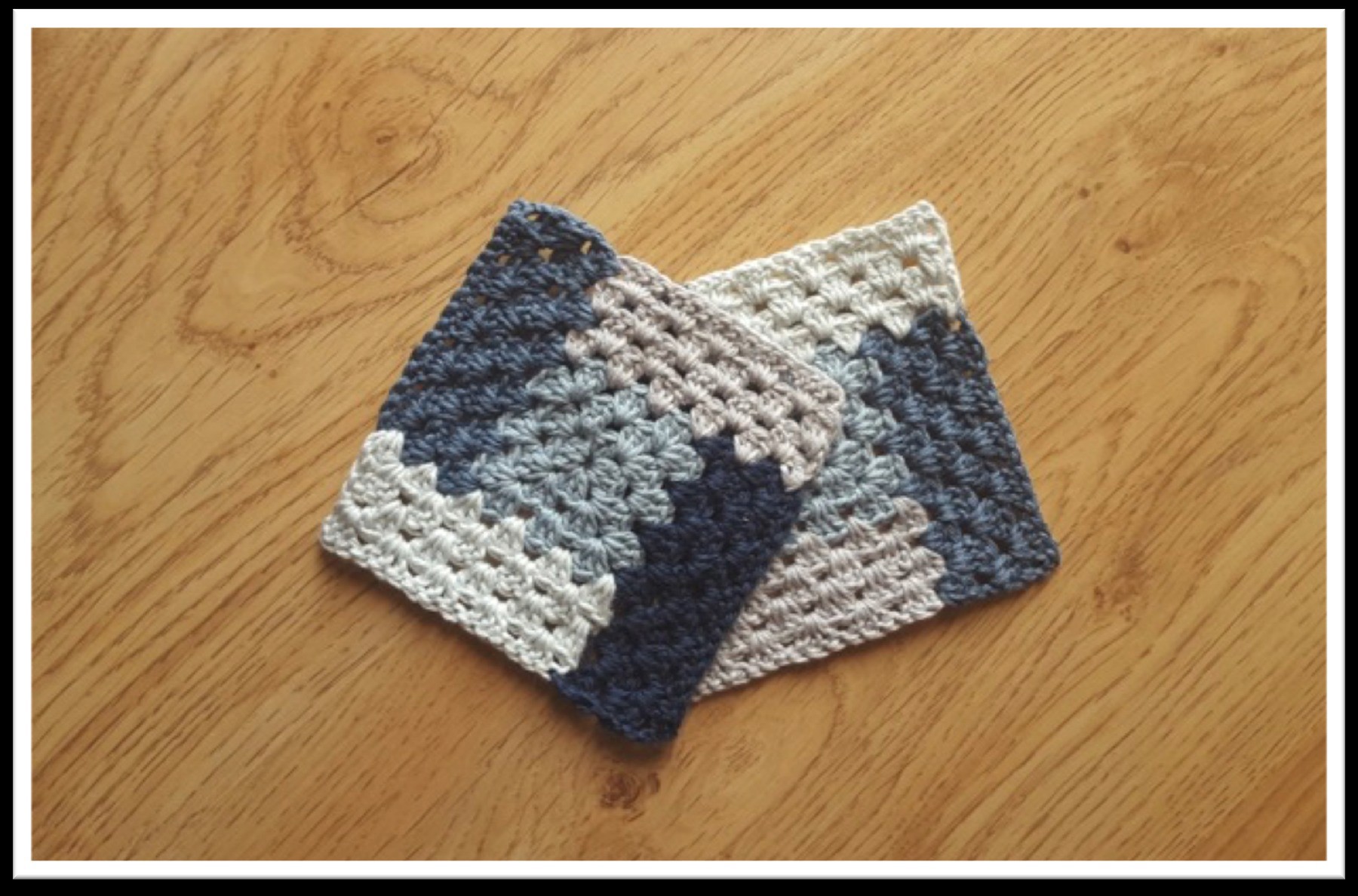
Make a second coaster with the same color order for a matching pair, or rotate the order while retaining the same yarn and hook. The source photographs demonstrate the five-block layout; the editorial checklist is a construction summary, not an extra stitch chart.
Frequently asked questions
Is this made from five separate squares?
No. A central granny square is extended with four colored blocks, and the final block joins to the first as you work.
Which rows complete the final join?
Rows sixteen through nineteen connect color E to the corresponding edge of color B.
Can I use fewer colors?
Yes, but using the same shade for adjacent blocks makes the pinwheel-like layout less distinct.
Original source and more crochet projects
Design credit: The Really Crafty Store, Color Block Square Crochet Coasters (2020). This article explains the supplied source and its construction; it does not claim an independently tested sample. The photographs are from that source, and the checklist is an editorial reading aid.
Open the original pattern in Drive. Source location: Whole PDF. Keep the original instructions and diagrams beside you when working the project.
For another project, explore Anima Floris crochet coasters, or Strand Basket pattern.
Leave a Reply