Chunky Striped Crochet Scarf Pattern: Lengthwise Half Double Crochet
· admin
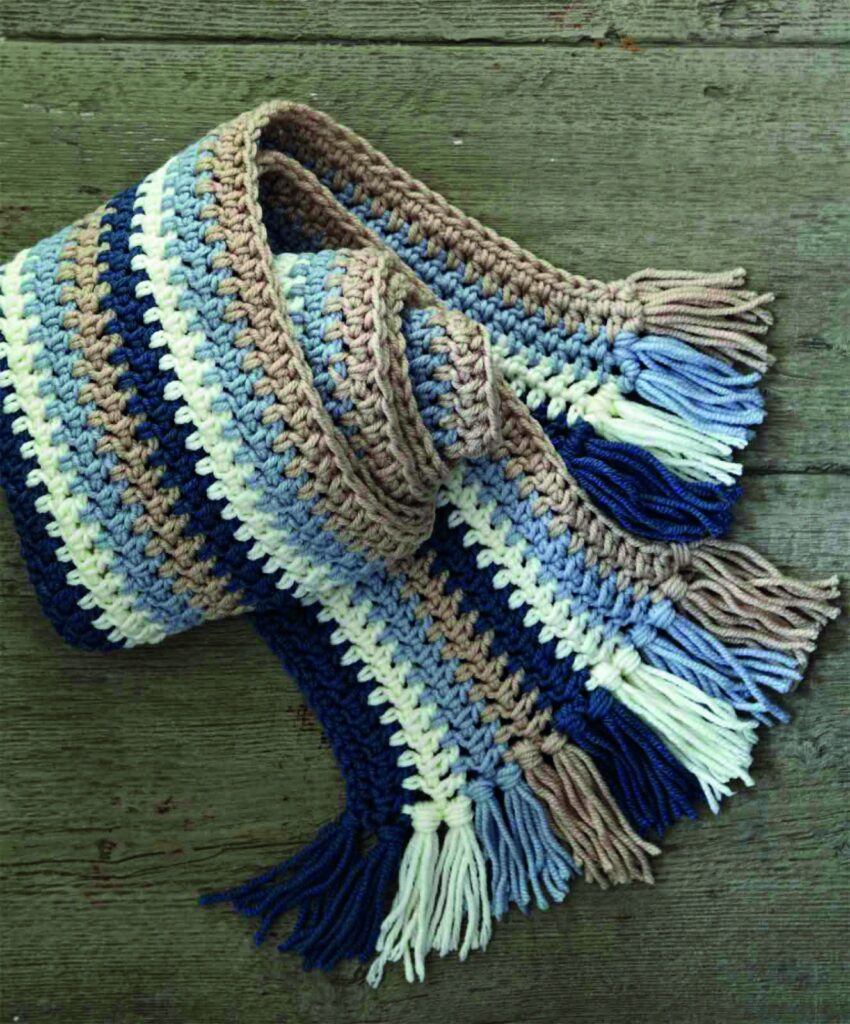
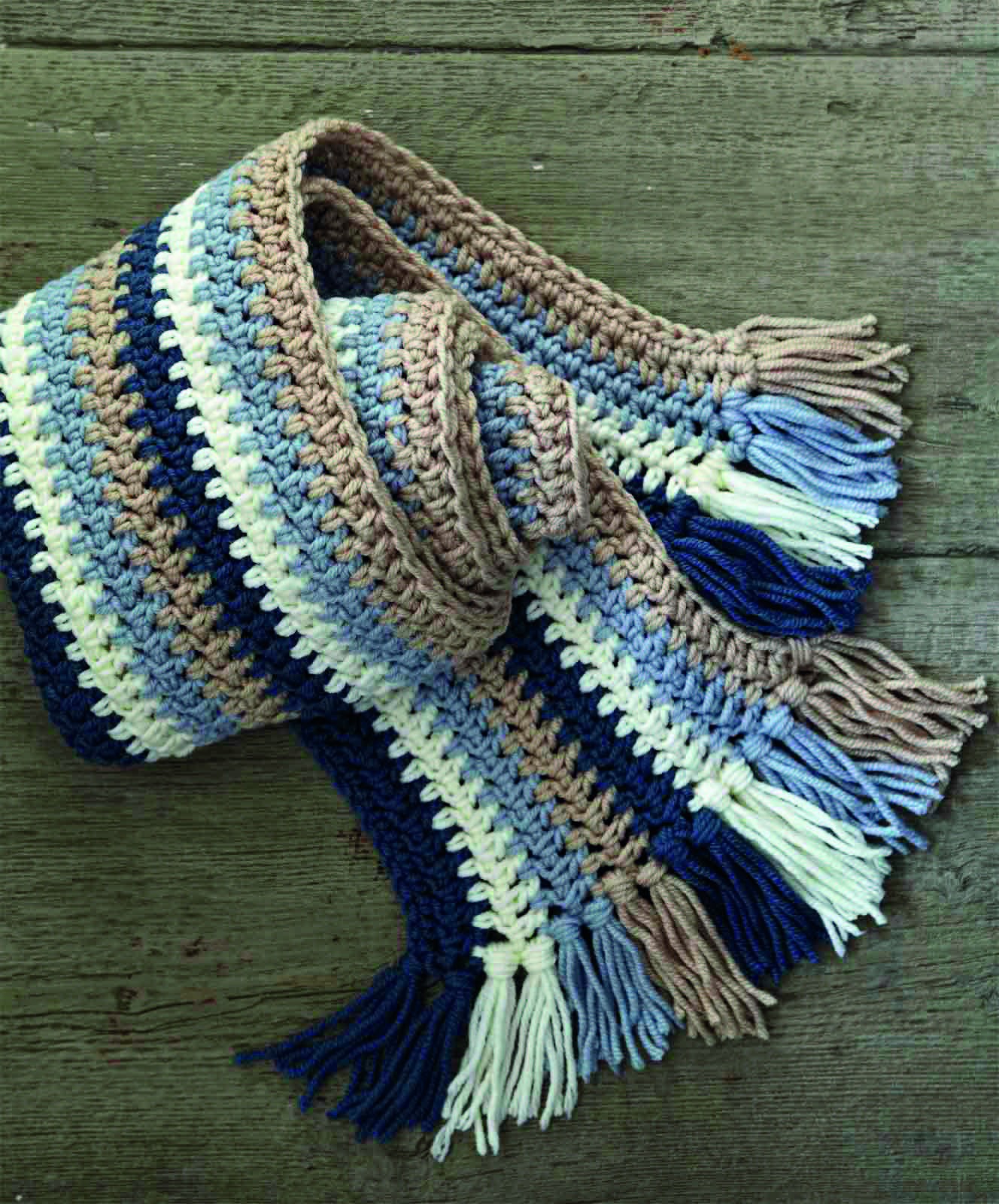
This chunky striped crochet scarf pattern runs the stitches along the full length rather than across the short end. Sixteen rows make broad color stripes, and half double crochet worked between stitches gives the fabric a soft, textured appearance. Tassels finish the row ends at both short sides.
Project at a glance
| Detail | Project information |
|---|---|
| Skill level | Easy lengthwise scarf |
| Finished size | Approximately 17 × 230 cm / 6¾ × 90½ in |
| Technique | Crochet; US stitch terms in this article unless a source image is labeled otherwise |
| Construction | Follow the project stages below |
Materials and tools
- Chunky merino yarn in four colors: source uses 2 × 50 g balls per color of Debbie Bliss Rialto Chunky, 60 m / 66 yd per ball
- A Navy 12; B Ecru 03; C Duck Egg 10; D Camel 06
- 6.5 mm hook, yarn needle, scissors and two end markers
Stitches and pattern notes
ch = chain; sl st = slip stitch; sc = single crochet; hdc = half double crochet; dc = double crochet; tr = treble crochet; st = stitch; sp = space; RS/WS = right/wrong side. A bracket followed by × 3 means repeat the entire bracket three times.
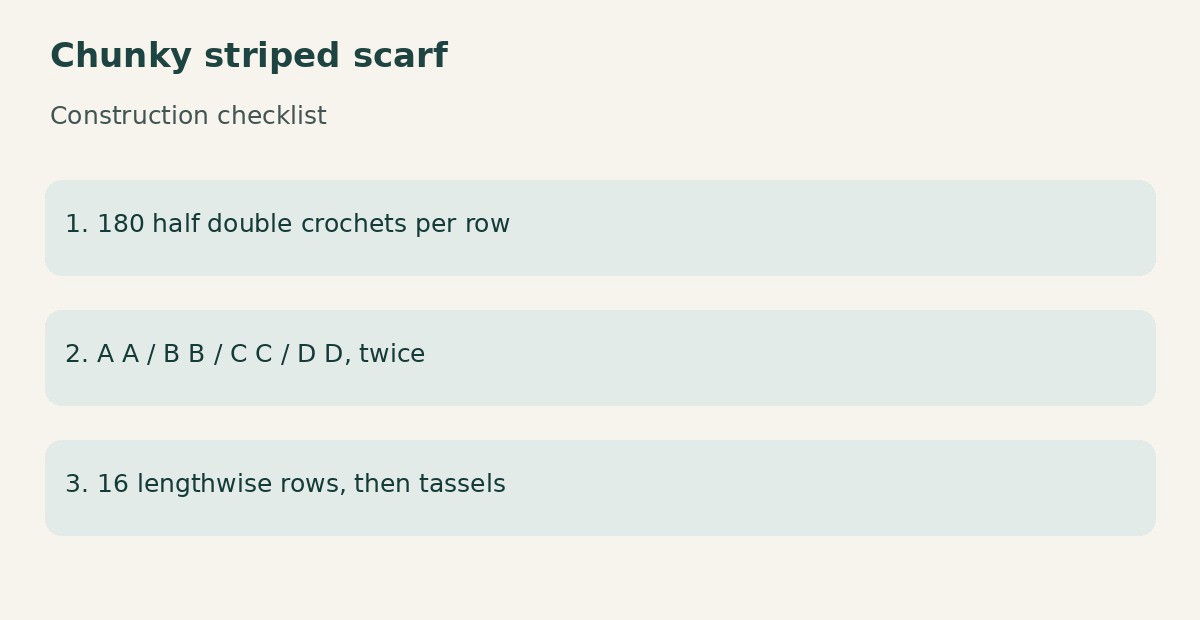
Gauge: 8 stitches and 9½ rows per 10 cm. There are 180 working hdc across each long row. Ch 2 is turning height, not an additional hdc. From the second row onward, work into the space between neighboring stitches rather than their top loops.
Crochet the lengthwise foundation
With A, chain 182 loosely. Hdc in the third chain from the hook and in every remaining chain, giving 180 hdc. Turn. Count the full row before continuing: a missed foundation chain is difficult to spot after several 180-stitch rows. A marker every 30 stitches can make that first count easier.
Work the between-stitch texture
Ch 2. Insert the hook into the gap between the first two stitches and make a hdc, then continue into the following gaps. Complete the edge using the final gap beside the turning chain so the row still has 180 stitches. Turn and repeat. The source describes the spaces between stitches; do not accidentally substitute ordinary top-loop hdc after the first row.
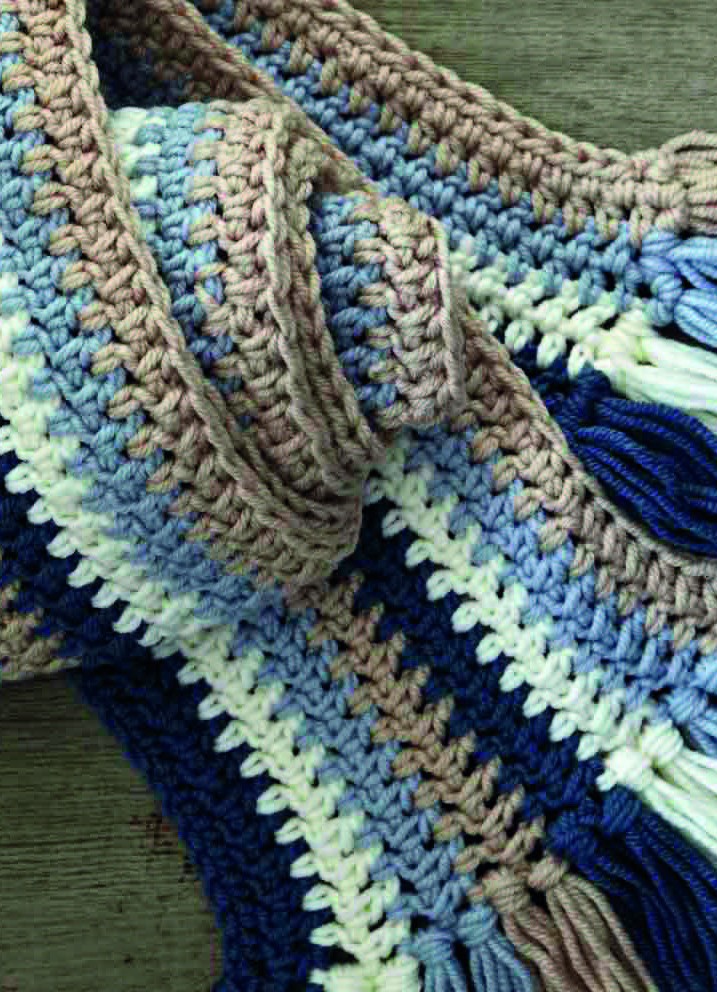
Follow the sixteen-row color plan
| Rows | Color |
|---|---|
| 1–2 | A — Navy |
| 3–4 | B — Ecru |
| 5–6 | C — Duck Egg |
| 7–8 | D — Camel |
| 9–10 | A — Navy |
| 11–12 | B — Ecru |
| 13–14 | C — Duck Egg |
| 15–16 | D — Camel |
Change yarn at a row end by drawing the new color through the last loops of the final hdc. Leave tails long enough to weave securely or manage alongside the tassels, according to your preferred finish. Do not carry several unused chunky strands up a short edge: that can produce a stiff, uneven tassel line.
Add the row-end tassels
For each tassel, cut four strands approximately 25 cm long and fold them together. Draw the folded loops through a row-end space, pull all loose ends through the loops and snug the bundle against the edge. The source places one tassel at each of the 16 row ends on both short sides: 32 bundles and 128 strands altogether. Lay them out before attaching so the color distribution is deliberate.
After every bundle is in position, smooth the scarf and trim the tassel ends evenly. Their finished drop is shorter than half the cut length because the attachment knot uses some yarn. Make a sample bundle first if a precise tassel length matters.
Finishing and size checks
Weave all remaining tails through the dense fabric, changing direction to help hold them. Check the scarf flat at its relaxed width. The source size is approximate, and the between-stitch fabric can lengthen when worn. If you change the foundation length, keep the 16-row color plan for the original width or adjust the row count in complete two-row stripes.
Tips for a clean finish
- Recount at the ends of color pairs; the target remains 180 stitches.
- Use the last gap beside the turning chain consistently to avoid tapering.
- Check a blocked swatch when replacing chunky merino with a less elastic fiber.
Frequently asked questions
Can I make it shorter?
Yes. Reduce the foundation chain to the required measured length, then add two turning chains. Maintain the same working count in every row.
Why only sixteen rows?
Each row spans the long dimension of the scarf. The row count builds its width, not its length.
More scarf and shawl ideas
Explore the Scarves & Shawls collection for more neckwear projects. Compare the yarn weight, width and construction before choosing your next pattern: an airy lace wrap and a dense winter scarf need different fabrics even when they use similar stitches.
Pattern source and credit
Based on [BONUS 2] Crochet Colors Theory.pdf, Printed pages 206-209; PDF pages 208-211. The readable source does not identify an individual designer. Photographs show the original source samples; construction checklists are editorial illustrations. The article reorganizes the source and adds practical explanations. Source ambiguities are identified where relevant; this is a document-based adaptation, not a claim of physical testing.
Open the original pattern in Drive to compare the instructions, source photographs and original layout.
Leave a Reply