Traditional Crochet Tea Cosy with Stripes and a Drawstring
· admin
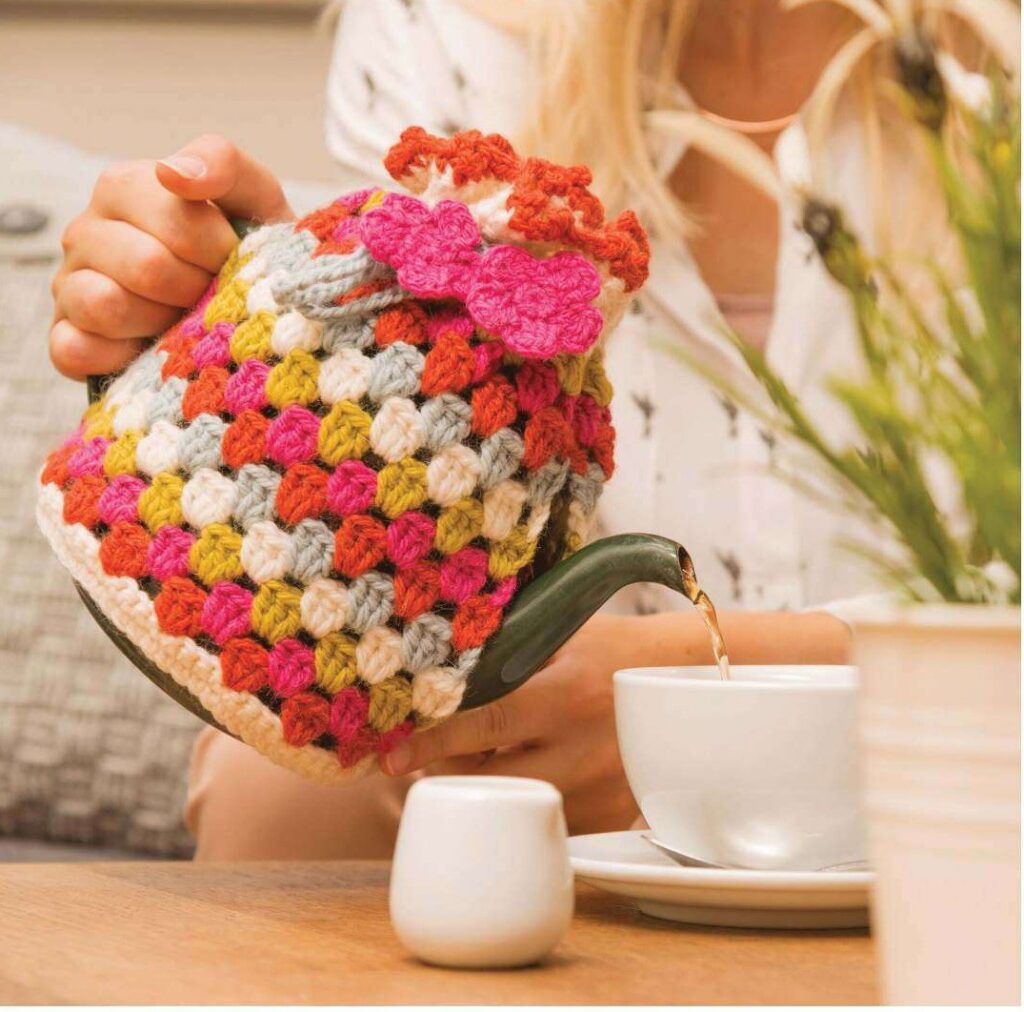
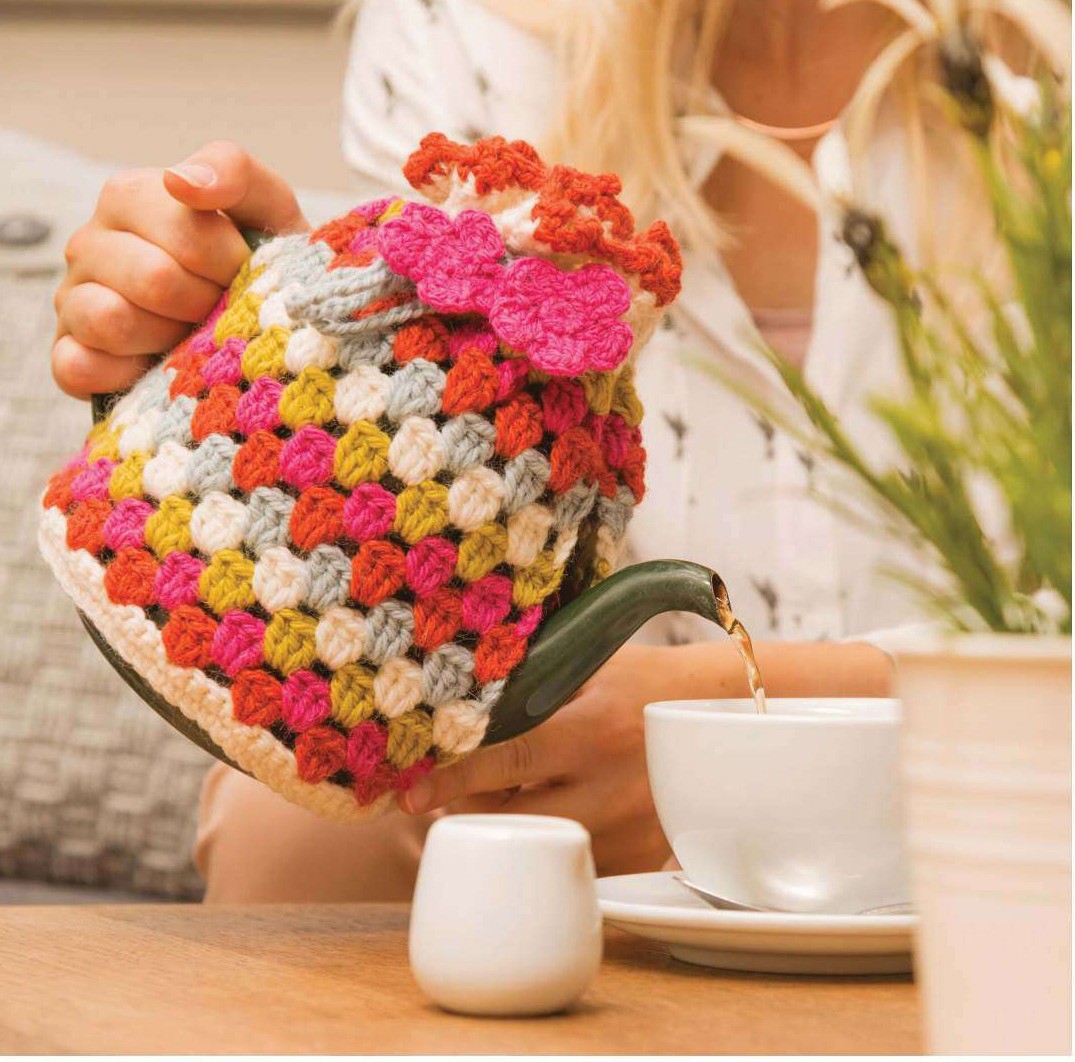
A traditional crochet tea cosy combines two striped side panels with a gathered top that adjusts around the pot. Sian Brown’s design uses granny-style groups in five colors, a small picot edge and two flowers at the ends of the drawstring. This guide explains the panel construction and UK terminology, with the original pages linked for the precise stripe repeat. The openings for the handle and spout are created during assembly rather than cut into finished fabric.
Materials and dimensions
The source uses Aran-weight wool or wool-and-alpaca yarn. It names Drops Alaska in Off-white for color one and lists Orange Mix, Cerise, Light Olive and Light Grey Green for colors two through five, with 75 m / 82 yd of each contrast shade. The photographed yarn description also refers to Drops Nepal. The off-white quantity is not clearly specified, so do not assume the contrast allowance is a confirmed total for that color.
Use 4 mm and 4.5 mm hooks, a tapestry needle, scissors and a tape measure. The listed panel width is 21.5 cm and the depth is 18 cm, excluding the gathered top. The main-pattern gauge is sixteen stitches and 8.5 rows per 10 cm with the 4.5 mm hook.
Translate the UK stitch names
The original uses UK dc, equivalent to US single crochet, and UK tr, equivalent to US double crochet. Its three-tr groups are therefore three US double crochets. Keep the original terminology consistent when moving between the firm lower band, granny section and flowers.
Use the metric hook sizes as the practical reference. The smaller hook is used for the firm bands, eyelets, edging, flowers and cord; the larger hook is used for the striped main fabric.
Make the two side panels
- For each panel, begin in off-white with ch 36 and work 35 UK dc from the second chain. Add the second firm row.
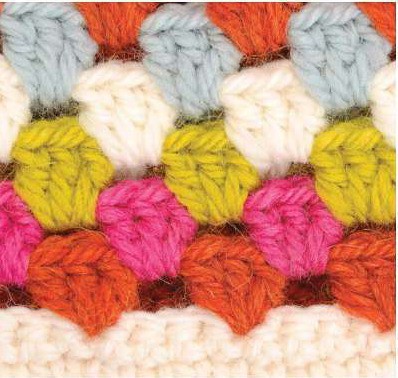
- Change to the 4.5 mm hook and establish the granny-group section. The source’s foundation and following two-row repeat use alternating edge treatments to keep the width even.
- Follow the color order: orange, cerise, light olive, off-white and light grey green, one row per color.
- The colored main rows are fastened off and begun again with the right side facing; the source explicitly says not to turn those rows.
- Repeat the established pair of pattern rows five more times while continuing the five-color sequence.
Because the color sequence has five shades and the stitch sequence has two rows, they do not restart together on every repeat. Track the stitch-row number separately from the color position. This avoids an accidental extra stripe or an edge worked with the wrong starting-chain treatment.
Work the eyelet top
Return to the 4 mm hook and off-white. Rebuild the upper band to 35 UK dc across the stitches and spaces, then follow the eyelet row on the original page. Its chain-one openings form the route for the drawstring. Work the remaining solid upper rows without closing those openings.
Keep both panels the same length and stitch count. A gathered top can accommodate the pot shape, but it cannot correct a large mismatch between the two side pieces.
Assemble, edge and add the cord
Place the panels around the actual teapot before sewing. Join the side seams while leaving suitable gaps for the spout and handle. Those positions depend on the pot: do not sew both seams completely shut and then force the handle through the fabric.
Add the source’s picot edge in orange. Make a chain cord approximately 60 cm long in light grey green and thread it through the top eyelets, beginning and ending at the center of a side. The two cerise flowers each begin with ten UK dc in a ring and form five petals on the following round. Sew one to each cord end.
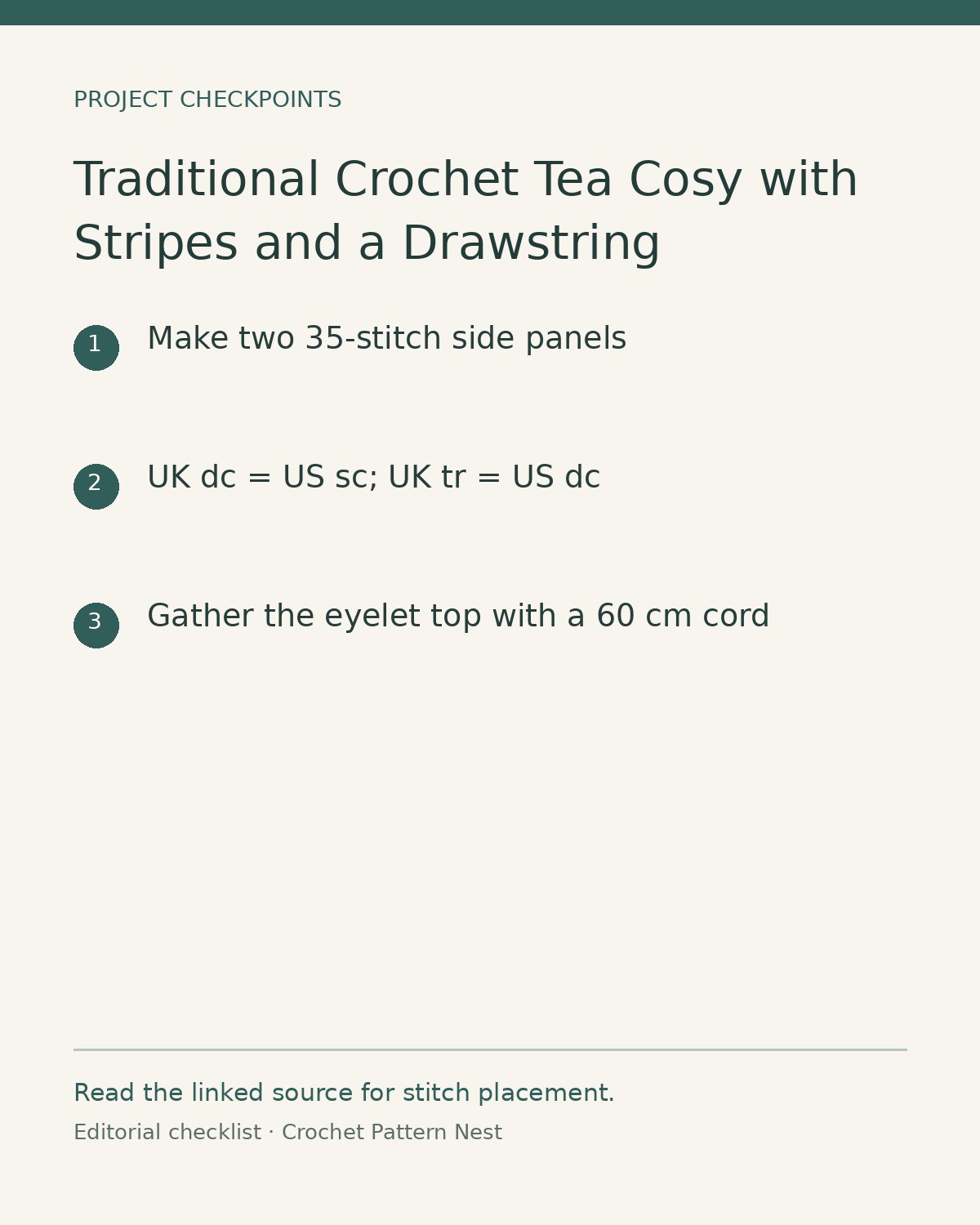
Gather the top gently to suit the pot. Check that the cosy does not obstruct a secure grip or the pouring spout, and remove it when necessary for safe handling and cleaning. Follow the wool label for washing and reshaping. The source photograph shows the actual striped design; the checklist summarizes its panel and cord construction.
Frequently asked questions
Does the source use US terms?
No. UK dc means US single crochet, and UK tr means US double crochet.
Are the colored rows turned?
No. The source starts them with the right side facing and fastens off rather than turning each colored row.
Where do the spout and handle openings come from?
They are left unsewn in the side seams when the two panels are assembled around the teapot.
Original source and more crochet projects
Design credit: Sian Brown, Traditional tea cosy; Crochet for Beginners printed pages 144–145 / PDF pages 140–141. This article explains the supplied source and its construction; it does not claim an independently tested sample. The photographs are from that source, and the checklist is an editorial reading aid.
Open the original pattern in Drive. Source location: Printed pages 144-145; PDF pages 140-141. Keep the original instructions and diagrams beside you when working the project.
For another project, explore Anima Floris crochet coasters, or Strand Basket pattern.
Leave a Reply