Pink and Yellow Crochet Baby Dress: Pattern Notes
· admin
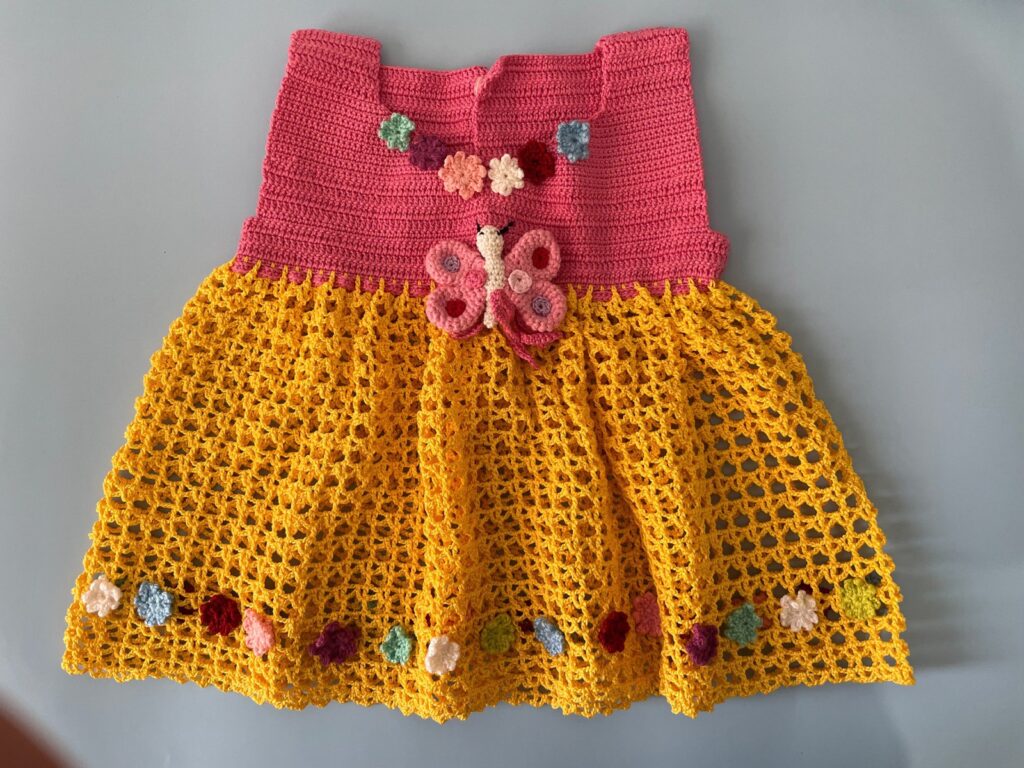
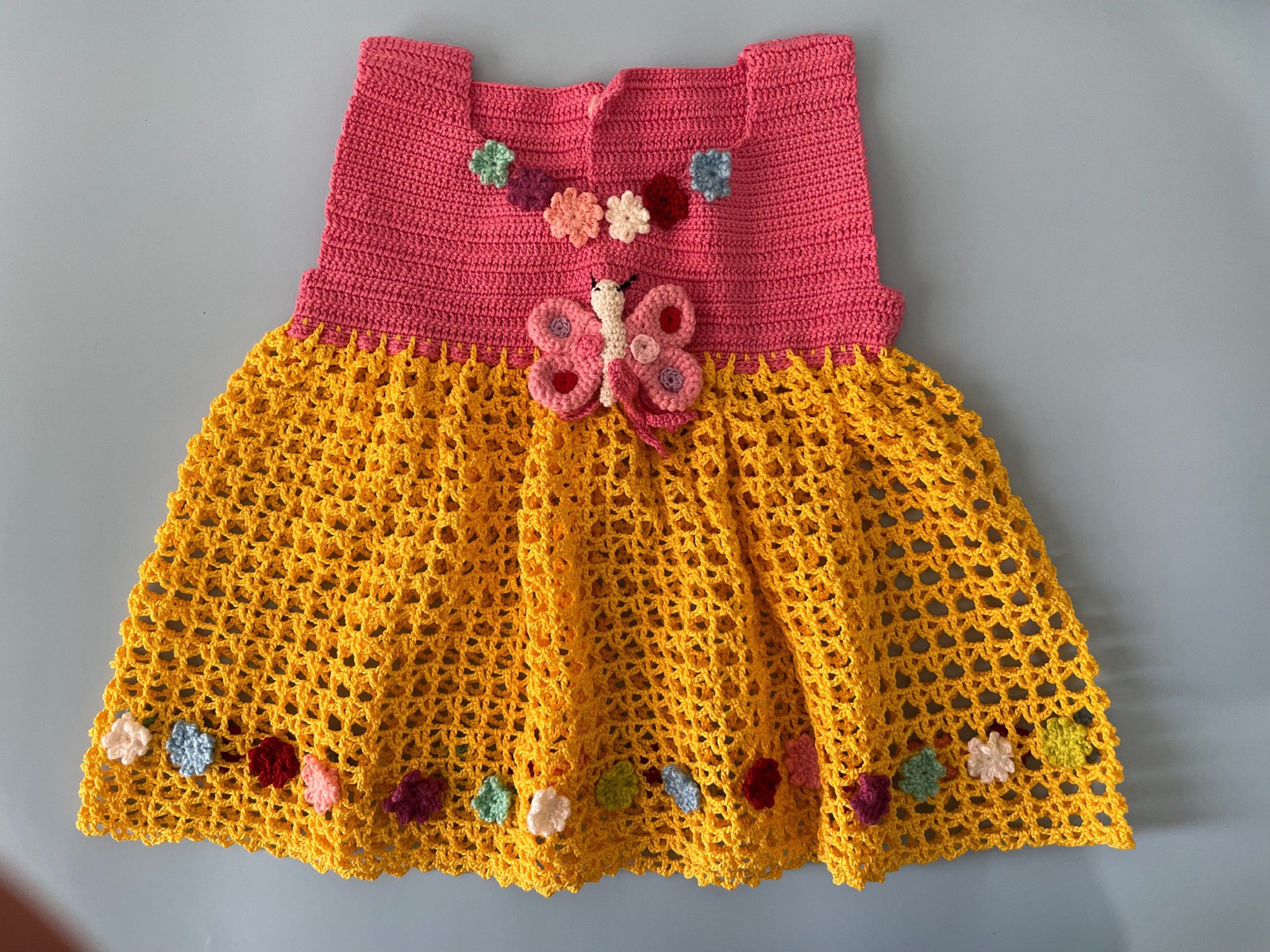
This pink and yellow crochet baby dress has a pink sleeveless bodice, an open yellow skirt and a layered butterfly at the front. Small flowers decorate the neckline and hem. The Tarif 31 source is illustrated with process photographs, but its generic cr abbreviation and several mixed row labels need clarification before it can be treated as a complete executable pattern.
Project details
| Skill level | Intermediate; source clarification required for some stitch labels |
|---|---|
| Size | Source label: 12–18 months and 45–48 cm, without a defined measurement type. |
| Hook | 2.5 mm or a hook appropriate to the chosen yarn. |
| Source | Tarif-31.pdf, supplied four-page illustrated dress reference; individual designer not identified in its readable cover. |
Materials and gauge
Pink and yellow yarn with cream, red, lilac and light-pink accents, 2.5 mm hook, needle, scissors and markers. The source does not specify yarn weight, a full yarn quantity or gauge.
Separate the three parts of the design
The bodice, skirt and decorative butterfly are distinct constructions. The front upper section is shaped around a broad neckline, and two rear sections form an opening. The skirt is picked up at the lower bodice edge. Make the garment body before attaching flowers or the butterfly so the decoration does not interfere with fit checks.
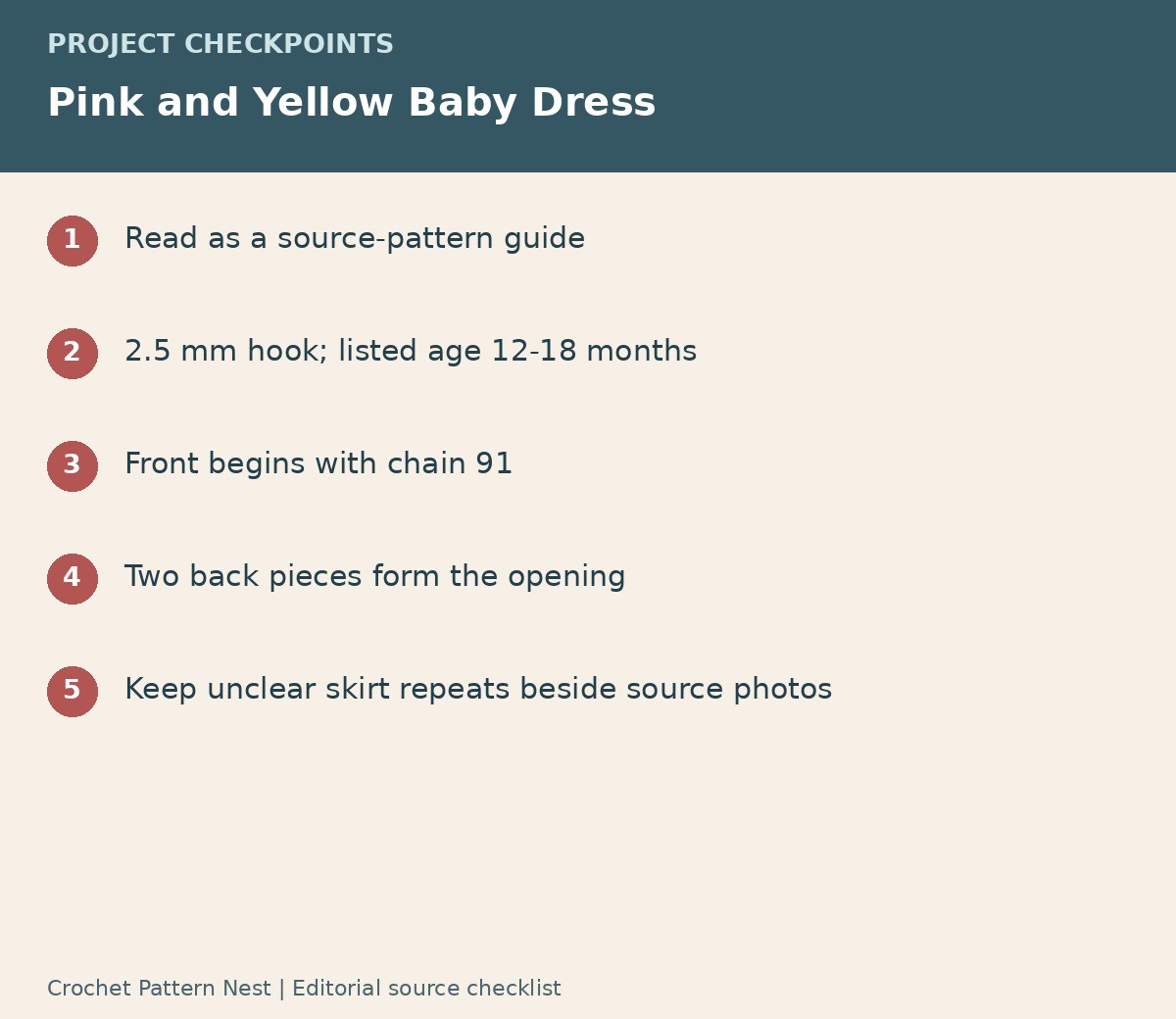
The source labels the size twelve to eighteen months and lists 45–48 cm without identifying the dimension. It gives a 2.5 mm hook but no yarn weight or gauge. Those omissions mean the age label cannot replace measuring a sample or comparing the finished bodice to a properly fitting garment.
Read the front and back counts as checkpoints
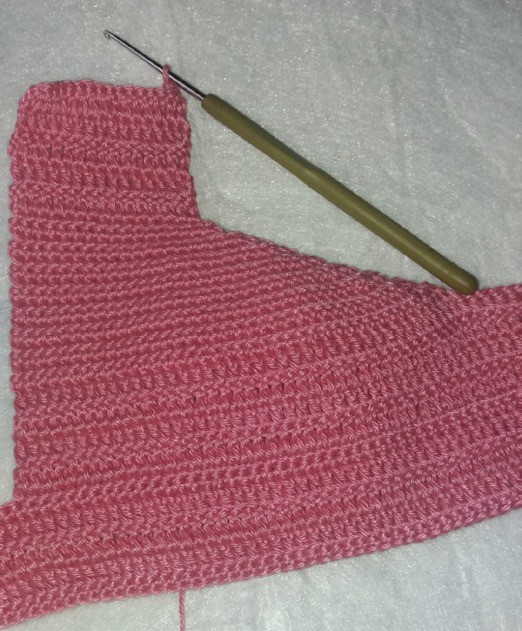
The front begins with chain 91 and ninety sc. Early rows move through eighty-five and eighty stitches. The neckline then divides toward a forty-stitch section that narrows in stages toward a fifteen-stitch shoulder. The other side mirrors the first.
The two back pieces begin with chain 46 and forty-five stitches. The source shows a narrower forty-stitch area, fastening gaps and fifteen-stitch shoulder ends. Use the photographs to compare the placement of the armhole and opening. The word “Rnd” is used even for turned flat rows, so do not join these bodice rows into a tube merely because of the label.
Clarify the skirt before making it
The skirt text describes repeated chain spaces beginning from the lower bodice. It lists an eighty-eight-repeat framework and longer repeated sections, but the “cr” abbreviation is defined only as crochet, not as a particular stitch. A chain-space repeat cannot be reconstructed reliably from that wording alone.
This article keeps the source plan and photographs available without claiming a newly verified full skirt pattern. Resolve the stitch height and repeat interpretation from the original reference before buying yarn for the entire garment. Do not substitute a familiar shell pattern and assume it will produce the exact pictured yellow skirt.
Understand the butterfly decoration
The cream body begins with a small six-stitch head, increases to twelve, holds its shape for two rounds and reduces back to six. It then widens again for the body section before narrowing into a short lower tail. The four pink wing pieces begin with 6 sc, increase to 12 and 18, then taper after a short plain section.
The source joins the wings in pairs and adds small contrasting circular spots. Make all four wings in the same yarn and compare their outlines before assembling them. Place the butterfly after the dress is shaped so it sits centered over the waist instead of pulling one side lower.
Add the flower trim last
The small flower motifs use chain loops anchored into a center ring. The source makes a larger set for the photographed decoration. Plan the spacing along the neckline and skirt edge first; a written quantity does not establish an exact border spacing when the garment gauge is unknown.
Finish with a clear project record
Sew each appliqué through multiple stable stitches and secure its yarn tails behind the bodice. Keep any fasteners firmly attached and check that the opening can be used without stretching the neckline. Record the yarn, actual gauge and resolved skirt interpretation with your finished project, because those details are not fully specified in the four-page source.
This is a source-reading guide to the pink-and-yellow design. It intentionally distinguishes the photographed structure from unresolved written instructions, helping you decide what needs clarification before starting.
Frequently asked questions
How does this differ from Tarif 30?
It has a pink bodice, yellow skirt, a separate butterfly and different foundation counts. It is a distinct illustrated design.
Does cr mean double crochet here?
The file does not define it that way. It lists cr only as crochet, so a specific stitch height should not be invented.
When should the butterfly be sewn on?
After the garment has been assembled and its shape checked, so the decoration can be positioned accurately.
Pattern and photograph credits
Tarif-31.pdf, supplied four-page illustrated dress reference; individual designer not identified in its readable cover. Photographs show the supplied source projects. Crops, rotated photographs and editorial checklists are identified in their captions. Any stitch-count or terminology clarification is identified in the relevant section.
Open the original Tarif-31.pdf pattern reference in Drive — Whole PDF. Keep the original pages beside this guide for the detailed diagrams and any section specifically referenced above.
Leave a Reply