Cow Baby Booties with Sculpted Crochet Heads
· admin
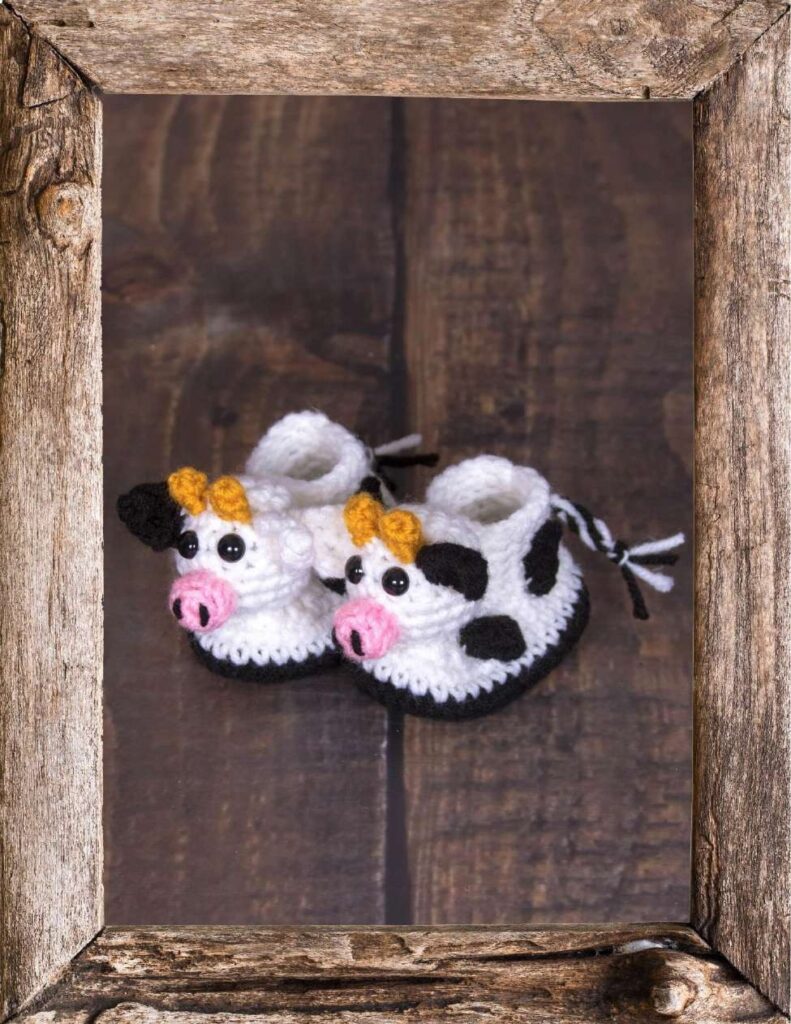
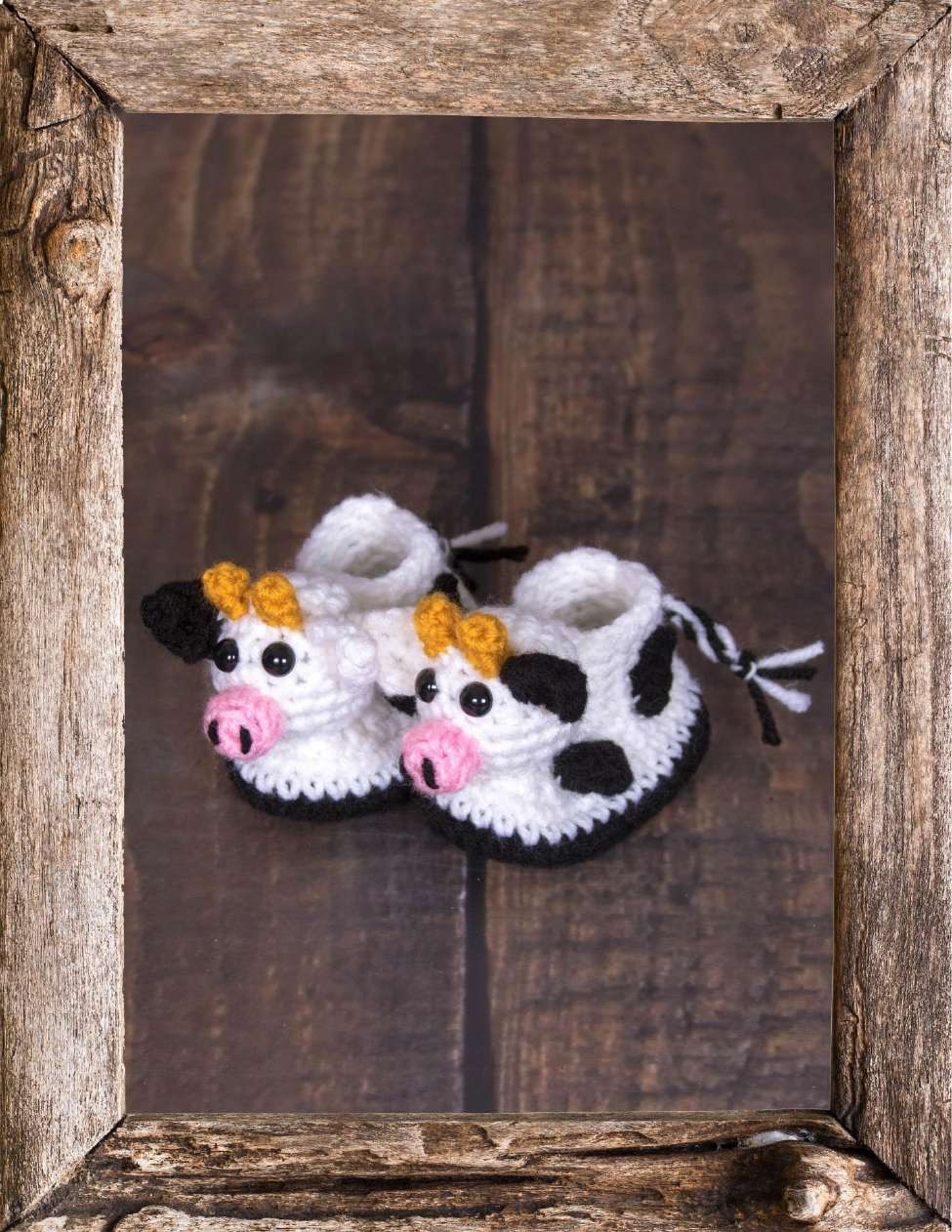
These cow baby booties combine a fitted ankle cuff with a small stuffed cow head on each toe. Pink muzzles, contrasting ears and gold horn nubs distinguish them from ordinary animal slippers. This guide follows the smallest base in the Barnyard Buddies collection and the separate Cow instructions; other animals and larger sizes remain in the original file.
Project details
| Skill level | Intermediate |
|---|---|
| Size | Selected base: 3.5-inch sole, approximately 0–3 months; measure the foot. |
| Hook | US G for the selected sole; US F for the animal features. |
| Source | Crochet Bootimals: Barnyard Buddies, supplied as Animal Booties.pdf; shared base and Cow section. |
Materials and gauge
Worsted yarn in white, black, pink and gold; US F and G hooks, filling, needle, marker and scissors. The source uses less than 2 oz of yarn per pair. Embroidered eyes can replace the source’s 9 mm eyes.
Choose the sole by measurement
The source gives a 3.5-inch sole with a G hook for the smallest base, or about four inches with an H hook using the same small-base instructions. Those age labels are estimates. Measure heel to longest toe and compare the actual crocheted sole before making the second shoe. Use the same yarn and hook for both soles.
Work the small base and upper
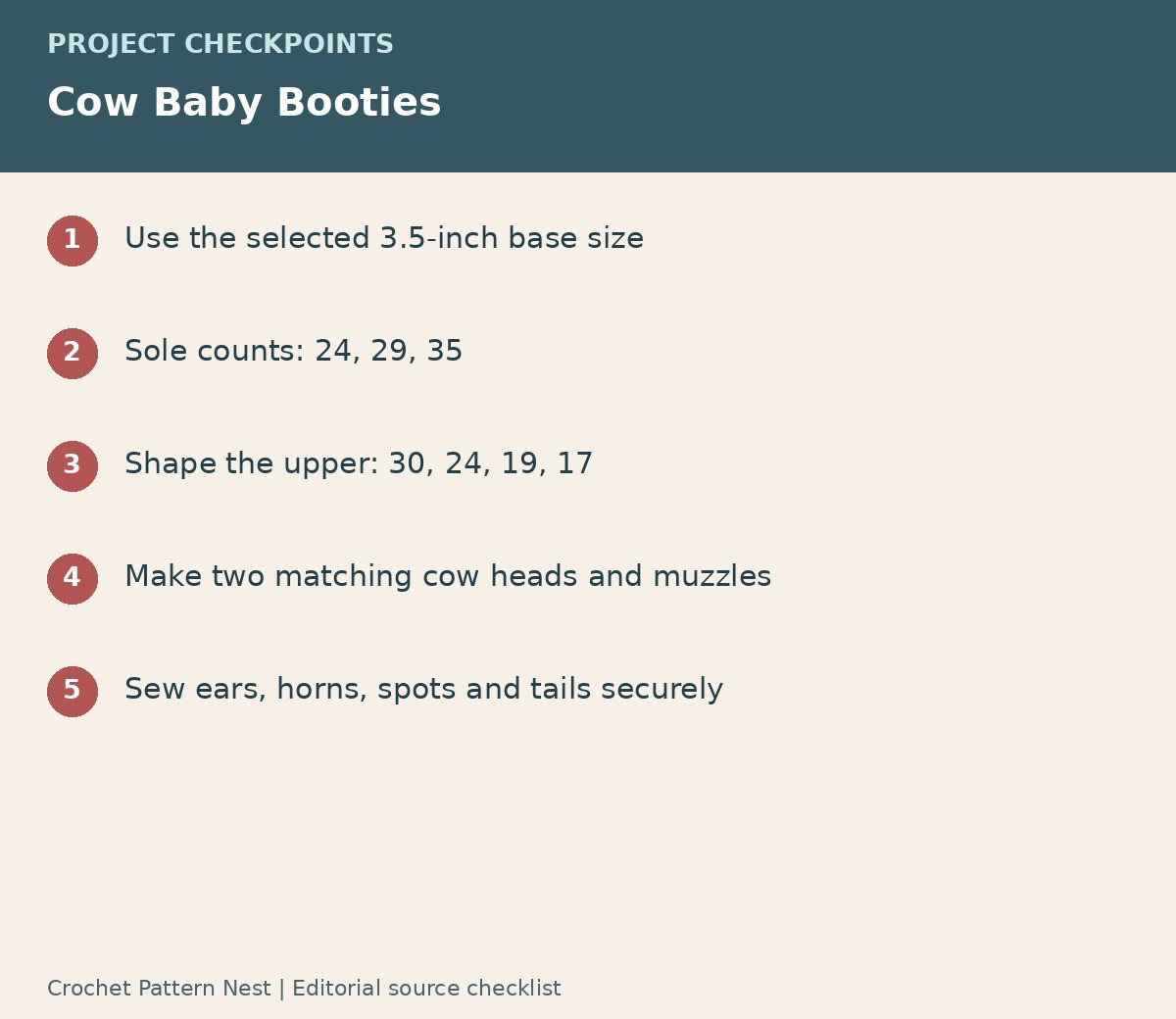
Begin with chain 10 and work around both sides. The first round combines sc and hdc, with extra hdc at the toe, for 24 stitches. Increase the second round to 29 and the third to 35. The early sole rounds are continuous; close only where the source directs a slip stitch at the end of round 3.
| Stage | Count |
|---|---|
| Sole rounds 1–3 | 24, 29, 35 |
| First upper round, BLO | 35 |
| Two plain upper rounds | 35 each |
| Toe-shaping rows | 30, 24, 19, 17 |
| Three FLO cuff rounds | 17 each |
The toe shaping combines skipped stitches with taller stitches and a dc decrease; it is not a regular evenly spaced sc decrease round. Keep the original pages 10–11 beside the work for those anchor positions. In particular, mark the first actual sc where the source skips the joining stitch. This prevents an accidental extra stitch at the back seam.
Make two cow heads
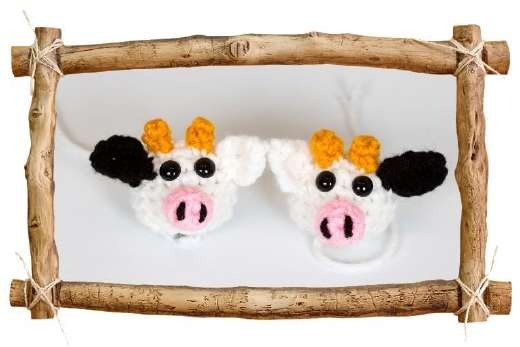
Use the F hook for the features. Each head begins with 6 sc in a small ring, increases to 12 and then 18, and stays at 18 for rounds 4–7. Round 8 repeats (dec, sc) six times for 12; round 9 decreases to 6. Leave a sewing tail. Keep the final opening accessible until the facial placement is settled.
For each pink muzzle, make 6 sc in a ring and work hdc around the back loops, followed by the source’s sc and slip-stitch finish. Embroider two nostrils before sewing the lightly filled muzzle over head rounds 6–7. Place the eyes above it around rounds 4–5. Yarn eyes avoid adding separate hard components to the face.
Ears, horn nubs and assembly
Make four ears, two black and two white. Each starts from one sc, grows to two, then widens again before working up the side and around the tip. Make four gold horn nubs: 4 sc in a ring followed by a plain four-stitch round. Round each nub with your fingers before sewing it between the ears.
Pin the completed heads on the toes and compare their angles. Sew around each lower head, then add several extra anchoring stitches between its back and the ankle cuff. Temporary tissue inside the toe can support the fabric while sewing; remove it afterward. The source finishes with a short braided black-and-white tail at the heel, which can be omitted as an optional embellishment.
Finish the pair evenly
Check the sole lengths, cuff openings and head positions side by side. Stuff only the animal parts, leaving the shoe interior clear for the foot. Weave in every tail on the inside of its own piece and inspect the feature seams before use. The source’s acrylic care directions apply to its particular yarn; follow your chosen fiber’s label for cleaning.
Frequently asked questions
Is the whole animal collection covered here?
No. This article selects the Cow design and the smallest shared base. The other animal designs remain separate work.
Why use a smaller hook for the head?
The F hook makes the stuffed features denser while the G hook produces the selected shoe size.
When should I attach the head?
After completing the cuff and checking the fit, so both heads can be positioned at the same height against the ankle.
Pattern and photograph credits
Crochet Bootimals: Barnyard Buddies, supplied as Animal Booties.pdf; shared base and Cow section. Photographs show the supplied source projects. Crops, rotated photographs and editorial checklists are identified in their captions. Any stitch-count or terminology clarification is identified in the relevant section.
Open the original Animal Booties.pdf pattern reference in Drive — PDF pages 3-19 and 32-35; smallest bootie size selected. Keep the original pages beside this guide for the detailed diagrams and any section specifically referenced above.
Leave a Reply