Mary Wave Crochet Baby Blanket in US Terms
· admin
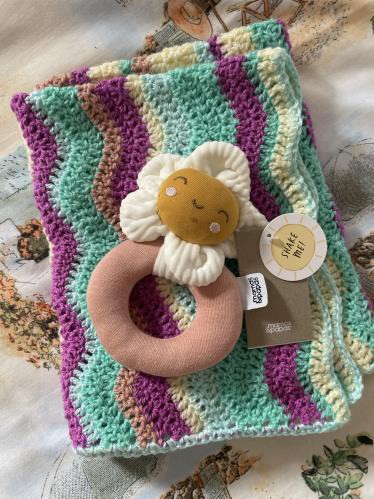
The Mary Wave crochet baby blanket uses paired decreases for valleys and paired increases for rounded peaks. Its original instructions are in UK terms; this complete adaptation uses US dc for the original UK treble and US sc for the original UK double crochet. Keep that conversion consistent in the body and edging.
Materials, Gauge and Size
About 170 g total DK yarn in five colors, a 4 mm hook and a needle. The source combines Oyster Pink, Magenta, Aran, Spearmint and a Mint sparkle accent. Its stated gauge is 20 UK trebles (US dc) × 9 rows per 10 cm square. It describes a 53 × 60 cm sample, but its seven-repeat foundation should be swatched and measured for width rather than treated as a guaranteed 53 cm at that gauge. The 55-row length and actual yarn choice also affect the result.
Stitches and Pattern Notes
US crochet terms: ch = chain; sc = single crochet; hdc = half double crochet; dc = double crochet; tr = treble crochet; sl st = slip stitch; st = stitch; sp = space; BLO = back loop only; inc = 2 stitches in one stitch. Sc2tog, hdc2tog and dc2tog combine two neighboring stitches into one. A number before a stitch tells you how many consecutive stitches to work. Parentheses followed by a repeat number describe one complete group repeated that many times.
Step 1: Work Seven Waves
With Oyster Pink, ch 87. First wave: dc in the fourth chain from the hook, dc in the next three chains, dc2tog over the next two chains twice, dc in the next three chains and 2 dc in the next chain. The skipped ch 3 supplies the first edge dc.
For each of the next six waves, work 2 dc in the next chain, 3 dc, dc2tog twice, 3 dc and 2 dc in the next chain. The seventh wave ends in the final chain. Turn. Keep the two neighboring decrease groups together at each valley and the paired increases at the peaks.
Step 2: Repeat the Ripple Row
Ch 3, counted as the first dc, and dc into the first stitch. Continue with 3 dc, dc2tog twice, 3 dc and 2 dc in the next stitch for the first wave. For each of the remaining six waves repeat (2 dc in next stitch, 3 dc, dc2tog twice, 3 dc, 2 dc in next stitch). On the final wave, place the last increase into the top of the previous row’s starting ch 3. Turn.
Keep seven wave repeats in every row. Each twelve-position section loses two positions through its two decreases and regains two through its end increases. Mark the valleys while learning the repeat and check the turning-chain top at the far edge before starting another row.
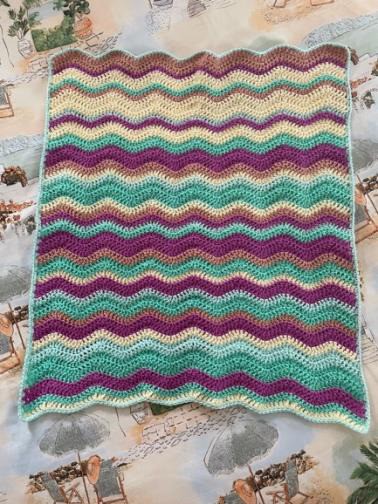
Step 3: Follow the 55-Row Stripe Chart
| Body rows | Color | Method |
|---|---|---|
| 1–2 | Oyster Pink | Repeat the ripple row |
| 3 | Magenta | Repeat the ripple row |
| 4–5 | Aran | Repeat the ripple row |
| 6 | Spearmint | Repeat the ripple row |
| 7 | Oyster Pink | Repeat the ripple row |
| 8–10 | Aran | Repeat the ripple row |
| 11 | Mint sparkle | Repeat the ripple row |
| 12 | Magenta | Repeat the ripple row |
| 13–14 | Aran | Repeat the ripple row |
| 15–16 | Spearmint | Repeat the ripple row |
| 17–19 | Magenta | Repeat the ripple row |
| 20 | Oyster Pink | Repeat the ripple row |
| 21 | Aran | Repeat the ripple row |
| 22 | Mint sparkle | Repeat the ripple row |
| 23–25 | Spearmint | Repeat the ripple row |
| 26 | Aran | Repeat the ripple row |
| 27 | Oyster Pink | Repeat the ripple row |
| 28 | Magenta | Repeat the ripple row |
| 29 | Mint sparkle | Repeat the ripple row |
| 30 | Spearmint | Repeat the ripple row |
| 31–33 | Magenta | Repeat the ripple row |
| 34 | Oyster Pink | Repeat the ripple row |
| 35–36 | Spearmint | Repeat the ripple row |
| 37 | Aran | Repeat the ripple row |
| 38–39 | Magenta | Repeat the ripple row |
| 40 | Mint sparkle | Repeat the ripple row |
| 41–42 | Spearmint | Repeat the ripple row |
| 43 | Oyster Pink | Repeat the ripple row |
| 44–45 | Magenta | Repeat the ripple row |
| 46 | Aran | Repeat the ripple row |
| 47–48 | Mint sparkle | Repeat the ripple row |
| 49–51 | Spearmint | Repeat the ripple row |
| 52–53 | Magenta | Repeat the ripple row |
| 54 | Spearmint | Repeat the ripple row |
| 55 | Aran | Repeat the ripple row |
Step 4: Check Width Before Completing the Body
The source uses blocks of twelve positions and permits adding a full block of twelve chains for a wider version. Swatch several waves, measure them relaxed and choose a repeat count that gives the width you want. Adding a partial wave changes the edge shaping.
Work through Row 55 using the table, changing yarn on the final pull-through where possible and leaving tails for secure finishing. The body uses only US dc and dc2tog; do not switch back to UK stitch names when following the color chart.
Step 5: Add the Single-Crochet Edge
With Mint, join in the lower left corner. Work three sc at that corner, then sc into the spaces between the body stitches along the lower edge. At each following corner work three sc. Along a side, work two sc around each row-end dc or starting ch-3 post. Across the upper edge, work sc between the dc positions as on the lower edge. Join to the first sc and fasten off.
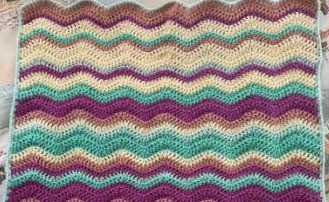
Keep the border relaxed so it follows the waves rather than trying to pull them into a straight line. Weave in the tails and wash according to the yarn labels, especially if the sparkle accent has different care instructions. The third article image is a detail crop of the full source photograph.
Frequently Asked Questions
Are the stitch names UK or US here? US throughout: the source’s UK treble becomes US dc, and its UK double crochet edging becomes US sc.
How do I widen it? Add complete twelve-chain repeats after measuring a ripple swatch.
Should I assume the foundation produces exactly 53 cm? No. The stated source dimensions and gauge need checking against a swatch of your yarn and ripple fabric.
More Baby Crochet Ideas
Browse our Crochet Baby collection, compare baby bootie patterns, or explore baby cardigan ideas. Save the project to Pinterest before gathering your yarn.
Pattern and Photo Credits
Adapted from the supplied Mary Waver Baby Blaket.pdf. Pattern and photographs: TraceyElaineDesign, Mary Wave Baby Blanket, 2022. Source photographs show the reference samples; captions identify any detail crops. This written adaptation has been reviewed against the supplied pattern pages but has not been physically crocheted or maker-tested. Yarn substitutions and tension can change the result.
Leave a Reply