Jungle Friends Crochet Baby Blanket and Animal Appliques
· admin
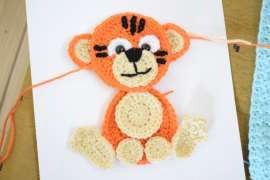
The Jungle Friends crochet baby blanket combines textured colored panels with six separate animal appliqués. Tiger, monkey, giraffe, lion, zebra and elephant each have their own pieces and assembly photos. Neutral rectangles separate the larger colored panels. This guide maps the blanket construction and the original animal sections without confusing them with the separate Forest Friends project.
Project details
| Skill level | Intermediate |
|---|---|
| Size | Source large panel approximately 22 × 24 cm; complete blanket size not stated. |
| Hook | 3.5 mm |
| Source | Jungle Friends Appliqués Baby Blanket, PDF pages 153–179 in the supplied Set 62 jungle animals collection. |
Materials and gauge
DK yarn in blue, green and beige for the blanket, plus animal colors; 3.5 mm hook, needle and scissors. The source lists one ball blue, one green and two beige. Use yarn eyes and sewn attachments for a soft blanket finish.
Make the textured panels
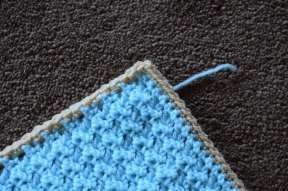
Use US terms. Begin with chain 43 and work forty-two sc into the foundation. The texture row starts with an edge sc, then alternates a paired sc and dc in one stitch with a skipped stitch, ending with a single edge stitch. Keep forty-two working positions across, using the original close-up for the final turning-chain anchor.
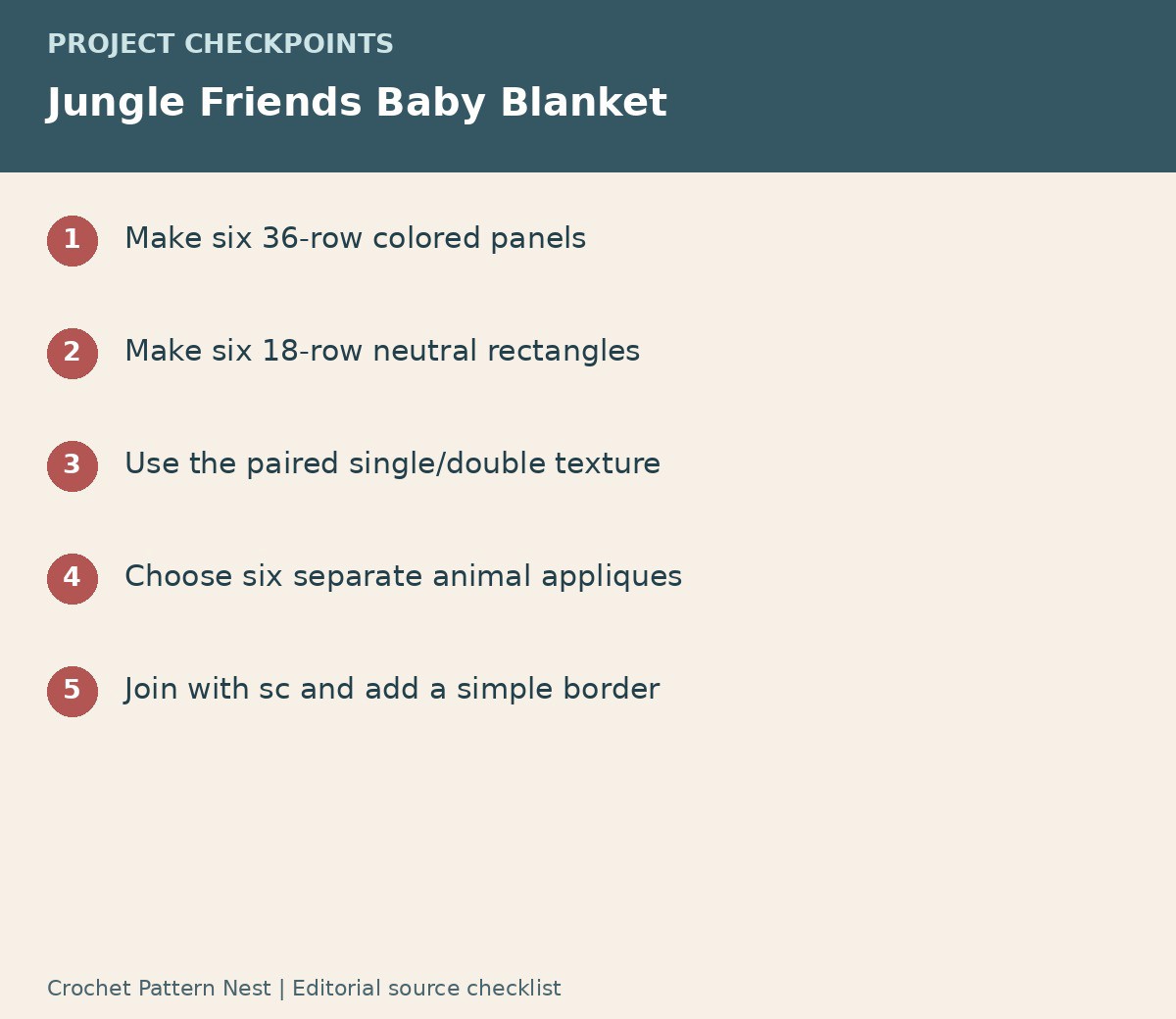
Repeat the textured row through row 35 and finish row 36 in sc. Make six large panels in the two colored yarns. The source large panel is about twenty-two centimeters wide and twenty-four high, so its label “square” should not be treated as a guarantee that the two dimensions are identical.
Make six beige rectangles with eighteen rows, finishing with a sc row. Keep the same width and stitch tension as the larger panels. The source also offers making the layout as three long color-changing columns, then joining those columns; that is an alternative to sewing every small panel separately.
Use the six animal sections
| Animal | Original PDF pages |
|---|---|
| Tiger | 156–160 |
| Monkey | 161–165 |
| Giraffe | 166–169 |
| Lion | 170–173 |
| Zebra | 174–176 |
| Elephant | 177–179 |
The original appliqués range roughly from thirteen to twenty centimeters high. Make one before deciding its position on a panel. Their pieces are shaped differently; a giraffe body worked as a long strip is not interchangeable with a round tiger body.
Understand the tiger construction
The pictured tiger uses a circular head, a smaller pale muzzle, layered ears, a shaped body, separate belly, feet, claws and tail. Its head grows through twelve, twenty-four and thirty-six dc before the outer hdc shaping. The source’s final printed head count should be checked against its increase repeat rather than assumed accurate.
Embroider the triangular nose on the muzzle before sewing it to the head. Add stripes with surface embroidery and place the eyes symmetrically. The source supplies both hard-eye and yarn-eye ideas; yarn eyes keep the decorative face entirely soft. Assemble the animal off the blanket first so the joining tails stay behind it.
Join the panels
Lay out all colored panels and neutral rectangles before joining. Photograph the arrangement as a reference. Put corresponding edges right sides together and sc through both layers, matching stitches or evenly spaced row ends as appropriate. Keep the joining seam consistent from one panel to the next.
Make an outer sc border, using (sc, chain 1, sc) at each blanket corner. Spread the row-end stitches so the border remains flat. The source does not state one complete finished blanket measurement, so calculate yours from the actual panels and seam width.
Attach the animals last
Pin the six appliqués to their chosen panels and check the full layout. Sew around stable portions of each body and add extra stitches under projecting heads, feet and tails. This guide uses sewn appliqués rather than relying only on adhesive. Weave the remaining tails into the backs of the panels and inspect all details before supervised handling.
Frequently asked questions
How many large panels are made?
Six, plus six shorter beige rectangles in the source layout.
Are the animal patterns all the same base?
No. Each animal has its own shaped components and original page sequence.
Is this the Forest Friends blanket?
No. Jungle Friends is a separate section with different animals and a printed forty-two-stitch textured blanket base.
Pattern and photograph credits
Jungle Friends Appliqués Baby Blanket, PDF pages 153–179 in the supplied Set 62 jungle animals collection. Photographs show the supplied source projects. Crops, rotated photographs and editorial checklists are identified in their captions. Any stitch-count or terminology clarification is identified in the relevant section.
Open the original Set 62 jungle animals.pdf pattern reference in Drive — PDF pages 153-179. Keep the original pages beside this guide for the detailed diagrams and any section specifically referenced above.
Leave a Reply