Tweed Stitch Crochet Cowl Pattern: A Möbius Neck Warmer
· admin
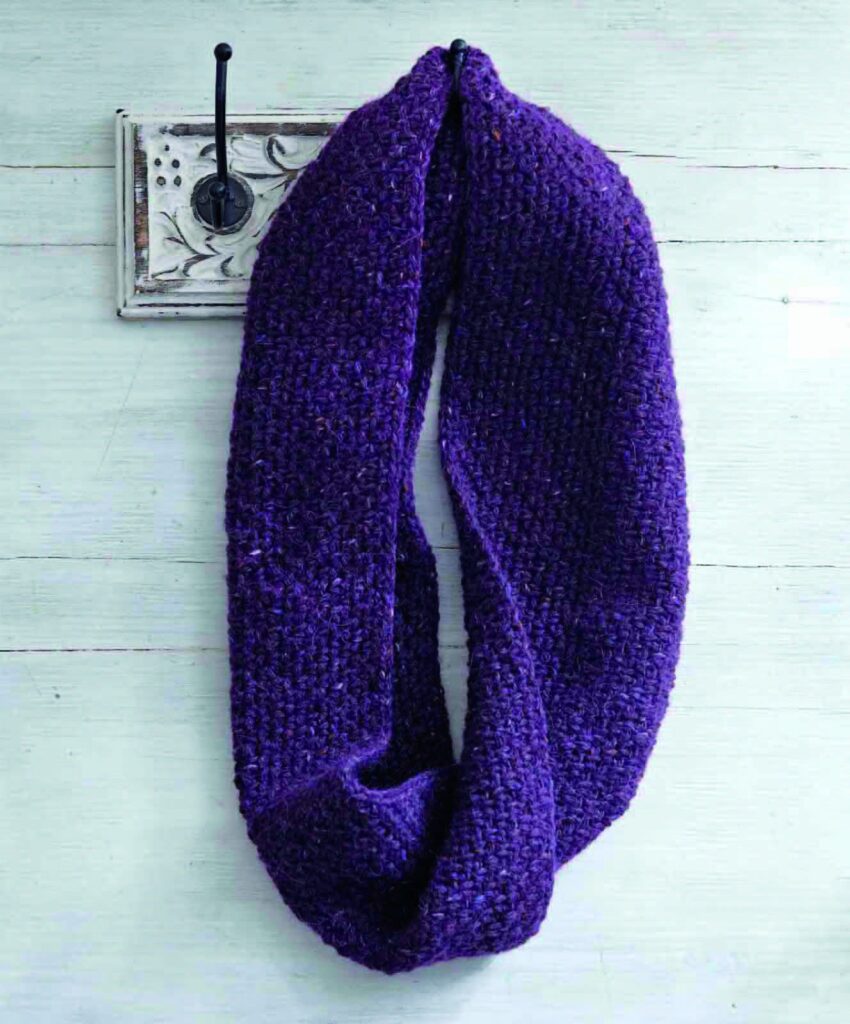
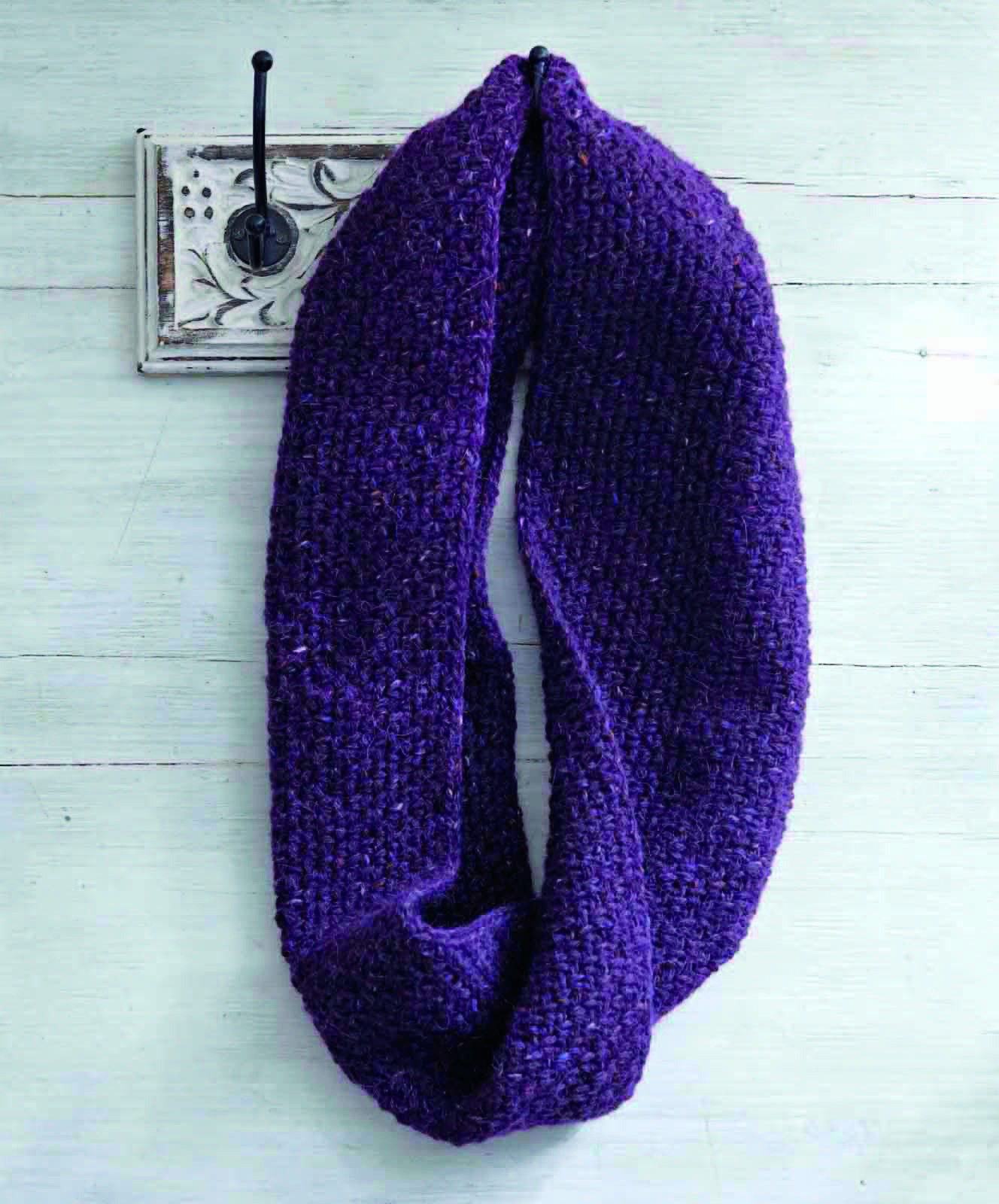
This tweed stitch crochet cowl pattern uses single crochet and chain spaces to make a dense, softly textured neck warmer. Its single half twist creates a Möbius construction: the joined path travels around both edges of the starting strip. Marking that path matters more than treating the work as an ordinary untwisted tube.
Project at a glance
| Detail | Project information |
|---|---|
| Skill level | Easy stitch pattern with a careful twisted join |
| Finished size | Approximately 92 × 18 cm / 36 × 7 in |
| Technique | Crochet; US stitch terms in this article unless a source image is labeled otherwise |
| Construction | Follow the project stages below |
Materials and tools
- 4 × 50 g balls Rowan Felted Tweed Aran, Plum 731; 87 m / 95 yd per ball
- 5.5 mm crochet hook
- Yarn needle and a removable marker or safety pin
Stitches and pattern notes
ch = chain; sl st = slip stitch; sc = single crochet; hdc = half double crochet; dc = double crochet; tr = treble crochet; st = stitch; sp = space; RS/WS = right/wrong side. A bracket followed by × 3 means repeat the entire bracket three times.
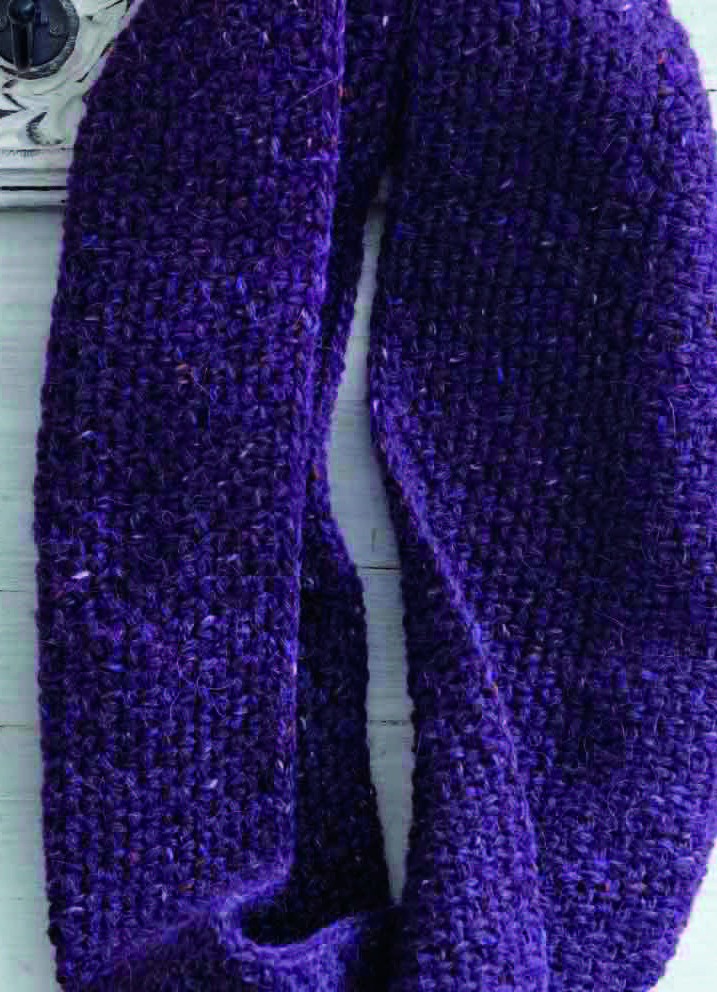
Gauge: 16 stitches and 18 rows per 10 cm. Tweed stitch here means sc separated by ch-1 spaces, also described as seed stitch in the source. Work new sc into the chain spaces of the preceding round and skip the intervening sc. A Möbius half twist is deliberate; additional twists change the construction.
Make the foundation strip
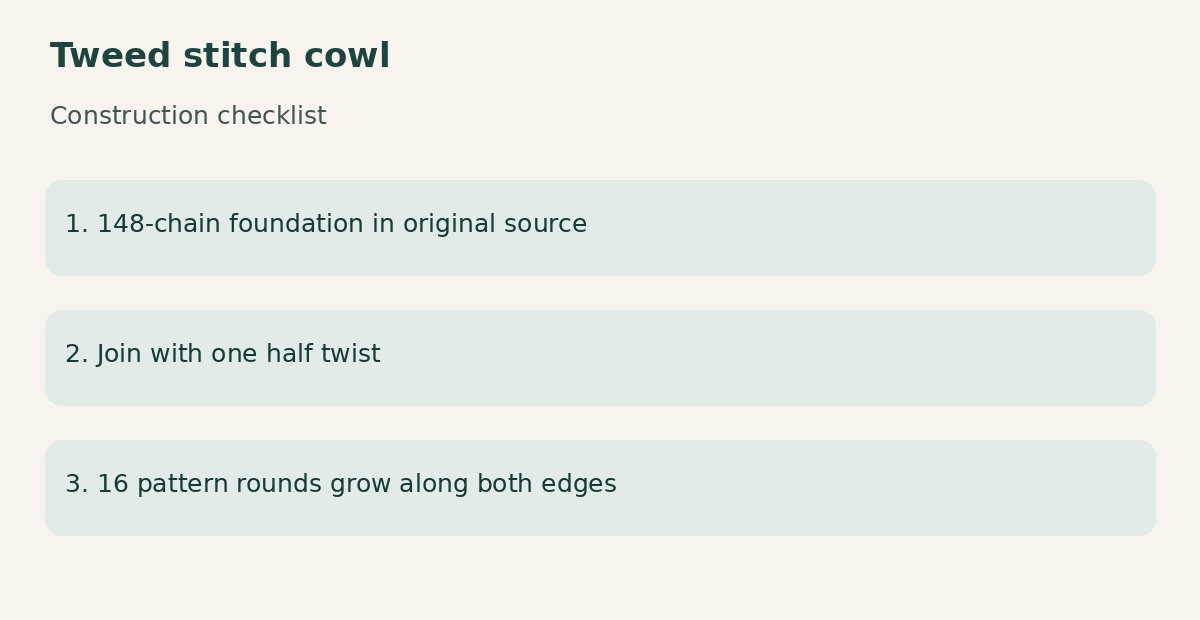
The original pattern begins with 148 chains. Starting in the third chain from the hook, it directs an alternating sequence of sc, ch 1 and skipping the next chain, ending with sc. Keep the chain loose and lay the narrow strip flat before joining. The source does not give a reliable finished foundation stitch count, and its chain-start and last-sc wording leaves an edge ambiguity. Check that the mesh alternation is regular rather than inventing an unsupported total.
If you prefer to establish the stitch first, make a short practice strip and identify its top stitch loops, bottom foundation loops and end chains. Those landmarks help you see why the first joined round enters the foundation base instead of continuing only along the usual top edge.
Join with one half twist
Following the source, join with a sl st into the chain at the base of the first stitch while introducing one half twist. The first working round runs into the base of the foundation stitches. Place a marker at the start of the route. Trace the joined edge with your finger before crocheting farther: on a Möbius strip, one complete journey includes both sides of the original narrow strip.
Work the tweed stitch rounds
| Step | Instructions | Checkpoint |
|---|---|---|
| Round 1 | Ch 1. Repeat sc into the chain space below, ch 1, skip the intervening stitch. Continue around the full marked path and join with sl st. | Work into the foundation base as established |
| Round 2 | Ch 3. Follow the source sequence: skip the next stitch, sc into the next chain space, ch 1; continue to the final stitch, work the final sc and join. | Keep the chain-space rhythm |
| Continue | Repeat Rounds 1 and 2 seven more times. | 16 pattern rounds overall |
The source calls the repeated units rows in its final sentence, although the cowl is joined. Here they are described as rounds to match the construction. Do not stop halfway around the Möbius path simply because you have reached the opposite face of the original strip. Return to the marker before counting a full round.
Check the fabric as it grows
Lay the cowl down after each pair of rounds and smooth the twist without stretching it. The sc and ch-1 alternation should remain visible, and both growing edges should feel similar in tension. A missing chain space can compress the next section; a sc worked into a sc instead of the intended space can interrupt the texture. Correct those local mistakes before they travel into later rounds.
Finish the neck warmer
Fasten off after 16 rounds and weave in the tails on a dense portion of the fabric. Follow the yarn label for washing and dry the cowl in its natural twisted shape. Avoid trying to block it into a flat untwisted tube. The listed source yarn totals approximately 348 m / 380 yd; yarn substitutions need a new gauge check.
Tips for a clean finish
- Use a distinctive start marker and move it only after completing the whole route.
- Check the single half twist before the first complete round.
- Keep joining stitches relaxed so a tight seam-like line does not form.
Frequently asked questions
Is this a flat scarf sewn into a loop?
No. The source joins the initial strip with a half twist, then works around the resulting Möbius route.
Why does one round seem unusually long?
A Möbius route travels around both edges of the original strip before returning to its starting point.
More scarf and shawl ideas
Explore the Scarves & Shawls collection for more neckwear projects. Compare the yarn weight, width and construction before choosing your next pattern: an airy lace wrap and a dense winter scarf need different fabrics even when they use similar stitches.
Pattern source and credit
Based on [BONUS 2] Crochet Colors Theory.pdf, Printed pages 204-205; PDF pages 206-207. The readable source does not identify an individual designer. Photographs show the original source samples; construction checklists are editorial illustrations. The article reorganizes the source and adds practical explanations. Source ambiguities are identified where relevant; this is a document-based adaptation, not a claim of physical testing.
Open the original pattern in Drive to compare the instructions, source photographs and original layout.
Leave a Reply