
Filet Crochet Summer Baby Blanket with Diamond Motifs
· admin
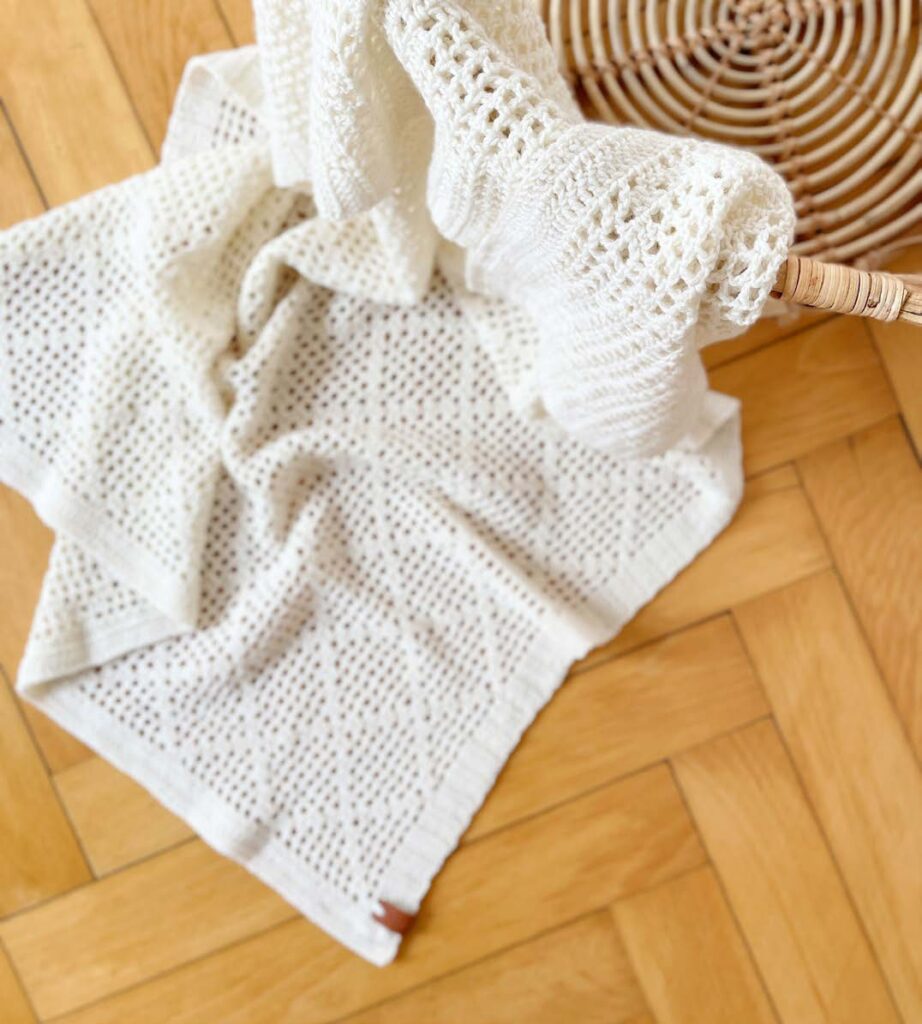
This filet crochet summer baby blanket places small solid diamonds inside an open mesh. Its sides and solid end bands are built into the rows, so there is no separate all-around border to attach. The complete instructions here follow the source’s smallest 70 × 100 cm version, using eight horizontal motif repeats.
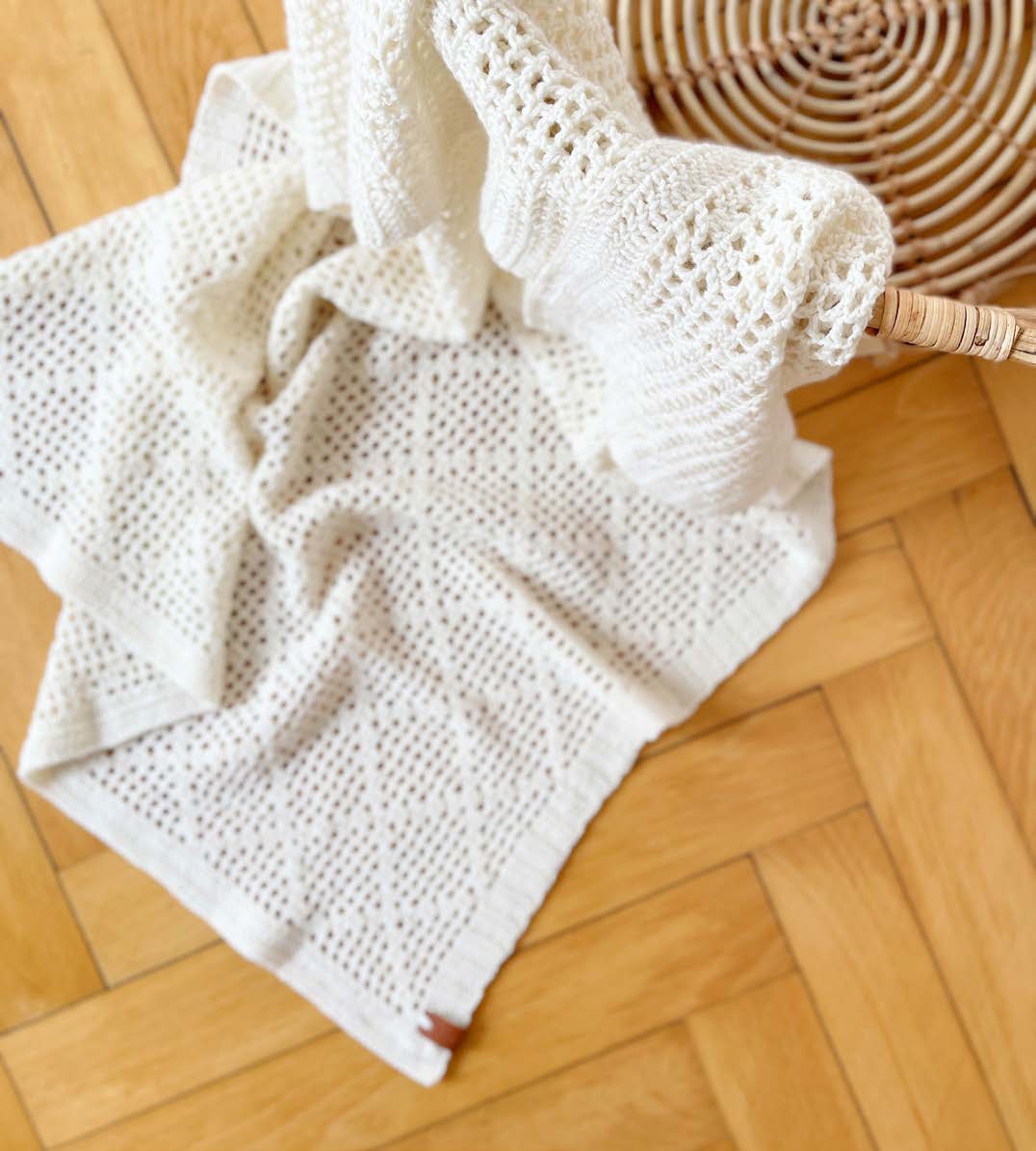
Materials, Gauge and Size
3.5 mm hook, scissors, markers and yarn needle. The source uses eight balls of Infinity Hearts Baby Merino in Nature 06 for its smallest blanket, or the same listed ball count of Drops Baby Merino. Reference gauge is 25 stitch positions and 11 rows per 10 cm, measured before blocking. The source also includes larger widths with different foundation counts; this article keeps the 173-position version throughout.
Stitches and Pattern Notes
US crochet terms: ch = chain; sc = single crochet; hdc = half double crochet; dc = double crochet; tr = treble crochet; sl st = slip stitch; st = stitch; sp = space; BLO = back loop only; inc = 2 stitches in one stitch. Sc2tog, hdc2tog and dc2tog combine two neighboring stitches into one. A number before a stitch tells you how many consecutive stitches to work. Parentheses followed by a repeat number describe one complete group repeated that many times.
Step 1: Learn Filet Chains and the Turning Start
Fch is the designer’s shorthand for ch 1 and skip one stitch. It occupies one grid position: it is not ch 1 plus another working stitch. When the next row calls for dc over an existing fch, work around its chain. This lets each motif row keep 173 positions even though some positions are open and others solid.
For the “Pretty Turning” start, turn without a normal chain. Make sc in the first stitch, then insert into the loop behind that sc and make a second sc stacked on top. Together the two sc count as one dc position. The source writes this as “2 pt”; do not count it as two dc.
Step 2: Establish the Solid Foundation
Begin the chainless foundation with ch 3 as the first dc position. For each next foundation dc, yarn over, insert into the foundation chain space, draw up a loop, yarn over and pull through one loop to make the next foundation chain, then finish the dc in two pull-throughs. Continue working into the newest foundation chain until there are 173 positions including the initial ch 3.
Mark the first and last positions. Work two solid rows with the stacked turning start plus 172 dc in each. These three solid foundation rows form the lower band. The stacked start always replaces the first dc rather than being added before 173 more stitches.
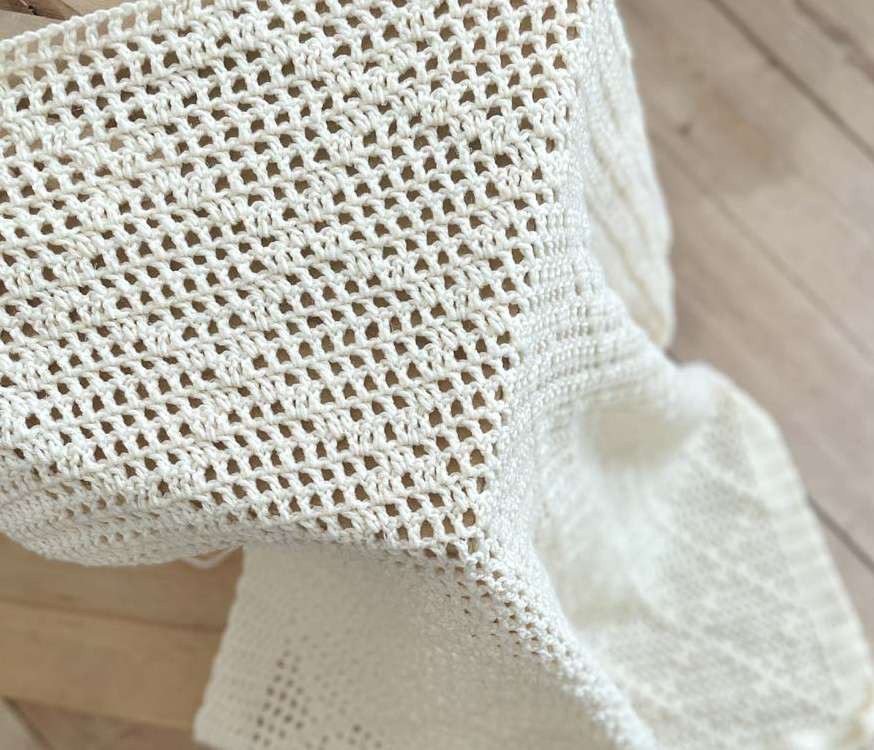
Step 3: Follow the Diamond Row Formulas
| Row / round | Instructions | Count / note |
|---|---|---|
| 1 | Make 173 foundation-dc positions; the initial ch 3 is the first position, followed by 172 foundation dc. | 173 |
| 2–3 | Stacked-sc turning start counted as one dc, then 172 dc. | 173 |
| 4 | Turning start, 4 dc, 3 dc; repeat ((fch, dc) nine times, 2 dc) eight times; 5 dc. | 173 |
| 5 | Turning start, 4 dc, dc, fch, dc; repeat (2 dc, (fch, dc) seven times, 2 dc, fch, dc) eight times; 5 dc. | 173 |
| 6 | Turning start, 4 dc, dc, fch, dc; repeat (fch, 3 dc, (fch, dc) five times, 2 dc, (fch, dc) twice) eight times; 5 dc. | 173 |
| 7 | Turning start, 4 dc, dc, fch, dc; repeat ((fch, dc) twice, 2 dc, (fch, dc) three times, 2 dc, (fch, dc) three times) eight times; 5 dc. | 173 |
| 8 | Turning start, 4 dc, dc, fch, dc; repeat ((fch, dc) three times, 2 dc, fch, dc, 2 dc, (fch, dc) four times) eight times; 5 dc. | 173 |
| 9 | Turning start, 4 dc, dc, fch, dc; repeat ((fch, dc) four times, 2 dc, (fch, dc) five times) eight times; 5 dc. | 173 |
| 10–14 | Work the formulas of Rows 8, 7, 6, 5 and 4 in that order. | Mirror the motif |
Step 4: Continue the Mirrored Repeat
After the first rising and falling motif sequence, repeat the formulas of Rows 5, 6, 7, 8, 9, 8, 7, 6, 5 and 4 in that order. Mark the beginning of each ten-row cycle and keep checking 173 positions, counting an fch as one position. The outer five positions on each side stay solid; the eight internal repeats each occupy twenty positions, with three extra solid positions before the repeated section in Row 4.
The source directs 101 rows of the patterned section before the final solid band. Treat this as the motif-section count, separate from the three starting solid rows, and measure against the intended finished length as you go. Finish with three solid dc rows to match the lower band.
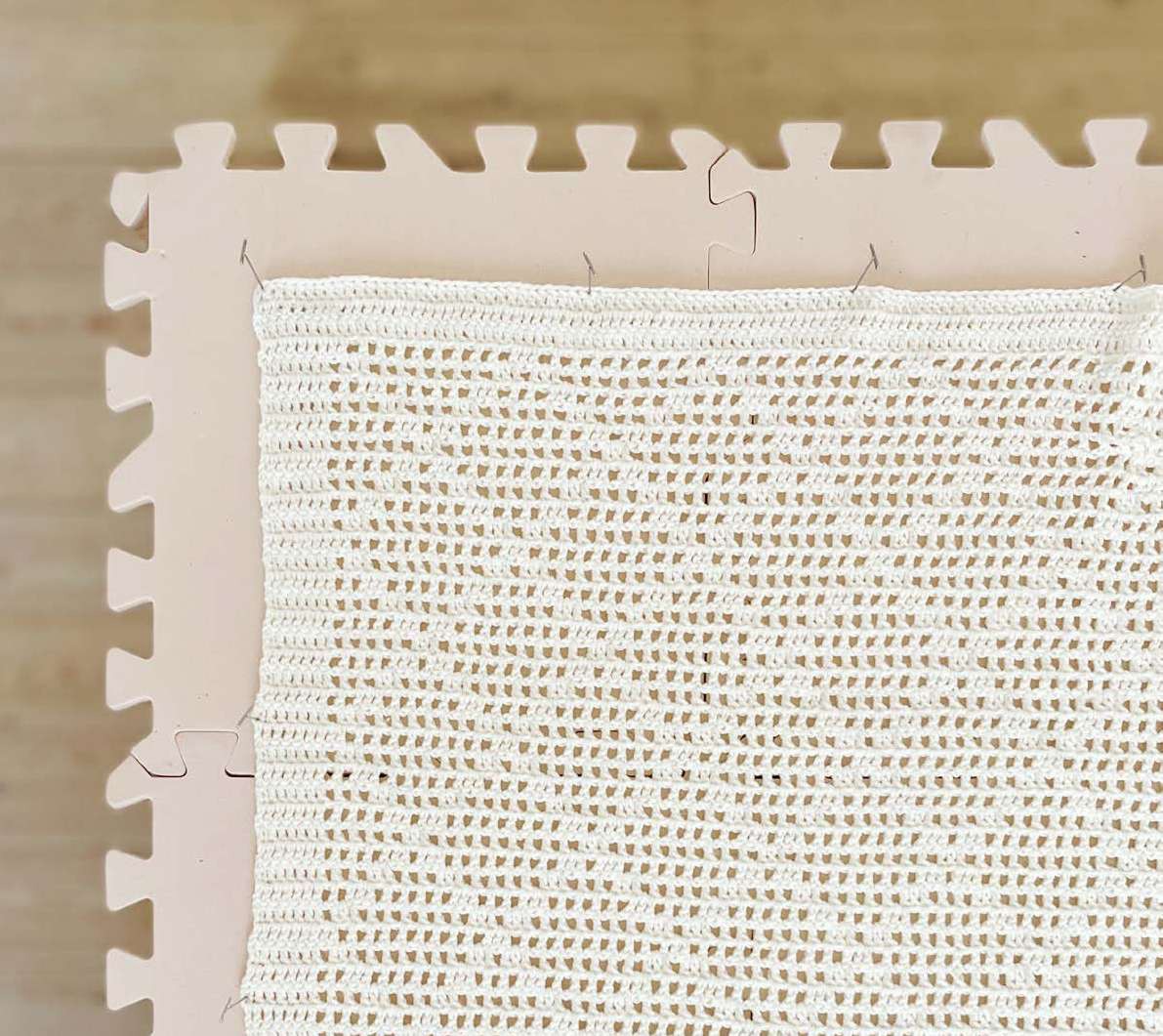
Step 5: Finish and Block
Fasten off and weave in the ends. Wash according to the yarn label, then gently pin out the diamond mesh and straight sides while drying. The listed dimensions and gauge are given before blocking, so record both your relaxed and finished measurements. Remove every pin before handling the blanket.
A swatch containing at least two twenty-position repeats is useful: it shows whether you are keeping fch spaces consistent and whether the stacked turning start matches the dc height. The original filet chart is a helpful visual cross-check, but the row table above is written for the smallest blanket only.
Frequently Asked Questions
Does fch mean a special stitch? It is a shorthand for chain one and skip one stitch.
Do the two stacked sc count as two stitches? No. They form one dc-height turning position.
Is an extra border required? No. The solid bands and side positions are part of the blanket rows.
More Baby Crochet Ideas
Browse our Crochet Baby collection, compare baby bootie patterns, or explore baby cardigan ideas. Save the project to Pinterest before gathering your yarn.
Pattern and Photo Credits
Adapted from the supplied Baby Blanket Throw.pdf. Pattern and photographs: Milla Billa, Baby Summer Blanket. Source photographs show the reference samples; captions identify any detail crops. This written adaptation has been reviewed against the supplied pattern pages but has not been physically crocheted or maker-tested. Yarn substitutions and tension can change the result.
Leave a Reply